How Mortgage Servicers Misapply Extra Principal (and How to Fix It)
Extra mortgage payment trapped in a suspense account? Learn why servicers misapply unapplied funds, how compound interest is lost, and how to file a CFPB Notice of Error.
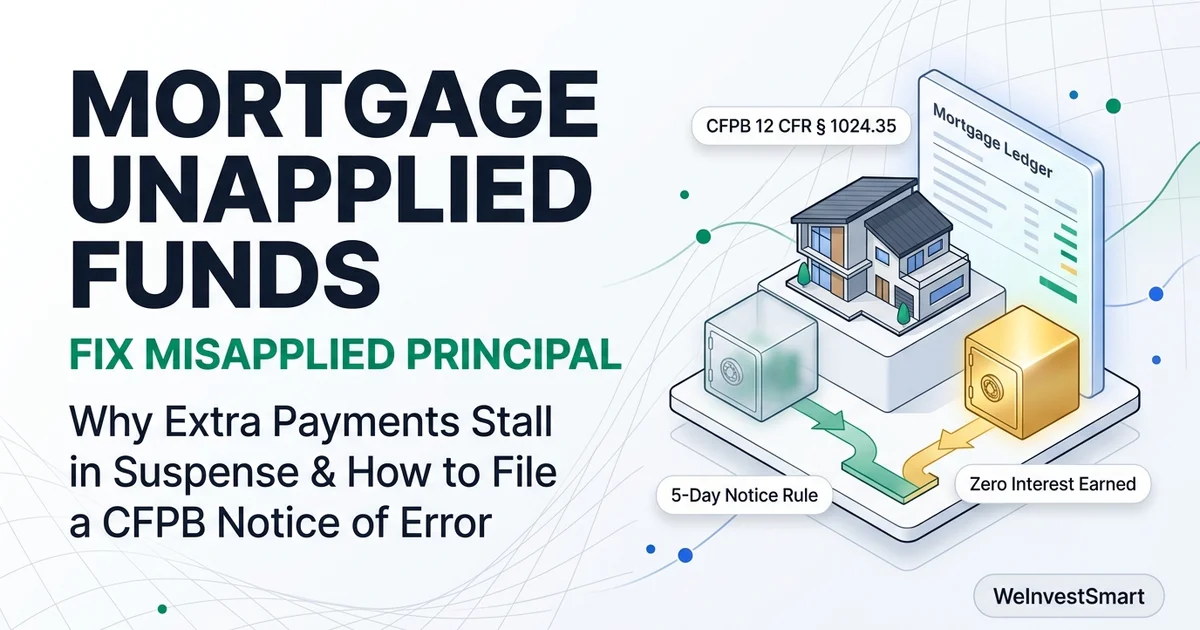
Sending extra money with your monthly mortgage payment is one of the most effective strategies to eliminate housing debt years ahead of schedule. As detailed in our comprehensive mortgage payoff vs investing guide, every dollar applied directly to principal stops compounding interest immediately at your note rate.
Unfortunately, thousands of disciplined homeowners discover that their loan servicers never actually apply those surplus dollars to their debt. Instead of accelerating debt freedom, those extra funds often sit completely dormant in a non-interest-bearing holding bucket known as a suspense account or unapplied funds balance.
When extra money is sidelined into an unapplied account, your loan balance remains untouched, daily interest continues to accumulate, and your payoff timeline stalls. Understanding why mortgage servicing software traps surplus payments and knowing your federal legal rights under Consumer Financial Protection Bureau regulations allows you to reclaim your money and force proper loan crediting.
Key Takeaways
- A mortgage suspense account (or unapplied funds balance) is a holding bucket where loan servicers park funds that do not match an exact full monthly payment installment.
- When extra principal payments sit idle in unapplied funds, interest continues compounding on your higher unpaid principal balance, completely negating your debt payoff acceleration.
- Under CFPB Regulation Z (12 CFR § 1026.41), servicers are legally required to itemize unapplied funds in the ‘Past Payment Breakdown’ box of your monthly billing statement.
- Sending a formal Notice of Error under CFPB Regulation X (12 CFR § 1024.35) forces your servicer to acknowledge receipt within 5 business days and resolve the misapplication within 30 business days.
- To prevent future payment stalls, avoid generic bank bill pay without curtailment memos and always designate extra funds as ‘Principal Only’ within your servicer’s online payment portal.
What Are Unapplied Funds and Why Do Servicers Use Suspense Accounts?
Unapplied funds represent money received by your mortgage servicer that has not been credited toward your contractual principal, interest, property taxes, or hazard insurance. Servicers warehouse these dollars in a suspense account while waiting for specific allocation instructions.
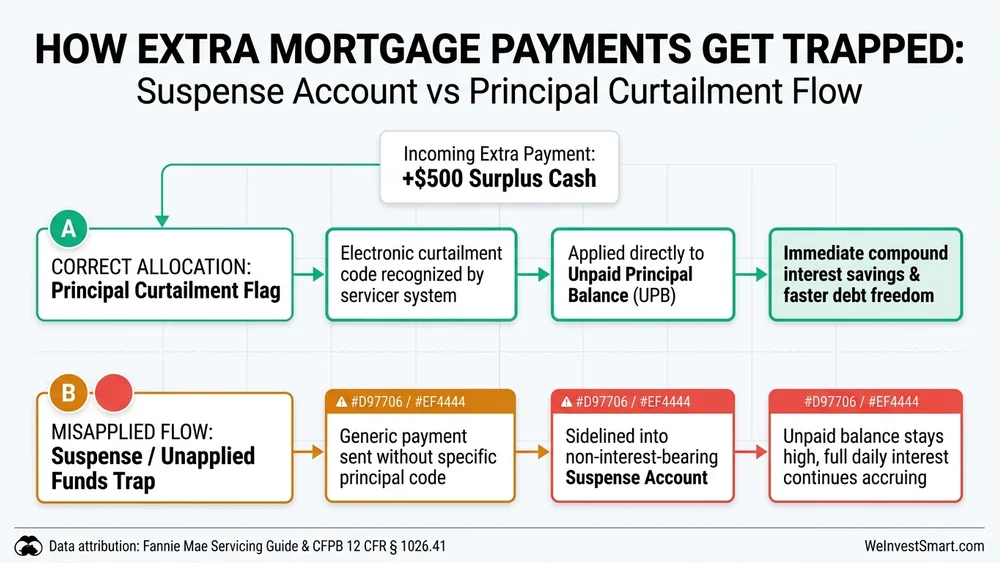
Mortgage servicing platforms such as Black Knight MSP process millions of transactions each night using rigid automation algorithms. When an incoming payment arrives, the software checks whether the transaction matches your exact contractual monthly installment (your principal, interest, taxes, and insurance, commonly called PITI).
If you owe $2,400 per month and send a check or electronic transfer for $2,700, the automated accounting software can easily credit the contractual $2,400. However, the system encounters an exception when handling the surplus $300 unless that additional amount carries a specific technical code.
Because the system cannot automatically infer whether the extra $300 is intended for your escrow deficit, next month’s payment, or loan principal, it routes the money into a suspense holding account.
Under Fannie Mae Servicing Guidelines, servicers are authorized to maintain suspense balances for partial payments until full installments accumulate. However, when borrowers intend to make a principal curtailment on a loan that is completely current, Fannie Mae rules mandate that the extra funds must be credited directly to the unpaid principal balance.
When servicers fail to apply that curtailment, the borrower bears the entire financial burden of the software glitch. For borrowers seeking lower monthly payments after making a lump sum rather than a standard curtailment, a mortgage recast vs. refinance provides an alternative contractual structure.
The Compounding Cost: How Stalled Principal Destroys Your Interest Savings
When an extra payment is routed into unapplied funds, your money does not earn interest, nor does it reduce your mortgage balance. It simply sits idle on the servicer’s balance sheet while your loan continues amortizing as if you never sent an extra penny.
Fixed-rate mortgages calculate monthly interest charges based on your unpaid principal balance at the beginning of each billing cycle. If your balance is $350,000 at a 6.75% interest rate, your monthly interest cost is approximately $1,968.75.
If you send an extra $500 each month intending to pay down that debt, but your servicer parks each $500 into unapplied funds, your principal balance never drops below the standard amortization schedule. Over twelve months, you will have accumulated $6,000 in unapplied funds while paying full interest on the higher balance.
The table below illustrates the financial damage of stranded principal on a $400,000 mortgage at 6.50% when an extra $400 monthly payment is misapplied to suspense over several years:
| Metric / Scenario | Correctly Applied Principal Curtailment | Sidelined in Suspense / Unapplied Funds | Lost Financial Value to Homeowner |
|---|---|---|---|
| Monthly Outflow | $2,928.27 ($2,528 base + $400 extra) | $2,928.27 ($2,528 base + $400 extra) | $0 (Identical cash paid out) |
| Principal Balance (Year 3) | $360,188.42 | $378,542.10 | +$18,353.68 higher balance |
| Total Interest Paid (Year 3) | $75,644.20 | $77,912.88 | $2,268.68 in wasted interest |
| Principal Balance (Year 5) | $328,495.12 | $361,844.75 | +$33,349.63 higher balance |
| Total Interest Paid (Year 5) | $121,452.33 | $127,112.50 | $5,660.17 in wasted interest |
| Loan Payoff Horizon | 20.8 years (9.2 years shaved) | 30.0 years (Zero years shaved) | 9.2 years of delayed debt freedom |
As the numbers demonstrate, letting extra funds sit in suspense for five years squanders more than $5,660 in needless interest charges. The homeowner assumes they are racing toward an early payoff, but their balance sheet remains completely unoptimized.
You can verify your true interest savings and check how much debt should be amortized using our interactive mortgage extra payments calculator.
How to Spot Misapplied Payments on Your Monthly Mortgage Statement
Federal lending rules establish clear disclosure requirements that enable borrowers to spot unapplied funds quickly. You do not need to wait for an annual tax form to verify that your payments are reaching your principal.
Under the Truth in Lending Act and Consumer Financial Protection Bureau mortgage servicing guidelines, servicers must deliver a standardized monthly periodic billing statement (12 CFR § 1026.41).
To detect whether your extra payments have been improperly diverted, inspect these three critical sections on your monthly mortgage statement:
1. The Past Payment Breakdown Box
CFPB rules mandate that every mortgage statement must contain a dedicated box titled “Past Payment Breakdown” or “Explanation of Amount Due.” This table itemizes where your previous month’s payments were allocated across Principal, Interest, Escrow, Fees, and Unapplied (Suspense) Funds.
If the Unapplied column displays any figure greater than $0.00, your servicer is holding your money without applying it toward your loan balance.
2. Transaction Activity / Payment History
Review the itemized ledger on the second page of your statement. Look for descriptors such as “Partial Payment,” “Suspense Credit,” “Miscellaneous Holding,” or “Unapplied Credit.”
If you see an entry that reflects your extra payment amount sitting without a corresponding “Principal Curtailment” line item, your money is stranded.
3. Current Unpaid Principal Balance (UPB)
Compare your current unpaid principal balance against your official loan amortization schedule. You can model your expected balance after extra payments using our free mortgage amortization calculator.
If your actual statement balance is higher than your calculated balance despite regular extra payments, your funds are being misallocated.
The Bank Bill Pay Trap: Why Automated Extra Payments Get Sidelined
One of the most frequent causes of misapplied mortgage payments is automated online bill pay through external consumer bank accounts.
Millions of homeowners set up recurring payments via their Chase, Bank of America, Wells Fargo, or credit union checking accounts. To accelerate their mortgage, they simply edit their recurring bill pay from $2,200 to $2,500, assuming the mortgage servicer will intuitively understand that the additional $300 should reduce principal.
This assumption regularly fails due to electronic banking infrastructure:
- Third-Party Clearinghouse Processing: When your bank initiates an automated bill pay payment, it often aggregates payments through third-party clearinghouses such as Fiserv or CheckFree.
- Loss of Payment Instructions: The clearinghouse transmits an electronic funds transfer (EFT) or mails a physical corporate check containing only your loan number and name. Any memo line reading “Apply extra $300 to principal” is frequently stripped out during automated electronic transmission.
- Servicer Algorithm Misinterpretation: When the servicer’s automated payment ingest module receives an unexpected dollar amount with no technical curtailment flag, it tags the payment as an irregular transaction and shunts the overage into suspense.
Some servicers even misinterpret the extra money as an advance partial payment for the subsequent month. When the next month arrives, the servicer pulls the partial funds from suspense, demands only the remaining difference, and leaves your long-term principal balance completely unaltered.
If you utilize bank bill pay to manage a bi-weekly payoff schedule, review our biweekly mortgage calculator to verify that your payments align with servicer processing calendars.
How to File a Legal Notice of Error Under CFPB Regulation X
If your mortgage servicer has placed your extra payments into unapplied funds, calling customer service is often frustrating. Frontline phone representatives frequently promise to submit an internal ticket, only for the funds to remain in suspense month after month.
To force a swift, legally binding resolution, you should bypass informal phone calls and exercise your statutory rights under federal law by submitting a formal Notice of Error (NOE).
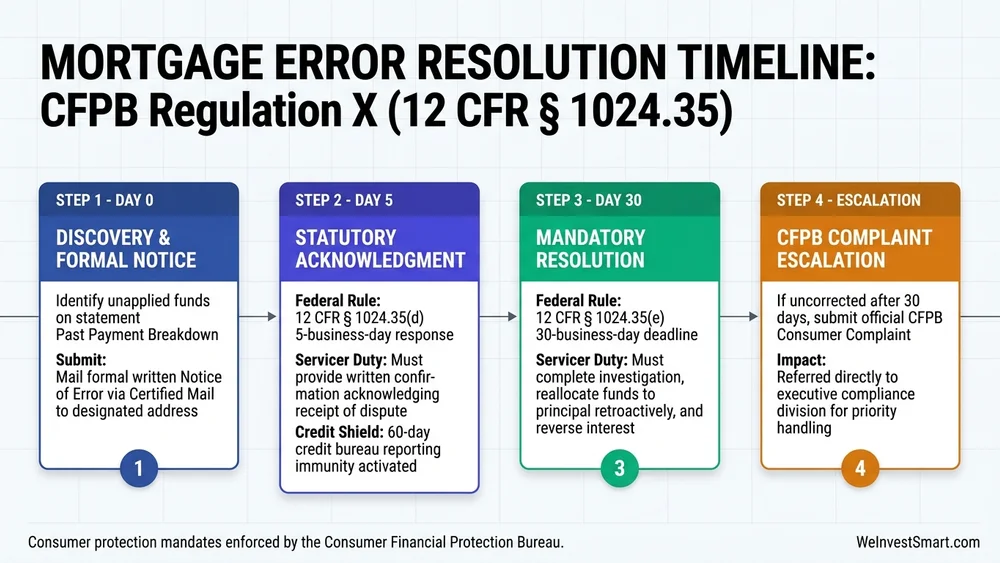
Under the Real Estate Settlement Procedures Act (RESPA), codified in CFPB Regulation X at 12 CFR § 1024.35, mortgage servicers are legally required to maintain formal error resolution procedures. Misapplying payments and improperly holding funds in suspense are explicitly categorized as covered servicing errors under 12 CFR § 1024.35(b).
The Five Mandatory Elements of a Valid Notice of Error
To trigger statutory protections and mandatory lender deadlines, your written notice must include:
- Borrower Identity: Full legal names of all borrowers listed on the mortgage note.
- Account Identification: Your complete mortgage loan account number and property address.
- Specific Error Description: A factual explanation detailing the date, dollar amount, and nature of the misapplied payment (e.g., “$500 sent on March 4th was placed in suspense rather than credited as a principal curtailment”).
- Requested Remedy: An explicit demand that the servicer reallocate the funds from suspense to the unpaid principal balance, effective retroactively to the date the payment was received.
- Delivery to the Designated Address: Servicers are legally permitted to establish a specific postal address exclusively for Notices of Error and Requests for Information. You must send your notice to this designated address, which is listed on the back of your monthly statement or on their official website. Sending it to the standard payment processing address invalidates your statutory protection.
Statutory Deadlines Servicers Must Obey
Once your Notice of Error is delivered to the designated address, the clock begins ticking under federal law:
- 5 Business Days: The servicer must provide written acknowledgment confirming receipt of your Notice of Error.
- 30 Business Days: The servicer must complete a thorough investigation and provide a written response. They must either correct the error, credit all misallocated funds retroactively to the date received, and reverse any improperly charged interest, or explain why no error occurred.
- 60-Day Credit Bureau Immunity: For 60 days following receipt of your Notice of Error, the servicer is prohibited by federal law from furnishing adverse credit reporting to Equifax, Experian, or TransUnion regarding any payment under dispute.
If the servicer fails to respond within 30 business days or refuses to correct a verified misallocation, you can immediately file an official complaint with the CFPB Consumer Complaint Database. Federal complaints are forwarded directly to executive compliance teams and typically yield rapid resolution within 15 days.
Sample Notice of Error Letter Template for Misapplied Mortgage Principal
You can customize the formal template below to assert your rights under 12 CFR § 1024.35. Send this correspondence via Certified Mail with Return Receipt Requested to maintain incontrovertible proof of delivery.
NOTICE OF ERROR PURSUANT TO 12 CFR § 1024.35
Date: [Current Date]
To: [Servicer Name]
Attention: Designated Error Resolution Office
Address: [Designated Notice of Error Address Found on Statement]Borrower Name(s): [Your Full Name(s)]
Loan Account Number: [Your Mortgage Loan Number]
Property Address: [Your Subject Property Address]Subject: Formal Notice of Error: Misapplication of Principal Curtailment Funds to Suspense / Unapplied Account
Dear Loan Servicing Department:
I am writing to submit a formal Notice of Error pursuant to Section 6 of the Real Estate Settlement Procedures Act (RESPA) and Consumer Financial Protection Bureau (CFPB) Regulation X, 12 CFR § 1024.35.
On [Date of Payment], I submitted a payment of $[Total Amount Sent], which exceeded my regular contractual monthly payment of $[Contractual Monthly Amount] by $[Extra Principal Amount]. My explicit intention for this surplus amount was to execute a principal curtailment to reduce my unpaid principal balance.
Upon reviewing my monthly billing statement dated [Statement Date], I discovered that this surplus amount of $[Extra Principal Amount] was not applied to reduce my principal balance. Instead, your servicing system placed these funds into an ‘Unapplied’ or ‘Suspense’ account.
Because my mortgage account is fully current and in good standing, failing to credit this payment directly to principal constitutes a covered servicing error under 12 CFR § 1024.35(b)(1) and (b)(2), and violates Fannie Mae Servicing Guidelines regarding the prompt crediting of principal curtailments. This misapplication has improperly inflated my interest-bearing principal balance and caused unnecessary interest charges to accrue.
Requested Corrective Action:
- Immediately reallocate the $[Extra Principal Amount] from the suspense account to my unpaid principal balance.
- Ensure this principal curtailment is backdated to [Date Payment Was Received], reflecting the true date of receipt.
- Recalculate my amortization schedule to reverse any excess interest charges that accrued as a result of this delay.
- Provide written confirmation of these corrections and an updated payment transaction history within thirty (30) business days, as mandated by 12 CFR § 1024.35(e).
Please be advised that pursuant to 12 CFR § 1024.35(d), you are required to acknowledge receipt of this Notice of Error in writing within five (5) business days.
Sincerely,
[Your Signature]
[Your Printed Name]
[Your Phone Number]
[Your Email Address]
How to Configure Online Portals and Bill Pay to Prevent Future Errors
Once you have resolved your trapped funds, taking proactive steps with your ongoing payment setup ensures your extra payments are never diverted again.
Method 1: Use the Servicer’s Native Payment Portal
The most foolproof method for making extra principal payments is through your mortgage servicer’s direct website or mobile app (such as Chase, Wells Fargo, Mr. Cooper, or Rocket Mortgage).
When scheduling a payment through the servicer’s native interface, the system typically provides itemized input fields:
- Regular Monthly Payment: $[Contractual Amount]
- Additional Principal: $[Your Extra Dollar Amount]
- Additional Escrow: $0.00
- Late Fees / Other: $0.00
Entering your extra contribution directly into the “Additional Principal” box bypasses manual intake and forces the software algorithm to generate a curtailment transaction code on your ledger automatically.
Method 2: Configure Split Bank Bill Pay Payments
If you prefer managing all household finances from your personal bank’s centralized bill pay platform, do not combine your regular payment and extra principal into a single transaction.
Instead, create two separate electronic payees in your online banking system:
- Payee 1 (Contractual Payment): Name it “Mortgage Monthly” and set the recurring amount to your exact contractually required payment.
- Payee 2 (Principal Curtailment): Name it “Mortgage Principal Only.” In the account number field, input your loan number followed immediately by the text “PRINCIPAL ONLY” or “PRIN REDUCTION.”
Sending two distinct transfers prevents the servicer’s automated processing system from treating the surplus as an overpayment error.
Method 3: Conduct a Quarterly Statement Audit
Set a recurring calendar reminder every three months to inspect your mortgage billing statement. Confirm that your unapplied funds balance remains at exactly $0.00, and ensure your unpaid principal balance is falling at the accelerated pace you planned.
Disciplined capital allocation requires vigilant account verification. By ensuring every extra dollar is applied immediately to principal, you protect your compounding math and guarantee that your path toward debt freedom remains on schedule. If you are debating whether extra principal curtailment beats holding cash, compare the after-tax numbers in our guide on paying off a mortgage vs. high-yield savings or Treasuries.
Frequently Asked Questions About Mortgage Unapplied Funds
What does unapplied funds mean on a mortgage statement?
Unapplied funds represent money received by your mortgage servicer that has not been credited toward principal, interest, taxes, or insurance. The servicer holds these funds in a non-interest-bearing suspense account until either enough money accumulates to cover a full monthly payment or the borrower provides explicit allocation instructions.
Why did my mortgage company put my extra payment in a suspense account?
Automated servicing software defaults to placing extra funds into suspense if the payment does not match the exact contractually scheduled monthly amount. Without an explicit electronic or written designation specifying ‘Principal Curtailment,’ the software cannot determine whether the money is intended for future escrow, principal, or late fees.
Does money sitting in unapplied funds reduce my mortgage interest charges?
No. Interest on fixed-rate mortgages is calculated directly from your outstanding unpaid principal balance. As long as surplus dollars remain stranded in an unapplied suspense account, your principal balance remains artificially elevated, allowing daily interest to continue accruing against you.
What is a Notice of Error under CFPB Regulation X?
A Notice of Error is a formal legal dispute submitted under 12 CFR § 1024.35 asserting that a loan servicer committed a covered servicing error, such as misapplying payments or improperly placing funds in suspense. Upon receipt at their designated address, the servicer must acknowledge the notice within five business days and investigate within thirty business days.
This article is for educational purposes only and should not be considered personalized financial advice. Consider consulting with a financial advisor for guidance specific to your situation.
For educational purposes. Consider your own circumstances before making financial decisions. Read our editorial policy.
From reading to planning
Explore the numbers for yourself.
Use our free calculators to compare scenarios and understand your options.