The Mortgage Points Break-Even Formula: When Buying Down Rates Wins
Should you buy mortgage discount points? Calculate your exact break-even timeline, compare 0 vs 1 vs 2 points on a $400k loan, and learn IRS deduction rules.
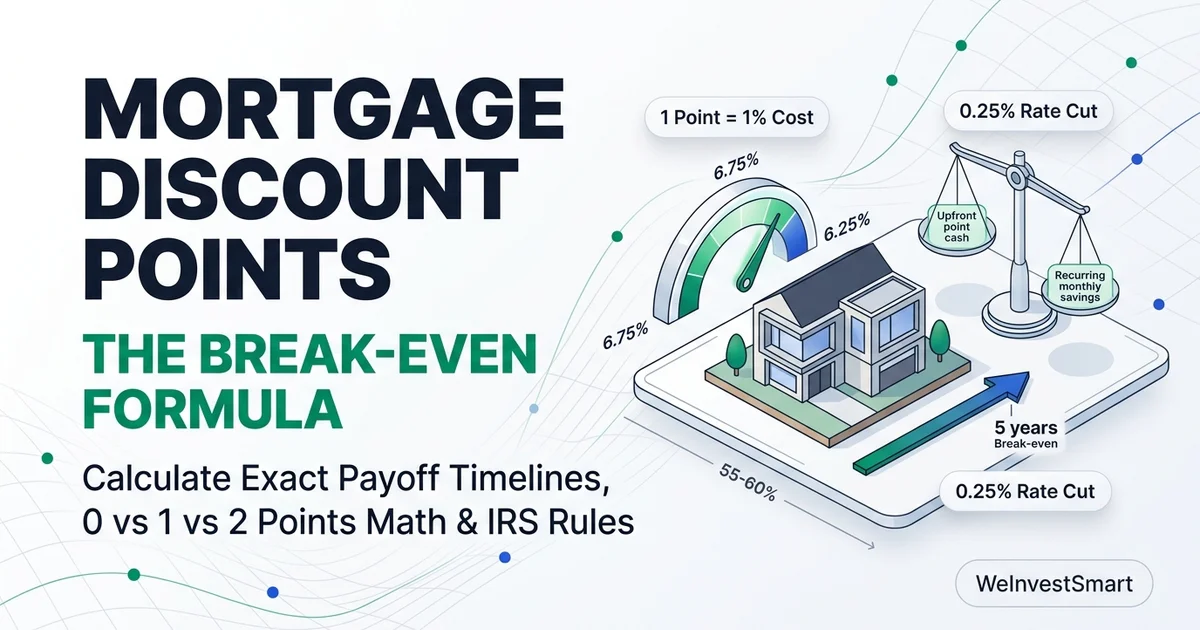
When shopping for a home loan, mortgage lenders frequently present rate quotes accompanied by optional upfront charges known as discount points. Lenders frame buying points as an effortless way to lock in a permanently lower interest rate and trim your monthly mortgage payment.
However, as emphasized in our foundational mortgage payoff vs investing guide, every dollar committed to upfront loan fees represents liquidity that cannot be deployed elsewhere. Paying thousands of dollars in extra cash at closing is only sensible if you hold the loan long enough for accumulated monthly savings to exceed that initial cost.
Evaluating whether to buy down your interest rate requires mastering the mathematical break-even formula, understanding IRS tax deductibility limits, and analyzing the opportunity cost of cold cash.
Key Takeaways
- One mortgage discount point costs exactly one percent of your loan amount and typically reduces your fixed interest rate by 0.25% (25 basis points).
- The break-even timeline formula is calculated by dividing total upfront point costs by your monthly payment savings, typically averaging 60 to 61 months (approximately 5 years).
- If you sell your home, refinance into a lower rate, or pay off your loan before reaching your break-even month, buying points results in a guaranteed net financial loss.
- Under IRS Publication 936, discount points on a primary home purchase are generally deductible in the year paid, but provide zero tax benefit for the 88%+ of filers claiming the standard deduction.
- Opportunity cost math demonstrates that investing the upfront cash in Treasury bills or broad index funds frequently outperforms buying points if your holding horizon is under seven years.
What Are Mortgage Discount Points and How Do They Work?
Mortgage discount points, often called buydown points or prepaid interest, are optional fees paid directly to your mortgage lender at closing in exchange for a permanently reduced interest rate across the lifespan of your loan.
In standard United States residential mortgage lending, points are priced strictly as a percentage of your total borrowed amount:
1 Mortgage Discount Point = Exactly 1.0% of Total Loan Principal
On a $300,000 mortgage, one point costs $3,000 at closing. On a $500,000 mortgage, one point costs $5,000.
Borrowers can also purchase fractional points, such as 0.50 points ($2,000 on a $400,000 loan) or 1.25 points ($5,000 on a $400,000 loan).
In exchange for this upfront payment, lenders lower your note interest rate. While lender pricing fluctuates based on secondary mortgage-backed securities markets, the standard industry convention is that paying one full point reduces a 30-year fixed mortgage rate by approximately 0.25% (25 basis points).
Under disclosure regulations enforced by the Consumer Financial Protection Bureau, all points must be transparently disclosed on Page 2, Section A (“Origination Charges”) of your official Loan Estimate and Closing Disclosure forms.
It is critical not to confuse discount points with loan origination fees. Origination fees are mandatory lender overhead charges that compensate the bank for processing, underwriting, and creating the loan. They do not lower your interest rate by a single basis point.
The Mathematical Break-Even Formula: How to Calculate Your Payoff Date
Before agreeing to purchase discount points, you must determine how long it will take for your lower monthly payments to pay back the upfront cash fee. This milestone is known as your break-even horizon.
The mathematical calculation is straightforward:
The Mortgage Points Break-Even Formula
Break-Even Horizon (Months) = Total Upfront Dollar Cost of Points / Monthly Payment Savings
To illustrate, consider a borrower taking out a $350,000 30-year fixed mortgage:
- Baseline Offer (0 Points): 6.75% Interest Rate | Monthly P&I: $2,270.09
- Buydown Offer (1 Point): 6.50% Interest Rate | Monthly P&I: $2,212.24
- Upfront Cost of 1 Point: $3,500 cash paid at closing ($350,000 multiplied by 0.01)
- Monthly Savings: $57.85 per month ($2,270.09 minus $2,212.24)
Plugging these figures into the formula gives:
$3,500 / $57.85 = 60.50 Months (5.04 Years)
In this scenario, it takes exactly 61 monthly payments just to recoup the $3,500 fee. You do not generate a single penny of net financial benefit until month 62.
You can calculate your personalized break-even timeline across different rate quotes using our interactive mortgage points calculator.
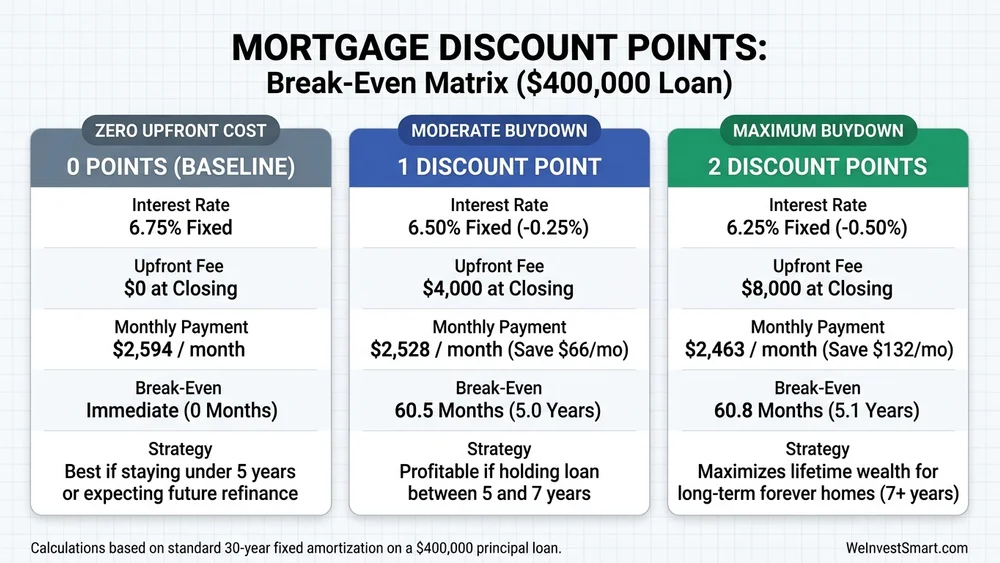
Worked Case Study: $400,000 Mortgage with 0, 1, and 2 Discount Points
To examine the compounding implications of buying points over time, let us analyze a real-world scenario featuring Marcus, a homebuyer securing a $400,000 30-year fixed mortgage.
Marcus’s lender provides three financing options:
- Option A (Zero Points): 6.75% fixed rate with $0 in points.
- Option B (One Point): 6.50% fixed rate for $4,000 in upfront points (0.25% rate reduction).
- Option C (Two Points): 6.25% fixed rate for $8,000 in upfront points (0.50% rate reduction).
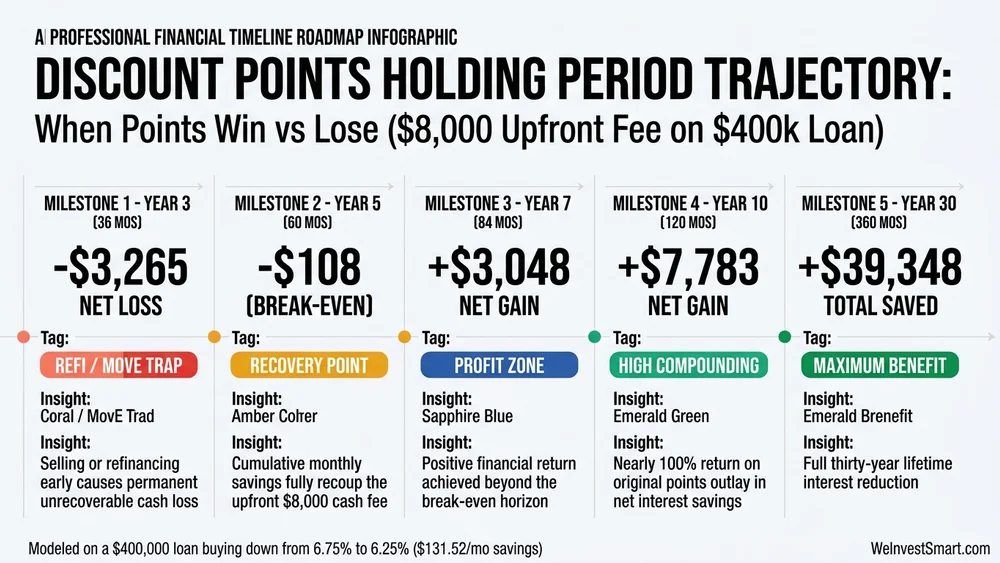
The table below details the monthly payment differences, cumulative savings, and net profit or loss across various holding periods:
| Holding Horizon / Metric | Option A: Baseline (0 Points at 6.75%) | Option B: 1 Point (Costs $4,000 at 6.50%) | Option C: 2 Points (Costs $8,000 at 6.25%) |
|---|---|---|---|
| Upfront Cost at Closing | $0 | $4,000 | $8,000 |
| Monthly Payment (P&I) | $2,594.39 | $2,528.27 | $2,462.87 |
| Monthly Cash Savings | $0 per month | +$66.12 per month | +$131.52 per month |
| Break-Even Horizon | N/A | 60.5 months (5.04 yrs) | 60.8 months (5.07 yrs) |
| Net Outcome at Year 3 (36 mos) | $0 | -$1,619.67 (Net Loss) | -$3,265.15 (Net Loss) |
| Net Outcome at Year 5 (60 mos) | $0 | -$32.78 (At Break-Even) | -$108.58 (At Break-Even) |
| Net Outcome at Year 7 (84 mos) | $0 | +$1,554.10 (Net Gain) | +$3,047.98 (Net Gain) |
| Net Outcome at Year 10 (120 mos) | $0 | +$3,934.44 (Net Gain) | +$7,782.83 (Net Gain) |
| Full 30-Year Net Savings | $0 | +$19,803.31 (Total Lifetime) | +$39,348.49 (Total Lifetime) |
Analyzing the Mathematical Results
The numbers establish two undeniable realities about discount points:
- Substantial Long-Term Wealth Generation: If Marcus keeps this mortgage for the full thirty-year term, paying $8,000 upfront for two points saves him $39,348.49 in net interest expenses after subtracting his initial cost.
- Acute Early-Termination Losses: If Marcus moves, sells the house, or refinances at Year 3, he walks away with an unrecoverable loss of $1,619.67 on one point and $3,265.15 on two points.
If you later accumulate surplus cash and want to lower monthly payments without paying thousands in upfront fees, you can explore a mortgage recast vs. refinance.
The 5-Year Break-Even Trap: Why Most Buyers Lose Money on Points
While lenders frequently pitch 30-year savings projections, real-world consumer behavior reveals why the majority of homebuyers who purchase discount points end up losing money.
According to research from the National Association of Realtors and Census migration data, the median American homeowner moves or sells their residence every seven to ten years. More importantly, homeowners refinance their mortgages far more frequently, averaging once every three to five years when macroeconomic interest rates decline.
Consider what occurs if interest rates drop by 1.5% three years into your loan:
If you paid $8,000 for discount points at closing, your break-even point is at month 61. At month 36, market rates fall and you execute a refinance into a 5.0% loan.
Because you terminated the original loan twenty-five months before reaching your break-even milestone, the remaining $3,265.15 of your upfront fee vanishes permanently. The lender keeps your upfront cash, and your anticipated long-term savings evaporate.
Unless you are completely confident you will occupy the property and keep the exact same mortgage note past year six, purchasing discount points is an unnecessary speculative gamble.
You can simulate how extra payments interact with your underlying amortization schedule using our free mortgage extra payments calculator.
The Opportunity Cost: Buying Down Rates vs. Investing Upfront Cash
A critical flaw in standard break-even calculations is that they ignore the time value of money and investment opportunity cost.
When you pay $8,000 for discount points at closing, that money is handed to a mortgage bank immediately. You forfeit the ability to invest that $8,000 in alternative financial assets that could generate passive compound returns.
To understand true economic cost, compare what happens to Marcus’s $8,000 over five years under two distinct choices:
Strategy A: Buying 2 Discount Points
Marcus pays $8,000 to lower his rate from 6.75% to 6.25%. Over sixty months, he saves $131.52 per month, accumulating $7,891.20 in nominal payment reductions. At month 60, he has essentially recovered his original $8,000, leaving him roughly at zero net profit.
Strategy B: Investing the $8,000 at 5.0% Yield
Marcus chooses the zero-point option at 6.75%. He takes the $8,000 in cash and deposits it into a conservative high-yield savings account, certificates of deposit (CDs), or short-term US Treasury bills yielding an annualized 5.0%.
Over five years, compounding $8,000 at 5.0% produces:
$8,000 * (1 + 0.05)^5 = $10,210.25
Marcus generates $2,210.25 in risk-free interest earnings. Even after paying his higher monthly mortgage payment ($131.52 per month, totaling $7,891.20 over five years), Marcus remains financially ahead because his capital remained liquid and earned compound returns.
Furthermore, if an unexpected job loss or medical emergency occurred in year two, Marcus had immediate access to $8,000 in liquid reserves. In contrast, under Strategy A, his capital was trapped permanently inside lender fees.
You can verify total interest amortization timelines on your own balance using our interactive mortgage payoff calculator.
IRS Tax Rules: When Are Mortgage Points Actually Deductible?
Under federal tax regulations, mortgage discount points represent prepaid interest, which is potentially deductible on federal income tax returns.
However, whether you actually capture a tax write-off depends on IRS publication guidelines and your filing choices:
1. Primary Residence Purchase Rules (IRS Publication 936)
Under IRS Publication 936 and IRS Topic 504, discount points paid on a loan to purchase or build your main home can generally be deducted in full during the tax year they are paid, provided you meet nine statutory IRS tests:
- The loan is secured by your primary home.
- Paying points is an established business practice in your geographic area.
- The points paid were not excessive compared to standard regional rates.
- The cash you brought to the closing table (including your down payment) exceeds the total points charged.
- The points are clearly itemized on your settlement statement as points.
2. Refinance Loan Rules: Amortization Over Time
If you pay discount points to refinance an existing mortgage, you cannot deduct the entire expense in the year paid.
The IRS mandates that refinance points must be deducted ratably over the life of the loan. On a 30-year refinance where you paid $3,600 in points, you can only deduct $120 per year ($10 per month) on Schedule A.
The sole exception occurs if you refinance again or pay off the loan early. At that point, any remaining unamortized points balance can be deducted in full in the payoff year.
3. The Standard Deduction Reality
While points are legally deductible, the practical tax benefit has been largely eliminated for ordinary homeowners.
Following the expansion of the standard deduction under federal tax reform, IRS Statistics of Income data confirms that over 88% of individual tax filers now claim the standard deduction rather than itemizing on Schedule A.
If your total itemized deductions (including state taxes, charitable gifts, and mortgage interest) do not exceed the standard deduction threshold, your mortgage points provide exactly $0.00 in tax savings. Never purchase points assuming Uncle Sam will subsidize the cost.
Permanent Discount Points vs. Temporary 2-1 Buydowns
In changing rate environments, homebuilders and sellers frequently market temporary rate buydowns as an alternative to permanent discount points. Understanding how these structures differ is essential for smart financing:
| Feature / Metric | Permanent Discount Points | Temporary 2-1 Buydown |
|---|---|---|
| Duration of Rate Cut | All 360 months (Full 30-year term) | First 24 months only (Resets to full rate) |
| Year 1 Interest Rate | Note rate minus 0.25% or 0.50% | Note rate minus 2.00% (e.g., 4.75% instead of 6.75%) |
| Year 2 Interest Rate | Note rate minus 0.25% or 0.50% | Note rate minus 1.00% (e.g., 5.75% instead of 6.75%) |
| Year 3–30 Interest Rate | Stays at lower discounted rate | Resets permanently to standard note rate (6.75%) |
| Funding Source | Typically paid by buyer at closing | Almost always paid by seller or builder as an incentive |
| Best Used For | Long-term forever homes (>7 years) | Bridging early years when expecting career income growth |
A 2-1 buydown does not alter the underlying promissory note rate. Instead, the seller deposits cash into an escrow subsidy account that supplements your payment for the first two years.
If you are buying a home and negotiate seller credits under CFPB closing rules, requesting a temporary buydown or asking the seller to pay for permanent discount points allows you to lower payments without spending a single dollar of your own liquid cash.
A 5-Point Checklist: When Should You Actually Buy Down Your Rate?
To determine whether purchasing mortgage discount points makes sense for your personal financial situation, walk through this 5-point decision checklist:
Will you remain in this home for at least 7 to 10 years?
If your holding horizon comfortably exceeds the 5-year break-even threshold, buying points has sufficient runway to generate net profits.Are prevailing interest rates historically low?
Buying points is most attractive when rates are already at cyclical lows and the likelihood of refinancing within 5 years is minimal. If rates are high, refinancing in the near future is probable, making points a financial trap.Do you possess abundant liquid cash reserves after closing?
Never spend emergency savings or liquid buffers on discount points. You should maintain at least three to six months of liquid reserves in a high-yield account after paying closing fees.Is the seller or builder paying for the points?
If you negotiated closing cost concessions that cannot be applied elsewhere, using seller credits to buy down your rate is an excellent move because you risk none of your own capital.Does the lower monthly payment provide necessary debt-to-income (DTI) qualification?
In tight lending scenarios, buying 0.5 to 1.0 point can reduce your monthly payment just enough to satisfy underwriting debt-to-income limits and qualify for the loan.
If you answer “No” to the first three questions, decline the discount points, choose the zero-point baseline rate, and keep your cash working in liquid, interest-bearing assets. To see how to balance cash yields against mortgage debt, read our analysis on paying off a mortgage vs. high-yield savings or Treasuries.
Frequently Asked Questions About Mortgage Points and Break-Even Math
How do you calculate the break-even point on mortgage points?
To calculate your break-even point, divide the total upfront dollar cost of the discount points by the monthly payment savings generated by the lower interest rate. The resulting figure represents the exact number of consecutive monthly payments required to recover your initial cash outlay.
Are mortgage discount points worth buying in today’s market?
Mortgage points are only worth buying if you are certain you will remain in the home and keep the same loan beyond the break-even timeline, which typically spans five to seven years. If interest rates fall and you refinance early, or if you sell the property, you forfeit the unrecouped upfront cost.
Are mortgage discount points tax-deductible under IRS rules?
Discount points paid on a primary home purchase are generally deductible as prepaid interest on Schedule A in the year paid if you itemize deductions under IRS Publication 936. However, because over 88% of American households claim the standard deduction, most borrowers receive zero tax write-offs for points.
What is the difference between discount points and origination points?
Discount points are optional upfront fees paid directly to buy down your ongoing note interest rate permanently. Origination points are mandatory administrative lender charges assessed to cover loan processing, underwriting, and closing services, providing zero interest rate reductions.
This article is for educational purposes only and should not be considered personalized financial advice. Consider consulting with a financial advisor for guidance specific to your situation.
For educational purposes. Consider your own circumstances before making financial decisions. Read our editorial policy.
From reading to planning
Explore the numbers for yourself.
Use our free calculators to compare scenarios and understand your options.