Mortgage Payoff vs. Investing: The Complete Decision Framework
Should you pay off your mortgage early or invest? Compare guaranteed debt savings against post-tax stock returns with concrete formulas and scenario math.
Homeowners often debate whether extra monthly cash flow should be routed toward the mortgage or channeled into broad market index funds. Financial commentators frequently oversimplify this choice into two extreme camps: debt elimination advocates who treat all debt as an emergency, and leverage proponents who treat any debt under 8% as free capital.
The optimal financial decision is neither ideological nor emotional. It is a mathematical trade-off between a guaranteed, risk-free rate of return and an uncertain expected return subject to taxation and liquidity constraints.
Key Takeaways
- Paying down mortgage principal generates a guaranteed, after-tax return equal to your note interest rate with zero market volatility.
- More than 88% of American filers take the standard deduction under IRS rules, rendering the mortgage interest deduction irrelevant for most homeowners.
- Home equity is completely illiquid capital; extra principal payments cannot be spent during an income crisis without selling the home or refinancing.
- Mortgages below 4% mathematically favor equity investing over extra debt payments. Loans above 6.5% create a powerful hurdle rate that favors principal prepayment.
- Always capture your full employer 401(k) match, eliminate high-interest consumer debt, and secure six months of liquid cash before sending extra principal to your mortgage servicer.
The Core Equation: Guaranteed Return vs. Expected Market Return
The mathematical dilemma between mortgage prepayment and investing centers on risk-adjusted capital efficiency. Every dollar routed to a mortgage principal curtailment saves interest at the exact note rate of the mortgage for the remaining term of the loan.
When you send an extra $1,000 to your loan servicer on a 6.50% 30-year fixed mortgage, you earn an instant, risk-free return of 6.50%. You do not have to monitor the stock market, withstand a 30% bear market drawdown, or pay management fees to capture that yield.
Mathematical Equivalence Formula
Equivalent Pre-Tax Investment Return = Mortgage Interest Rate / (1 - Marginal Tax Rate)
In contrast, equity investments like the S&P 500 have historically produced an annualized nominal return of approximately 10% over multi-decade periods, or roughly 7% after adjusting for long-term inflation. However, market returns are volatile and unevenly distributed. A homeowner paying off debt captures certainty, while an investor accepts volatility in exchange for an equity risk premium.
To compare these options fairly on a taxable basis, you must adjust market returns for federal and state income taxes. If you hold index funds in a regular taxable brokerage account, you will face annual tax drag on qualified dividends (taxed at 15% or 20% federally) and eventual capital gains taxes upon sale.
If your mortgage carries a 6.50% interest rate and you reside in the 24% federal tax bracket, earning 6.50% guaranteed is economically equivalent to finding a taxable bond or certificate of deposit yielding 8.55% before taxes:
8.55% pre-tax yield * (1 - 0.24 tax) = 6.50% net after-tax return
Finding a guaranteed 8.55% risk-free return in public debt markets is rare outside of severe inflationary shocks. This equation illustrates why the macro-interest rate environment matters fundamentally to this decision.
To model how extra monthly payments compress your payoff timeline, test your specific loan numbers with our interactive mortgage payoff calculator.
The Tax Deduction Myth: Why IRS Publication 936 Rules Shift the Math
Many homeowners hesitate to prepay their mortgages because friends or family tell them they will lose their mortgage interest tax deduction. In the modern American tax landscape, this belief is largely obsolete.
Following the Tax Cuts and Jobs Act, the federal standard deduction nearly doubled. For married couples filing jointly, the standard deduction stands above $29,000, while single filers receive over $14,600. According to the Internal Revenue Service Statistics of Income Report, over 88% of individual taxpayers now claim the standard deduction rather than itemizing on Schedule A.
If you claim the standard deduction, you receive exactly zero tax benefit from your mortgage interest. Your mortgage interest is paid entirely with post-tax dollars, and paying off the loan early forfeits no tax advantages whatsoever.
Effective Rate Principle
Net Effective Mortgage Rate (Standard Deduction) = Stated Promissory Note Rate
Even for high-balance borrowers who do itemize deductions under IRS Publication 936 rules, the tax deduction is merely a partial rebate on money paid to a bank. Under IRS regulations, deductible acquisition debt is capped at $750,000 for single or married joint filers ($375,000 for married filing separately).
Consider a homeowner who itemizes in the 32% marginal tax bracket with an active mortgage:
- The borrower pays $10,000 in mortgage interest to the lending institution across the calendar year.
- The deduction reduces their taxable income by $10,000, reducing their federal tax liability by $3,200.
- The net cash outflow for the borrower is still $6,800 ($10,000 paid minus $3,200 saved).
Spending $1.00 in interest charges to the bank simply to save $0.32 in taxes to the government leaves you thirty-two cents richer on paper, but sixty-eight cents poorer in real cash. Retaining a mortgage solely for the tax write-off is mathematically counterproductive.
The same tax reality applies to upfront rate buydowns: as analyzed in our guide to mortgage discount points break-even math, borrowers claiming the standard deduction receive zero tax deductions for points paid at closing.
The Liquidity Trap: Why Home Equity Is Harder to Access in a Crisis
Financial returns cannot be evaluated in a vacuum without analyzing liquidity. The biggest danger of aggressive mortgage prepayment is what financial planners refer to as the housing liquidity trap.
Home equity is illiquid. You cannot easily spend your kitchen counters or sell two bricks from your exterior wall to pay for emergency medical bills, automotive repairs, or groceries. Once money is sent to a mortgage servicer as an extra principal curtailment, that cash is locked inside the structure of your home.
Available Liquid Cash does not equal Net Real Estate Equity.
To extract equity from a partially paid-down home, you have only three viable options:
- Apply for a Home Equity Line of Credit (HELOC).
- Execute a cash-out refinance loan.
- Sell the property on the open market.
All three extraction mechanisms depend on stable employment, strong credit scores, and favorable market conditions. If you experience a sudden job loss or an economic downturn, banks will routinely freeze existing credit lines or reject new mortgage applications. In the middle of an income crisis, having $250,000 in locked home equity and $5,000 in checking creates severe financial distress.
Conversely, money deployed into a diversified investment portfolio inside a taxable brokerage account remains highly liquid. Brokerage shares can be liquidated and settled in your checking account within one to two business days.
Before allocating excess cash flow toward mortgage acceleration, ensure you have established a separate, fully liquid cash reserve. You can follow our step-by-step roadmap in how to build an emergency fund to verify your baseline liquid cushion before locking capital into real estate equity.
Mortgage Rate Tiers: How Your Interest Rate Dictates the Strategy
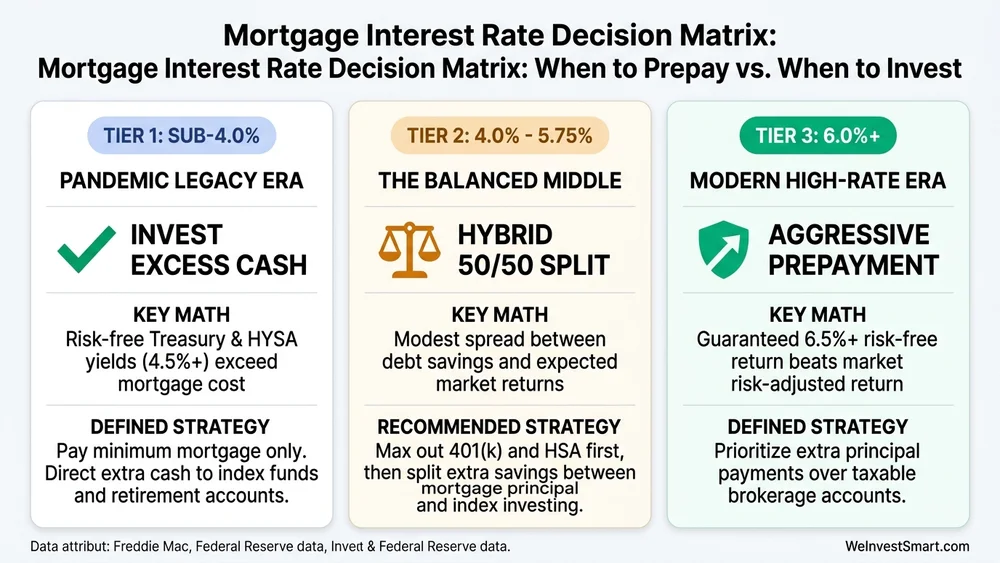
The macro-economic interest rate on your underlying promissory note is the primary factor that dictates whether debt elimination or asset accumulation wins. Modern mortgage holders in the United States generally fall into three distinct interest rate tiers.
| Mortgage Interest Tier | Historical Benchmark | Core Recommendation | Primary Financial Rationale |
|---|---|---|---|
| Tier 1: Sub-4.0% | Low-rate fixed loans | Minimum payments only | Risk-free cash yields exceed mortgage interest cost |
| Tier 2: 4.0% to 5.75% | Balanced middle range | Balanced hybrid approach | Modest spread between market returns and debt savings |
| Tier 3: 6.0% and Higher | Modern high-rate loans | Aggressive principal prepayment | Guaranteed 6.5%+ return beats risk-adjusted market returns |
Tier 1: Sub-4.0% Interest Rates (Low-Rate Fixed Loans)
For borrowers holding fixed mortgages between 2.50% and 3.75%, prepaying principal is mathematically inefficient.
When high-yield savings accounts, short-term US Treasury bills, and certificates of deposit offer yields between 4.5% and 5.25%, you can earn more interest risk-free by holding cash in a bank account than you save by paying down your mortgage. Even after paying income taxes on the interest earned, a 5.0% Treasury bill nets 3.8% in a 24% tax bracket, easily outpacing a 2.75% mortgage note.
In this tier, extra cash flow should be deployed into broad equity index funds, retirement accounts, or short-term yield instruments.
Tier 2: 4.0% to 5.75% Interest Rates (The Neutral Zone)
In this intermediate zone, the mathematical spread narrows. An aggressive equity investor who expects historical 9% to 10% stock market returns will still achieve higher wealth accumulation over twenty years by investing.
However, a conservative homeowner who values psychological peace of mind and lower fixed monthly overhead can justify an accelerated payoff schedule. Many individuals in this tier adopt a hybrid strategy: maxing out tax-advantaged retirement accounts first, then splitting remaining discretionary savings 50/50 between extra mortgage principal and index fund investing.
Tier 3: 6.0% and Higher (Modern Higher-Rate Environment)
According to data tracked by the Federal Reserve Bank of St. Louis (FRED Series: MORTGAGE30US), average 30-year fixed mortgage rates have sustained elevated levels above 6.50%.
At 6.50% to 7.50%, the hurdle rate shifts heavily in favor of debt payoff. Capturing a guaranteed, tax-free return of 7.00% is mathematically competitive with the historical nominal returns of the stock market. Because you eliminate investment volatility, risk-adjusted returns heavily favor prepaying principal.
If you hold a 7.0% mortgage, paying down principal should be prioritized over taxable brokerage investing. For a mathematical breakdown comparing safe cash yields against debt reduction, explore our analysis on paying off a mortgage vs. high-yield savings or Treasuries.
Worked Case Study: $400,000 Mortgage at 6.5% vs. S&P 500 Indexing
To see the real-world dollar impact over time, let us examine a concrete scenario with a realistic thirty-year timeline.
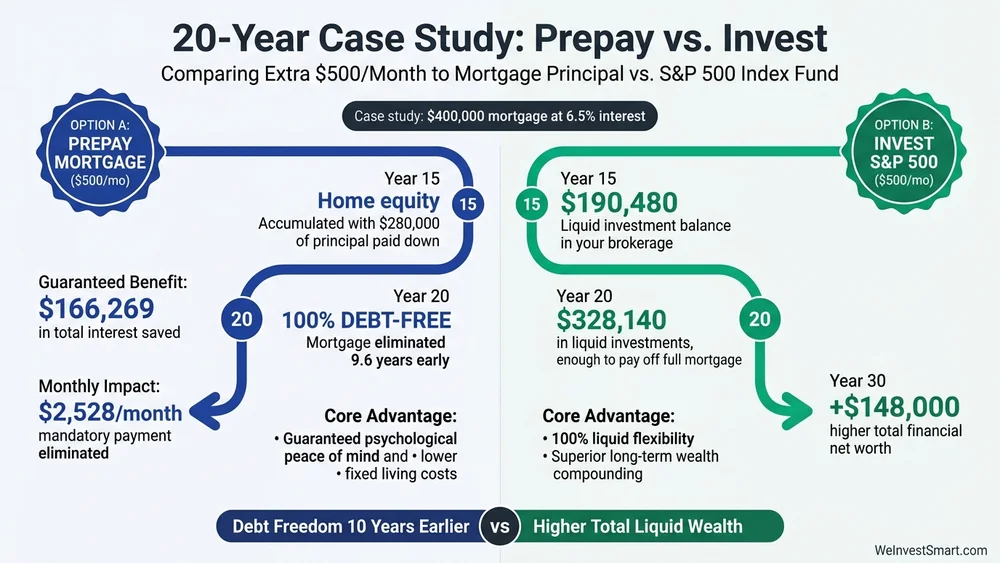
Meet David and Sarah, a couple earning $160,000 annually. They recently purchased a home with a $400,000 loan balance on a 30-year fixed mortgage at 6.50%. Their base monthly principal and interest payment is $2,528.27.
They have an additional $500 per month in discretionary cash flow. They are evaluating two distinct paths over the next 15 to 20 years:
- Option A (Accelerated Debt Payoff): Add $500 per month as a curtailment payment directly to the mortgage principal. When making extra principal payments, verify that your loan servicer does not misapply payments into suspense by reviewing our guide on mortgage servicer unapplied funds.
- Option B (Market Investing): Pay only the mandatory $2,528.27 to the lender and invest the $500 monthly into a low-cost S&P 500 index fund yielding an annualized 8.5% return net of fees and taxes.
| Financial Metric | Option A: Prepay Mortgage ($500/mo) | Option B: Invest S&P 500 ($500/mo) |
|---|---|---|
| New Loan Payoff Timeline | 20 Years, 4 Months (saves 9.6 yrs) | 30 Years (standard term) |
| Total Mortgage Interest Paid | $343,908 | $510,177 |
| Total Mortgage Interest Saved | $166,269 (guaranteed savings) | $0 |
| Investment Portfolio Value (Year 15) | $0 | $190,480 |
| Investment Portfolio Value (Year 20) | $0 (house paid off around now) | $328,140 |
| Liquid Capital Available at Year 15 | $0 (equity locked in home) | $190,480 (liquid in brokerage) |
| Total Net Worth Difference (Year 30) | Higher equity earlier | +$148,000 higher total wealth |
Analyzing the Outcome
In Option A, David and Sarah eliminate nearly ten full years of mortgage payments and save over $166,000 in interest charges with complete certainty. By year 21, their fixed living expenses drop by $2,528 per month, providing immense lifestyle freedom and resilience against economic shocks.
In Option B, David and Sarah accept the volatility of financial markets. Because the 8.5% net investment return outpaces the 6.5% mortgage interest cost, their total liquid investment portfolio reaches $328,140 by year 20.
At year 20, they hold enough liquid capital to pay off their remaining loan balance in a single wire transfer while retaining $80,000 in surplus investments. Option B produces greater ultimate financial net worth, but Option A delivers peace of mind and slashes monthly fixed overhead a decade earlier.
To test how alternating between bi-weekly and monthly schedules impacts these numbers, run your figures through our biweekly mortgage calculator.
The 5-Tier Cash Flow Decision Hierarchy
Before deciding to route extra cash toward your mortgage principal, your money should move through a structured financial priority waterfall. Prepaying low-cost or moderate-cost debt prematurely when you have unaddressed vulnerabilities elsewhere in your financial life is a major planning error.
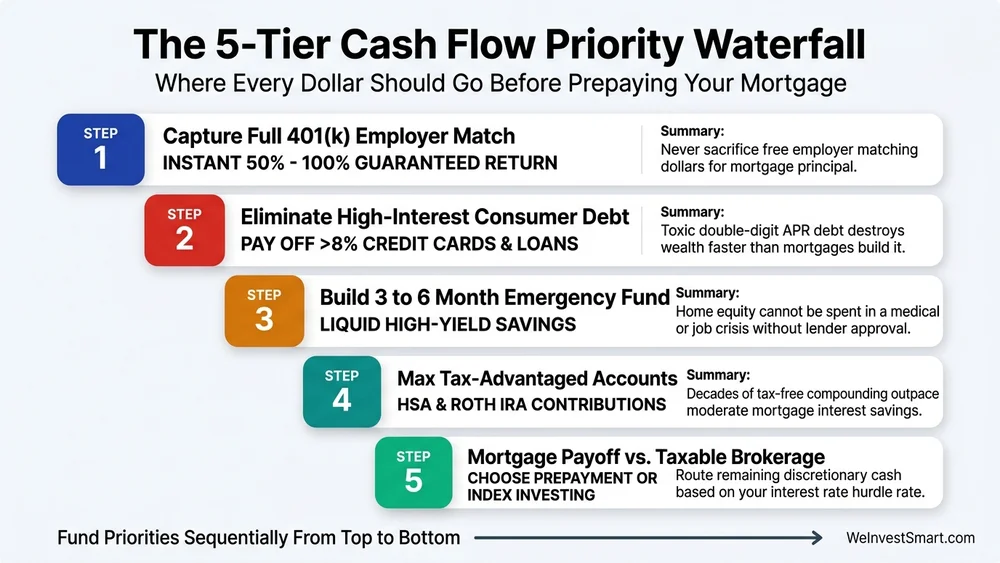
- Capture Full Employer 401(k) Match: If your employer provides a match on retirement contributions, funding that tier yields an immediate, guaranteed 50% to 100% return on your money. No mortgage interest rate in modern history can compete with an employer match.
- Eliminate High-Interest Consumer Debt: Credit cards and personal loans frequently carry APRs between 15% and 28%. Review our analysis of good debt vs. bad debt to structure your debt repayment order before sending extra principal to a mortgage.
- Build a 3-to-6 Month Liquid Emergency Reserve: Because home equity cannot be accessed during emergencies without lender approval, you must establish an emergency buffer in a liquid high-yield savings account or money market fund.
- Maximize Tax-Advantaged Accounts (HSA and Roth IRA): Health Savings Accounts offer triple tax advantages, while Roth IRAs provide completely tax-free compounding. Tax-sheltered growth over multiple decades typically outpaces the interest savings of moderate mortgage debt.
- Evaluate Mortgage Payoff vs. Taxable Investing: Once the first four tiers are fully funded, you can allocate remaining monthly cash flow to mortgage principal curtailment, taxable index fund investing, or a balanced hybrid strategy. If your mortgage currently carries mortgage insurance, routing surplus cash to reach 20% equity allows you to cancel PMI without refinancing, instantly eliminating an unproductive monthly surcharge.
Hybrid Compromises: Recasting and Sinking Funds
If you feel torn between the psychological relief of eliminating mortgage debt and the mathematical power of market investing, you do not have to choose strictly between all-or-nothing extremes. Two practical hybrid methods provide both flexibility and debt reduction.
The Mortgage Recast Strategy
Many borrowers mistakenly believe the only way to lower their mandatory monthly payment is to spend thousands of dollars on a full mortgage refinance. However, most conventional loan servicers offer a process called a mortgage recast.
In a recast, you make a lump-sum principal payment (often a minimum of $5,000 to $10,000) and pay a small administrative processing fee (typically $250 to $500). The lender keeps your original interest rate and remaining loan term unchanged, but completely recalculates your monthly amortization schedule based on the new, reduced balance.
Unlike extra monthly curtailment payments (which shorten the loan term without reducing mandatory monthly obligations), a recast permanently lowers your required monthly overhead. This improves your monthly cash flow flexibility while reducing total interest expenses. For a complete mathematical comparison of administrative fees, amortization math, and servicer rules, read our dedicated mortgage recast vs. refinance guide.
The Dedicated Payoff Sinking Fund
Rather than sending extra principal checks to your mortgage servicer every month where the cash is locked, open a dedicated high-yield savings account or a conservative brokerage portfolio.
Direct your extra $500 per month into this dedicated investment account. Your capital remains 100% liquid and accessible in case you face job loss, health crises, or profitable investment opportunities.
Once the balance in your dedicated sinking fund grows to match the exact remaining payoff balance of your mortgage, you have captured complete choice. You can write a single check to pay off the house entirely, or continue letting your invested assets compound in the financial markets.
For long-term asset building, practicing steady dollar-cost averaging (DCA) into index funds inside a sinking fund portfolio preserves both liquidity and mathematical growth.
Frequently Asked Questions About Mortgage Payoff vs. Investing
Is it better to pay off a mortgage early or invest in the S&P 500?
Paying off your mortgage delivers a guaranteed, risk-free return equal to your loan interest rate with zero volatility. Investing in broad index funds historically yields a higher long-term return of 7% to 10%, but exposes you to market risk and requires a decade-long investment horizon.
What mortgage interest rate makes early payoff mathematically compelling?
When mortgage rates exceed 6.0% to 6.5%, prepaying principal becomes highly competitive because matching that guaranteed after-tax return in financial markets requires pre-tax yields of 8% or more. For sub-4% mortgages, broad market investing almost always produces greater long-term net worth.
Does the mortgage interest deduction make keeping a mortgage worthwhile?
For more than 88% of American households, the mortgage interest deduction provides zero tax savings because the standard deduction is significantly higher than their total itemized deductions. Even for those who itemize, spending one dollar in bank interest to save twenty-four to thirty-two cents on taxes still results in a net cash loss.
What is the biggest financial risk of paying off a mortgage early?
The primary risk is illiquidity, which traps your liquid net worth inside physical home equity where it cannot be accessed without selling the home or qualifying for a loan. If you experience unexpected job loss or medical emergencies, lenders will often deny home equity lines of credit precisely when you need cash the most.
This article is for educational purposes only and should not be considered personalized financial advice. Consider consulting with a financial advisor for guidance specific to your situation.
For educational purposes. Consider your own circumstances before making financial decisions. Read our editorial policy.
From reading to planning
Explore the numbers for yourself.
Use our free calculators to compare scenarios and understand your options.