How to Cancel PMI Early Without Refinancing
Paying $150 to $300 a month in PMI? Discover the four legal pathways to cancel PMI early without refinancing, Fannie Mae 75/80 rules, and sample request letters.
Buying a home with less than a twenty percent down payment is standard practice for millions of American buyers. However, putting down less than twenty percent triggers a recurring monthly surcharge known as Private Mortgage Insurance (PMI).
As detailed in our mortgage payoff vs investing guide, recurring monthly debt charges drain hundreds of dollars from discretionary cash flow. Eliminating this non-equity expense keeps more capital compounding in wealth-building assets.
When homeowners build substantial equity, lenders frequently advise them that the only way to eliminate PMI is to pay thousands of dollars in closing costs for a full mortgage refinance. That advice is often expensive and unnecessary, especially if you secured a competitive fixed interest rate that you want to protect.
Federal consumer legislation and secondary mortgage market guidelines establish clear legal rights for borrowers to terminate conventional PMI early without changing their loan terms or paying thousands in refinance fees. Understanding these rules allows you to drop this monthly surcharge and permanently lower your housing expenses.
Key Takeaways
- Under the federal Homeowners Protection Act of 1998, homeowners have the legal right to request PMI cancellation once their principal balance hits 80% of the original home value.
- Servicers are legally mandated to automatically terminate conventional PMI when the balance is scheduled to reach 78% of original value, provided payments are completely current.
- Under Fannie Mae Servicing Guide B-8.1-04, you can remove PMI based on current market appreciation if your loan is seasoned 2 to 5 years at 75% LTV, or 5+ years at 80% LTV.
- Making substantial home renovations (such as a kitchen remodel or bedroom addition) allows you to bypass the standard 2-year seasoning restriction and cancel PMI at 80% LTV immediately.
- FHA mortgage insurance premiums (MIP) for loans with less than 10% down cannot be cancelled under the Homeowners Protection Act and require a full conventional refinance to remove.
The True Cost of PMI: Why Eliminating It Without Refinancing Wins
Private Mortgage Insurance typically costs between 0.5% and 1.5% of your original loan amount each year, divided into twelve monthly payments. On a $350,000 mortgage, that surcharge adds $145 to $435 to your mandatory monthly housing obligation.
Unlike principal payments that build equity or interest payments that are occasionally tax-deductible for itemizing filers, PMI is a pure deadweight loss. It provides zero financial return, zero property protection, and zero equity build-up for the homeowner. It exists solely to reimburse the mortgage investor if you default on your note.
When interest rates rise or remain steady, spending $6,000 to $10,000 in closing costs to refinance out of PMI makes no financial sense. Swapping a 5.5% or 6.0% mortgage for a new loan merely to eliminate a $180 monthly insurance premium often requires five to seven years just to break even, mirroring the multi-year horizons seen when calculating mortgage discount points break-even math.
In contrast, cancelling PMI through administrative pathways costs between $0 and $500 for a servicer-ordered appraisal or Broker Price Opinion (BPO). The savings take effect on your very next billing statement, producing an immediate, permanent return on investment.
The Four Legal Pathways to Cancel Conventional PMI Early
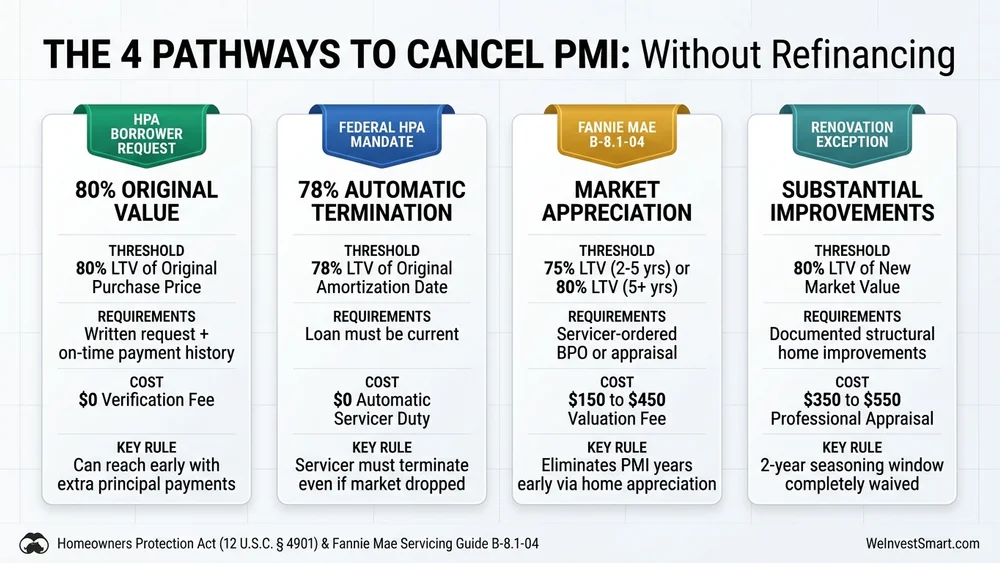
Borrowers holding conventional loans backed by Fannie Mae or Freddie Mac have four distinct mechanisms to terminate private mortgage insurance without executing a new loan.
The table below outlines each pathway, including required equity ratios, appraisal rules, and typical costs:
| Pathway / Method | Required Equity / LTV | Valuation Basis | Seasoning Requirement | Typical Verification Cost |
|---|---|---|---|---|
| 1. Borrower Request (Original Value) | 80% LTV (20% equity) | Original purchase price or initial appraisal | None (can reach early via extra principal) | $0 (No appraisal required) |
| 2. Automatic Termination (HPA) | 78% LTV (22% equity) | Original purchase price schedule | Reached at scheduled amortization date | $0 (Automatic servicer duty) |
| 3. Market Appreciation (2–5 Yrs) | 75% LTV (25% equity) | Current appraised market value | 24 to 60 consecutive months | $150 to $450 (Servicer BPO/appraisal) |
| 4. Market Appreciation (5+ Yrs) | 80% LTV (20% equity) | Current appraised market value | 60+ consecutive months | $150 to $450 (Servicer BPO/appraisal) |
| Bonus: Substantial Improvements | 80% LTV (20% equity) | Current appraised market value | 0 months (Seasoning waived with proof) | $350 to $600 (Full professional appraisal) |
Choosing the right pathway depends on whether your equity growth has been driven by paying down your loan balance or by surging regional real estate values.
Homeowners Protection Act Rights: 80% Request vs. 78% Automatic Termination
Federal consumer rights regarding mortgage insurance are codified under the Homeowners Protection Act of 1998 (HPA), located at 12 U.S.C. § 4901 et seq. and enforced by the Consumer Financial Protection Bureau.
The HPA establishes two statutory milestones based strictly on your home’s Original Value, defined as the lesser of the contract purchase price or the appraisal value at the time of origination:
1. Borrower-Initiated Cancellation at 80% LTV
You possess the legal right to submit a formal written request to cancel PMI on the date your principal balance reaches eighty percent of the original value.
You can achieve this milestone ahead of schedule by making extra monthly principal curtailments or sending a lump sum.
To qualify for cancellation at 80% of original value, you must meet three statutory conditions:
- Good Payment History: No payments 30 days late within the preceding twelve months, and no payments 60 days late within the preceding twenty-four months.
- Written Cancellation Request: You must submit your request in writing to your servicer.
- No Subordinate Liens: Your property must be free from second mortgages, home equity lines of credit (HELOCs), or tax liens, unless your servicer allows subordinate financing within specific guidelines.
2. Automatic Termination at 78% LTV
If you do not submit a written request at eighty percent, the law protects you from perpetual insurance billing.
Under 12 U.S.C. § 4902(b), your loan servicer is legally required to cancel PMI automatically on the date your principal balance is scheduled to reach seventy-eight percent of the original value based on your original amortization contract.
Unlike the 80% rule, automatic termination is date-driven. If you make payments on time, your servicer must terminate the insurance even if your home’s current market value has declined since you purchased it. The only requirement is that your contractual monthly payments are current on the termination date.
You can calculate the exact calendar month your loan hits these milestones using our interactive mortgage payoff calculator.
Fannie Mae & Freddie Mac Current Market Value Rules (75% vs. 80% LTV)
While the federal Homeowners Protection Act focuses on original home value, the vast majority of homeowners build equity through rapid local property appreciation rather than thirty years of scheduled amortization.
If homes in your neighborhood have increased in value by twenty to thirty percent since you purchased your property, you do not have to wait years for your principal balance to drop to eighty percent of your old purchase price.
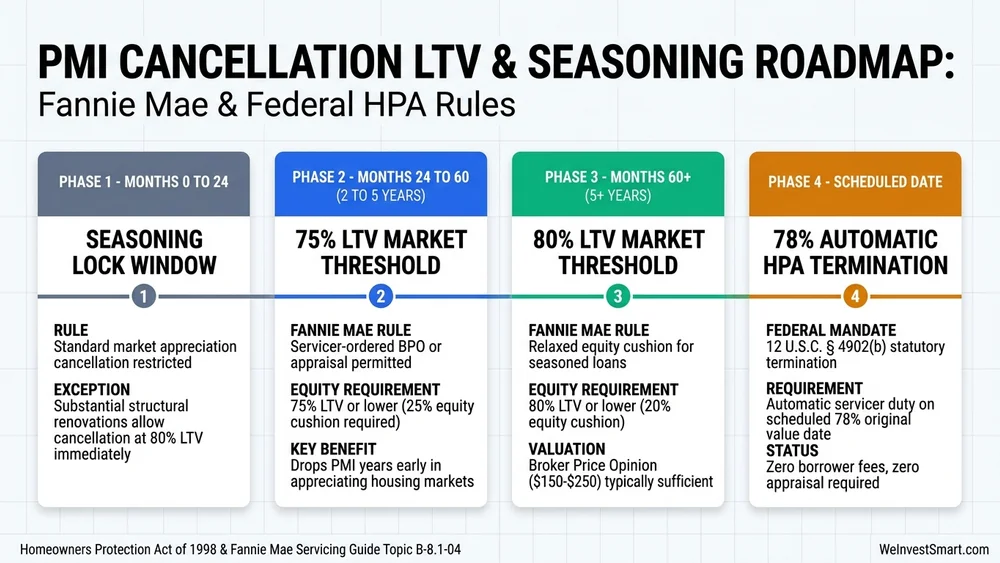
Under Fannie Mae Servicing Guidelines (Topic B-8.1-04), borrowers can request PMI cancellation based on their home’s Current Market Value. Fannie Mae and Freddie Mac enforce specific seasoning rules to evaluate these requests:
Seasoning Between Two and Five Years: 75% LTV Requirement
If your mortgage is between twenty-four and sixty months old, Fannie Mae requires an extra safety margin against market volatility.
Your unpaid principal balance must be seventy-five percent or less of the home’s current appraised market value (representing twenty-five percent equity). For example, if you owe $300,000, your home must appraise for at least $400,000 ($300,000 divided by $400,000 equals 75% LTV).
Seasoning Greater Than Five Years: 80% LTV Requirement
Once your loan surpasses sixty months of age, the required equity cushion relaxes.
Your principal balance must be eighty percent or less of the current market value (representing twenty percent equity). If your remaining balance is $320,000, your property must appraise for at least $400,000 ($320,000 divided by $400,000 equals 80% LTV).
The Critical Appraisal Rule
You cannot hire an independent real estate appraiser yourself. Under Fannie Mae servicing standards, any appraisal or Broker Price Opinion (BPO) used to cancel PMI must be ordered directly by your loan servicer through an approved valuation management vendor.
A Broker Price Opinion typically costs between $150 and $250, while a full residential appraisal costs between $350 and $550. This fee must be paid by the borrower upfront, but it remains vastly cheaper than refinancing.
If you have extra cash and want to lower both your monthly payment and your insurance surcharge, explore our analysis of a mortgage recast vs. refinance.
The Substantial Improvements Exception: Bypassing the Seasoning Window
One of the most valuable exceptions in secondary mortgage servicing guidelines allows homeowners to bypass the standard two-year seasoning requirement completely.
Under Fannie Mae Servicing Guide Topic B-8.1-04, the two-year seasoning requirement is explicitly waived if the borrower has made substantial structural improvements to the property that increased its market value.
What Qualifies as a Substantial Improvement?
To satisfy servicer underwriting for this exception, the improvements must be permanent structural or interior additions that measurably increase living space or utility:
- Adding a finished basement or converting an attic into living space
- Adding a permitted full bathroom or bedroom addition
- Complete gut modernization of a kitchen with structural reconfiguration
- Installing an inground swimming pool or permanent detached guest suite
Minor repairs, routine maintenance, new interior paint, and replacement carpeting do not qualify as substantial improvements.
The Substantial Improvement Math
If you purchased a home twelve months ago for $350,000 with a $332,500 loan (5% down) and spent $45,000 renovating the kitchen and adding a master suite, your home may now appraise for $450,000.
Because your remaining loan balance of $325,000 is 72.2% of the new $450,000 value, you easily exceed the required 80% LTV threshold.
You can request an immediate appraisal from your servicer. Once verified, the servicer terminates your PMI immediately, saving you hundreds of dollars each month without waiting for the two-year mark.
The FHA Warning: Why FHA MIP Cannot Be Removed Under Federal HPA Rules
A frequent point of confusion among homeowners involves the critical distinction between conventional Private Mortgage Insurance (PMI) and government-backed Mortgage Insurance Premiums (MIP).
If you hold a loan insured by the Federal Housing Administration under HUD Guidelines, the Homeowners Protection Act does not apply.
Under federal rules enacted in 2013, the cancellation rules for FHA loans are strictly governed by your initial down payment:
- Down Payment Less Than 10%: If you put down less than ten percent when you purchased your home (such as the standard 3.5% minimum), your annual MIP remains in effect for the entire life of the mortgage. It can never be cancelled through extra principal payments or market appreciation.
- Down Payment of 10% or Greater: If you made a down payment of at least ten percent at origination, your annual MIP terminates automatically after eleven years (132 monthly payments), provided your loan is current.
For FHA borrowers who put down 3.5% and now hold significant equity, the only legal method to eliminate mortgage insurance is to execute a conventional refinance once your equity hits twenty percent.
You can run your current numbers through our mortgage extra payments calculator to determine whether refinancing into a conventional note will lower your all-in monthly payment.
Step-by-Step Guide: How to Request and Execute PMI Removal
Removing PMI requires disciplined follow-through with your loan servicer. Follow this sequential roadmap to ensure your cancellation request is processed efficiently:
Step 1: Check Recent Comparable Sales
Before contacting your lender, research recent closed sales of similar homes in your immediate neighborhood. Verify that your estimated market value comfortably places your loan balance below the 75% or 80% LTV threshold needed for your seasoning window.
Step 2: Contact Your Servicer’s PMI Department
Log into your servicer’s online portal or call customer support. Request their formal “PMI Removal Requirements” disclosure package.
Ask the representative to confirm:
- Is your loan owned by Fannie Mae, Freddie Mac, or held in a private portfolio?
- What is their specific LTV threshold for your loan’s age?
- What valuation method do they require (Broker Price Opinion vs. full appraisal)?
- What is the fee to order the valuation through their approved management company?
Step 3: Submit a Formal Written Cancellation Request
Prepare a written request detailing your loan number, property address, and the specific basis for your cancellation (original value paydown, market appreciation, or substantial improvements).
Step 4: Pay the Servicer Valuation Fee and Facilitate Inspection
Once your written request is logged, your servicer will instruct you to pay the appraisal fee. When the appraiser or real estate broker contacts you to schedule the visit, provide them with a typed list of all major structural improvements and renovations made to the property.
Step 5: Verify the Updated Billing Statement
Once the appraisal report confirms your eligible equity ratio, your servicer must issue a formal cancellation notice within thirty business days. Verify on your next billing statement that the PMI line item has been removed and ensure extra payments were not misrouted into mortgage servicer unapplied funds.
Sample PMI Cancellation Request Letter Template
Submit the following formal letter to your servicer’s designated customer service or escrow correspondence address. Send it via Certified Mail with Return Receipt Requested to document your timeline.
FORMAL REQUEST FOR PRIVATE MORTGAGE INSURANCE (PMI) CANCELLATION
Date: [Current Date]
To: [Mortgage Servicer Name]
Attention: Mortgage Insurance / Escrow Administration Department
Address: [Servicer Correspondence Address Found on Statement]Borrower Name(s): [Your Full Legal Name(s)]
Loan Account Number: [Your Mortgage Loan Number]
Property Address: [Your Subject Property Address]Subject: Formal Written Request to Cancel Private Mortgage Insurance Pursuant to Fannie Mae Servicing Guidelines / Homeowners Protection Act
Dear Loan Servicing Department:
I am writing to formally request the cancellation of Private Mortgage Insurance (PMI) on the above-referenced mortgage loan.
My account is currently in good standing, with zero payments thirty days past due in the preceding twelve months and zero payments sixty days past due in the preceding twenty-four months. Furthermore, there are no subordinate liens or secondary encumbrances on the subject property.
I am requesting cancellation based upon [Select One of the Following Options]:
Option A (Original Value Paydown): Pursuant to the federal Homeowners Protection Act of 1998 (12 U.S.C. § 4902), my unpaid principal balance has been paid down to $[Current Balance], which is eighty percent (80%) or less of the original purchase value of $[Original Purchase Price].
Option B (Current Market Appreciation): Pursuant to Fannie Mae Servicing Guide Topic B-8.1-04, my loan has achieved sufficient seasoning, and local property appreciation has increased the current market value of the property such that my current balance satisfies your required loan-to-value threshold. I hereby authorize your office to order a Broker Price Opinion (BPO) or residential appraisal through your approved vendor at my expense.
Option C (Substantial Improvements): Pursuant to Fannie Mae Servicing Guide Topic B-8.1-04, I have completed substantial structural improvements to the property that have significantly increased its market value. Attached please find documentation and receipts detailing these renovations. I authorize your office to order an appraisal at my expense to verify that my current loan-to-value ratio is eighty percent (80%) or lower.
Please provide written confirmation of receipt of this request and instructions for remitting the necessary valuation fee within thirty (30) business days.
Sincerely,
[Your Signature]
[Your Printed Legal Name]
[Your Telephone Number]
[Your Email Address]
Frequently Asked Questions About Cancelling PMI Without Refinancing
Can you remove PMI without refinancing your mortgage?
Yes. Conventional mortgage borrowers can remove PMI without refinancing by paying down principal to 80% of the original purchase price or ordering a servicer-directed appraisal to demonstrate an equity position of 20% to 25% based on current market appreciation.
What is the difference between the 80% and 78% PMI cancellation rules?
Under the federal Homeowners Protection Act, borrowers can formally request PMI cancellation in writing when their balance reaches 80% of original value. Lenders are legally mandated to cancel PMI automatically once the loan reaches 78% of original value on its scheduled amortization date.
Can home improvements help you drop PMI before two years of seasoning?
Yes. Under Fannie Mae Servicing Guide Topic B-8.1-04, borrowers who make substantial structural renovations that verifiably increase property value can request an appraisal to remove PMI at an 80% loan-to-value ratio, waiving the typical two-year seasoning requirement.
Can you cancel mortgage insurance on an FHA loan without refinancing?
No. FHA loans originated with less than 10% down require annual mortgage insurance premiums for the entire duration of the loan. The only legal method to eliminate FHA insurance premiums is to refinance into a conventional loan once your equity reaches 20%.
This article is for educational purposes only and should not be considered personalized financial advice. Consider consulting with a financial advisor for guidance specific to your situation.
For educational purposes. Consider your own circumstances before making financial decisions. Read our editorial policy.
From reading to planning
Explore the numbers for yourself.
Use our free calculators to compare scenarios and understand your options.