Mortgage Recast vs. Refinance vs. Principal Paydown: Which Wins?
Compare mortgage recasting, refinancing, and extra principal paydown. Discover cost differences, payment impacts, Fannie Mae rules, and worked math.
Receiving a significant lump sum of money from an annual bonus, an inheritance, or a prior home sale creates an immediate financial decision fork. Applying that capital toward your existing home loan can immediately strengthen your personal balance sheet.
While evaluating our broader mortgage payoff vs investing guide helps determine whether debt reduction beats equity investing, choosing how to execute that paydown introduces a critical second decision. Homeowners must decide whether to prioritize monthly cash flow relief or maximum lifetime interest savings.
Most homeowners assume their only options are continuing to send sporadic extra payments or paying thousands of dollars to completely refinance their mortgage. Yet there is a third, often overlooked mechanism known as a mortgage recast that delivers the cash flow relief of a refinance without resetting your interest rate or paying thousands in closing fees.
Understanding the mechanics, costs, and tradeoffs between recasting, refinancing, and making extra principal curtailments allows you to tailor your mortgage structure to your exact cash flow needs.
Key Takeaways
- A mortgage recast applies a lump-sum payment to your existing loan and re-amortizes the remaining balance, lowering your monthly payment without changing your interest rate or loan term.
- Refinancing replaces your existing loan with a brand-new note and interest rate, incurring 2% to 5% ($5,000 to $12,000+) in closing costs and resetting your amortization schedule.
- Making extra principal payments without recasting shortens your total loan duration and maximizes lifetime interest savings, but leaves your mandatory monthly payment completely unchanged.
- Government-backed loans including FHA, VA, and USDA mortgages legally prohibit loan recasting under HUD and VA guidelines, while conventional Fannie Mae and Freddie Mac loans permit it.
- A mortgage recast typically costs between $150 and $500 with zero appraisal or underwriting requirements, making it the fastest way to lower monthly cash commitments if you hold a low interest rate.
What Is a Mortgage Recast and How Does It Work?
A mortgage recast, also referred to by lenders as loan re-amortization, is an administrative modification where your loan servicer recalculates your monthly principal and interest payment based on a substantially reduced loan balance following a lump-sum payment.
When you obtain a fixed-rate mortgage, your lender establishes a fixed monthly payment calculated to reduce your balance to exactly zero over a defined period, typically 360 months for a standard 30-year loan. Each month, your payment is split between interest charges and principal paydown.
If you make an extra $30,000 payment toward your principal without taking any other action, your lender simply deducts that amount from your outstanding balance. Your next monthly payment remains identical to the previous month. The only difference is that a larger share of each future payment goes toward principal, which causes your mortgage to pay off years ahead of schedule.
However, you must ensure your servicer does not misallocate your payment into a suspense account. Learn how to verify your billing statement in our guide on mortgage servicer unapplied funds.
A mortgage recast alters that dynamic. Instead of keeping your required monthly payment fixed and shortening your loan term, your servicer keeps your original loan maturity date and interest rate identical, but recalculates your monthly payment downward.
Under Fannie Mae Servicing Guidelines, loan servicers are authorized to process a principal curtailment and re-amortize the remaining balance across the remaining months of the original term. Because your remaining balance is smaller, your required monthly payment drops permanently for the rest of the loan.
Mortgage Recast vs. Refinance vs. Principal Paydown: The Core Comparison
Choosing between a recast, a refinance, and an un-recasted principal curtailment comes down to balancing transaction costs, interest rates, payment obligations, and total interest paid over time.
Each option serves an entirely different financial objective, as outlined in the following comparative matrix:
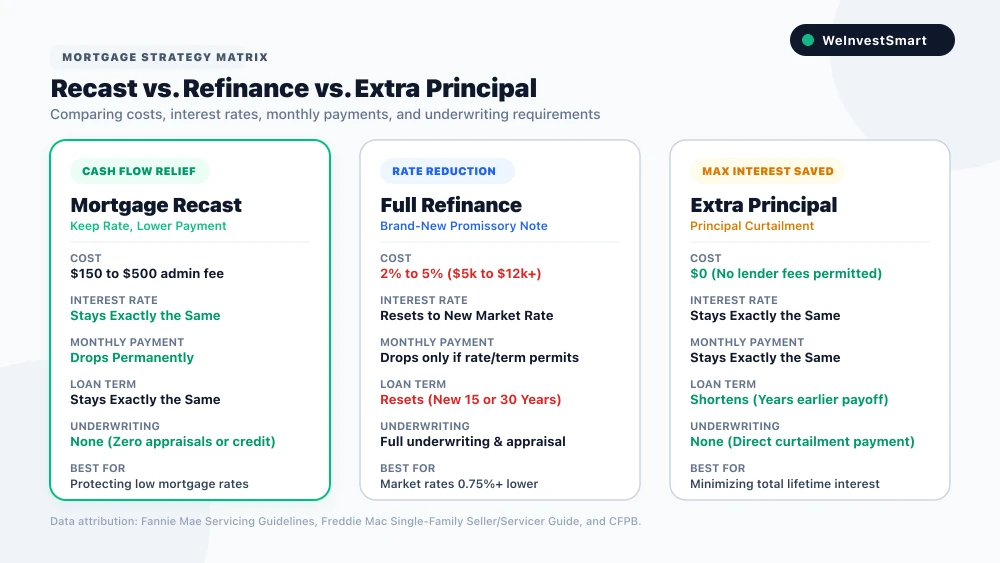
| Feature / Metric | Mortgage Recast | Full Mortgage Refinance | Extra Principal Paydown (No Recast) |
|---|---|---|---|
| Primary Goal | Lower monthly cash payment while keeping current rate | Secure lower interest rate or change loan duration | Shorten debt duration and maximize interest savings |
| Typical Cost | $150 to $500 administrative fee | 2% to 5% of loan balance ($5,000 to $12,000+) | $0 (No fees permitted) |
| Lump Sum Required? | Yes (Typically $5,000 to $10,000 minimum) | No (Can refinance existing balance or cash out) | No (Any extra dollar amount accepted) |
| Interest Rate Impact | Stays exactly the same | Changes to current prevailing market rate | Stays exactly the same |
| Loan Term / End Date | Stays exactly the same | Resets to new duration (e.g., new 15 or 30 years) | Shortened significantly (often by several years) |
| Monthly Payment | Drops permanently | Drops if rate or term allows; increases if shortening term | Stays exactly the same |
| Underwriting Required? | No credit check, no income verification, no appraisal | Full underwriting, credit check, income docs, appraisal | None |
| Processing Time | 30 to 45 business days | 30 to 60 business days | Immediate (next billing cycle) |
| Eligible Loans | Conventional Fannie/Freddie and select Jumbo loans | Almost all loan types (Conventional, FHA, VA, Jumbo) | All residential mortgage loans |
When evaluating these three choices, your primary consideration should be whether your existing interest rate is lower or higher than current market rates.
If you secured a 3.0% or 4.0% mortgage in prior years, refinancing into a higher-rate environment would destroy thousands of dollars in interest savings. A recast allows you to keep that historic low interest rate while capturing lower monthly payments.
Conversely, if your current mortgage carries an 8.0% interest rate and market rates have dropped to 5.75%, paying closing costs to refinance using our mortgage refinance calculator can dramatically lower your rate across the entire remaining balance.
Eligibility Rules: Fannie Mae, Freddie Mac, and FHA/VA Restrictions
Not every homeowner has the legal or contractual right to recast their mortgage loan. Eligibility is governed by federal loan backing rules and individual mortgage servicer policies.
Conventional conforming loans backed by Fannie Mae and Freddie Mac almost always allow recasting. However, government-insured loans have strict statutory prohibitions that prevent servicers from modifying amortization schedules in this manner:
Government-Backed Loan Prohibitions
- FHA Mortgages: Under the Department of Housing and Urban Development HUD Handbook 4000.1, Federal Housing Administration loans do not permit loan recasting. FHA rules mandate that any extra principal paid must be applied directly to curtailment without re-amortizing scheduled payments.
- VA Mortgages: The Department of Veterans Affairs loan program does not support mortgage recasting under VA Pamphlet 26-7 guidelines. Veterans holding VA loans who wish to lower their monthly payments must either execute an Interest Rate Reduction Refinance Loan (IRRRL) or a conventional refinance.
- USDA Mortgages: Loans issued through the United States Department of Agriculture Rural Development program strictly prohibit recasting.
Conventional Conforming Guidelines
For conventional mortgages, Fannie Mae allows servicers to execute a recast provided the borrower meets several core conditions:
- Good Standing: Your account must be completely current, with no 30-day late payments within the preceding 12 months.
- Minimum Principal Reduction: Most major servicers (including Chase, Wells Fargo, Pennymac, and Rocket Mortgage) require a minimum principal curtailment of $5,000 to $10,000.
- Administrative Processing Fee: Servicers typically assess a processing fee between $150 and $300 to prepare the modified amortization schedule. This fee cannot be financed into the loan balance and must be paid upfront.
- Seasoning Requirement: Many servicers require you to have made at least two to six consecutive monthly on-time payments before requesting a recast.
Jumbo loans held in private bank portfolios or securitized through private trusts may or may not allow recasting. Portfolio lenders often require higher minimum payments, typically starting at $20,000 to $50,000, before approving a recast agreement.
Worked Case Study: $400,000 Mortgage with a $40,000 Lump Sum
To understand the actual financial differences between recasting, refinancing, and extra principal curtailment, let us examine a concrete scenario using exact amortization mathematics.
Consider Sarah, a homeowner who purchased a home five years ago with a $400,000 30-year fixed mortgage at 6.50% interest.
Her initial monthly principal and interest payment was $2,528.27. After 60 months of faithful on-time payments, her remaining principal balance is $374,443.91, and she has 300 months (25 years) remaining on her loan.
Sarah receives an inheritance of $40,000 and evaluates how to deploy this capital across the three strategies:
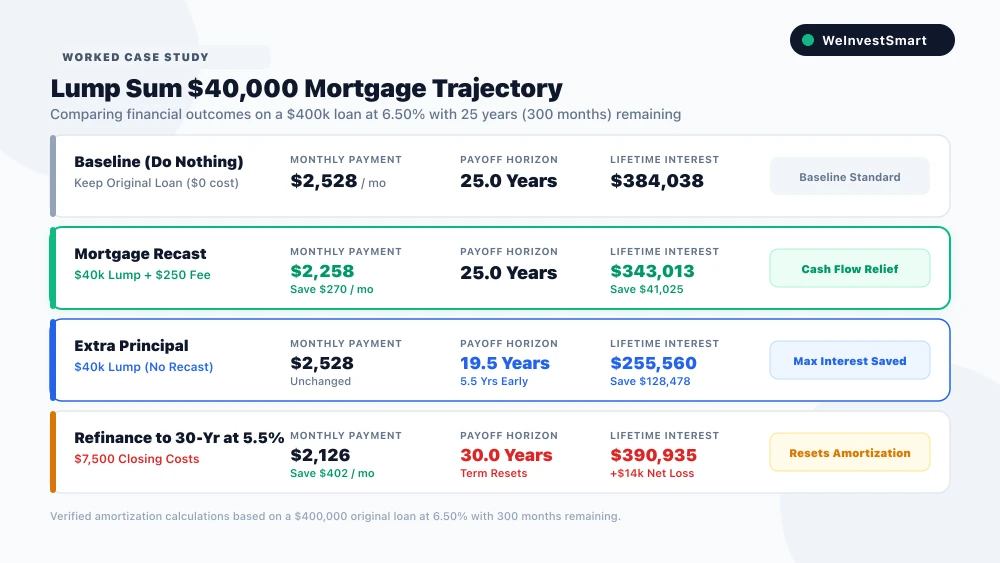
| Metric / Outcome | Strategy A: Baseline (No Extra Payment) | Strategy B: Mortgage Recast ($40,000 Lump Sum) | Strategy C: Extra Principal ($40,000 Lump Sum, No Recast) | Strategy D: Refinance to 30-Yr at 5.50% ($0 Lump Sum) |
|---|---|---|---|---|
| Upfront Out-of-Pocket Cost | $0 | $40,250 ($40k lump + $250 fee) | $40,000 ($40k lump + $0 fee) | $7,500 (Closing costs paid cash) |
| New Remaining Balance | $374,443.91 | $334,443.91 | $334,443.91 | $374,443.91 |
| New Monthly Payment (P&I) | $2,528.27 | $2,258.19 | $2,528.27 | $2,126.05 |
| Monthly Cash Flow Change | $0 | +$270.08 per month | $0 per month | +$402.22 per month |
| Remaining Payoff Horizon | 25.0 years (300 mos) | 25.0 years (300 mos) | 19.5 years (234 mos) | 30.0 years (360 mos) |
| Remaining Lifetime Interest | $384,037.72 | $343,012.86 | $255,560.18 | $390,934.57 |
| Total Lifetime Interest Saved | $0 | $41,024.86 | $128,477.54 | -$14,396.85 (Net loss vs baseline) |
Analyzing the Mathematical Results
The numbers reveal critical trade-offs that defy common financial assumptions:
- Recasting Provides Immediate Cash Flow Without Extending Duration: By executing a recast, Sarah reduces her required monthly housing expense by $270.08 every single month for the next 25 years. She saves $41,024.86 in lifetime interest while paying only a $250 administrative fee.
- Extra Principal Maximizes Lifetime Wealth: If Sarah simply applies the $40,000 to her principal without requesting a recast, she saves $128,477.54 in interest, which is more than triple the savings of the recast. Her mortgage is paid off 5.5 years early. However, her monthly payment remains locked at $2,528.27.
- The Refinance Duration Trap: If Sarah refinances into a new 30-year mortgage at 5.50% (a full percentage point lower than her original rate), her payment drops by $402.22 per month. However, because the loan term resets to 360 months, her total lifetime interest paid actually increases by $6,896.85. After adding $7,500 in closing costs, she loses $14,396.85 compared to doing nothing, unless she accelerates payments or moves within a few years.
You can simulate these exact prepayment scenarios on your own mortgage balance using our free mortgage extra payments calculator.
Refinance Break-Even Math: When Does Refinancing Actually Win?
While a mortgage recast is vastly cheaper than refinancing in terms of transaction fees, refinancing is still the superior tool under specific market conditions.
According to consumer disclosure rules enforced by the Consumer Financial Protection Bureau (CFPB), lenders must provide a Loan Estimate and Closing Disclosure outlining all transaction charges. In the United States, closing costs on a refinance typically total between 2% and 5% of the new loan amount.
On a $350,000 loan, closing costs will generally range from $7,000 to $10,500, encompassing:
- Lender origination charges (0.5% to 1.0%)
- Appraisal fee ($450 to $750)
- Lender title insurance and escrow settlement ($1,500 to $3,000)
- Recording fees, transfer taxes, and prepaid interest
To determine whether a refinance makes financial sense compared to a recast, you must calculate your exact break-even timeline:
Refinance Break-Even Formula Break-Even Timeline (Months) = Total Upfront Closing Costs / Net Monthly Payment Savings
For example, if spending $8,000 in closing costs lowers your monthly mortgage payment by $250 per month, your break-even point is:
$8,000 / $250 = 32 months (2.67 years)
If you plan to remain in your home for five years or longer, paying the closing costs pays for itself and yields ongoing monthly savings. But if you move or sell the property before month 32, you will suffer a net financial loss on the refinance.
In contrast, a mortgage recast with a $250 fee and a $270 monthly payment reduction breaks even in less than 30 days. The same break-even logic applies when evaluating whether to buy down your interest rate at closing: check our mortgage discount points break-even formula to see if paying upfront points pays off for your timeline.
The Four Optimal Scenarios for a Mortgage Recast
A mortgage recast is not a universal solution for every borrower, but under several frequent homeownership circumstances, it represents the single most efficient financial move available.
1. Buying a New Home Before Selling Your Old One
In competitive housing markets, many buyers use bridge financing, savings, or a low-down-payment conventional loan to purchase a new property before their existing home sells.
Once their previous home successfully closes, they receive a large check representing their accumulated equity, often $50,000 to $200,000.
Instead of undergoing another expensive refinance, the homeowner can apply those proceeds directly to their new loan and request an immediate recast. This drops their monthly mortgage payment down to the exact level it would have been had they made a massive down payment on day one, all for a minor $250 processing fee.
2. Protecting a Low-Rate Mortgage
Between 2020 and 2021, millions of American homeowners locked in 30-year fixed mortgages with interest rates between 2.50% and 3.50%.
If you hold one of these historically low interest rates and want to lower your monthly budget commitments after receiving a bonus or inheritance, refinancing would force you into significantly higher prevailing market rates. Recasting preserves your low rate while instantly reducing your monthly payment obligations.
3. Transitioning into Retirement on a Fixed Income
Pre-retirees often face a shift from high employment earnings to a fixed income from pensions and Social Security. Reducing mandatory monthly fixed expenses is often critical for budgeting comfort.
By allocating a portion of a retirement lump sum or non-qualified brokerage assets toward a mortgage recast, pre-retirees can reduce their monthly housing overhead by hundreds of dollars without parting with the full capital required to pay off the mortgage entirely.
4. Maximizing Cash Flow Flexibility While Retaining Prepayment Optionality
A recast provides valuable asymmetric flexibility. Once your servicer lowers your required payment, you are never forbidden from paying extra principal in future months.
If your budget allows, you can continue paying your old, higher monthly amount, which rapidly amortizes your debt just as an extra principal strategy would. But if you experience an unexpected job interruption or medical expense, your legally required payment remains at the new, lower rate.
You can inspect the impact of shifting payment tiers over time using our interactive mortgage amortization calculator.
Step-by-Step Guide: How to Request and Execute a Mortgage Recast
Because a mortgage recast is an internal servicer modification rather than a new loan origination, the process is streamlined and involves minimal paperwork. Follow these steps to ensure your recast is executed smoothly:
Step 1: Contact Your Loan Servicer
Reach out to your current mortgage servicer through their customer service portal or phone line. Ask specifically for their “Loan Re-amortization” or “Mortgage Recast” department.
Confirm the following details before transferring any funds:
- Does your loan type qualify for recasting?
- What is the servicer’s minimum principal curtailment threshold?
- What is the exact administrative processing fee?
- Are you required to submit a written recast application or signed modification agreement?
Step 2: Confirm Account Status and Seasoning
Ensure your account has had zero delinquent payments in the past 12 months. If you recently purchased or refinanced the property, verify that you have satisfied the servicer’s minimum seasoning window (typically 60 to 90 days from loan closing).
Step 3: Wire or Transfer the Lump-Sum Principal Payment
Instruct your servicer on how to apply the funds. This distinction is critical: specify that the lump sum must be credited strictly as a Principal Curtailment, not as advance monthly payments.
If an electronic servicer portal allows it, select the “Principal Only” designation when scheduling the transfer.
Step 4: Submit the Recast Application and Pay the Administrative Fee
Most servicers will provide a simple one-to-two-page agreement stating that you are requesting a re-amortization of your balance over the remaining term. Sign the document and pay the administrative fee via check or electronic transfer.
Step 5: Review Your Updated Amortization Schedule
Within 30 to 45 business days, your servicer will process the recalculation and issue an updated billing statement reflecting your new, reduced monthly principal and interest payment. Verify that your interest rate and maturity date remain unchanged.
Frequently Asked Questions About Mortgage Recasting and Refinancing
What is the difference between a mortgage recast and a refinance?
A mortgage recast keeps your original interest rate and maturity date while re-amortizing a smaller principal balance after a lump-sum payment for a modest fee of $150 to $500. A refinance replaces your current mortgage with an entirely new loan, requiring complete credit underwriting, an appraisal, and $5,000 to $12,000 in closing costs.
Does a mortgage recast lower your interest rate or shorten your loan term?
No. A mortgage recast changes neither your interest rate nor your remaining payoff date. It solely recalculates your mandatory monthly principal and interest payment so that your reduced loan balance pays off evenly across the remaining original schedule.
Can you recast an FHA, VA, or USDA mortgage loan?
No. Government-backed mortgages issued under FHA guidelines (HUD Handbook 4000.1), VA loan programs, and USDA rural housing regulations do not permit loan recasting. Borrowers holding these loans must execute a full refinance to lower their required monthly payment.
Is it better to recast a mortgage or just make extra principal payments?
Making extra principal payments saves more total interest over time and pays off your debt earlier, but it does not reduce your mandatory monthly payment. If your primary objective is freeing up monthly cash flow while keeping an ultra-low interest rate, a mortgage recast is the mathematically superior choice.
This article is for educational purposes only and should not be considered personalized financial advice. Consider consulting with a financial advisor for guidance specific to your situation.
For educational purposes. Consider your own circumstances before making financial decisions. Read our editorial policy.
From reading to planning
Explore the numbers for yourself.
Use our free calculators to compare scenarios and understand your options.