Social Security Tax Torpedo: Why Retirees Face 40.7% Tax Rates
Explore how provisional income triggers the Social Security tax torpedo, producing 40.7% marginal rates, and discover five ways to disarm the trap.
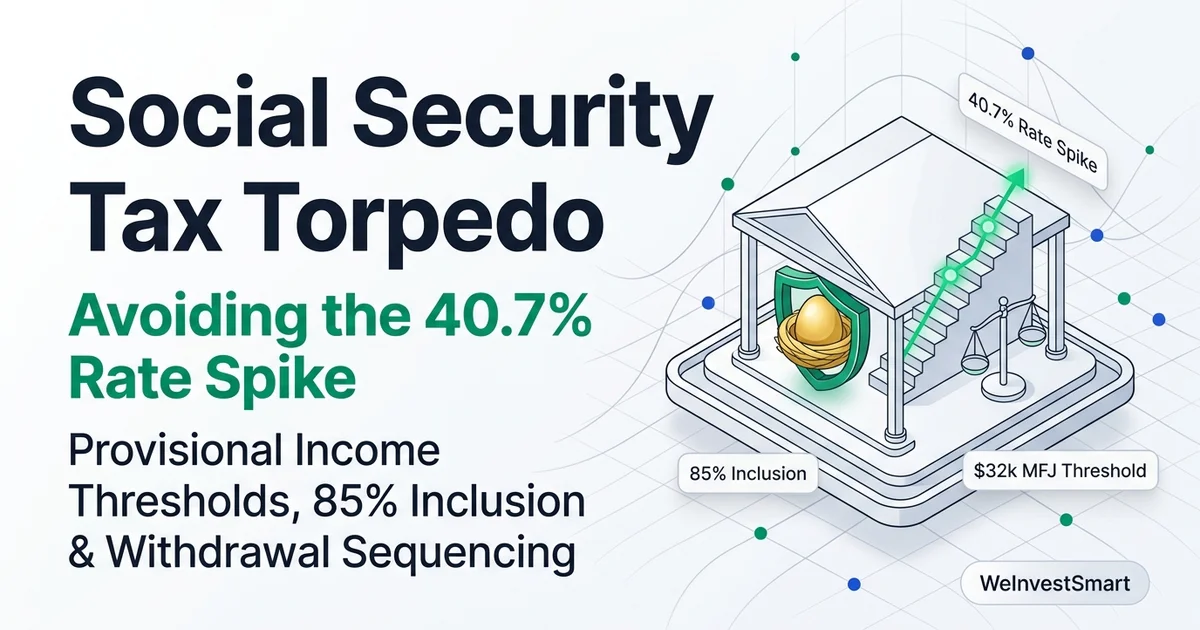
Most Americans anticipate entering lower tax brackets once their working careers conclude. Yet thousands of middle-income retirees encounter a harsh mathematical surprise on their tax returns: a sudden jump in their effective marginal tax rate to 40.7% or higher.
This financial shock is widely known among wealth managers as the Social Security tax torpedo. It does not result from an official tax hike or an IRS audit. Instead, it is an engineered consequence of how the Internal Revenue Code measures retirement cash flow. As outlined in our foundation guide on US stealth marginal tax traps, statutory phaseout rules often cause far more financial damage than nominal bracket rates.
Under Internal Revenue Code Section 86, generating extra income does not just get taxed at your ordinary bracket rate. That extra income simultaneously forces an additional portion of your previously tax-free Social Security benefits into the taxable column.
[!NOTE] Key Takeaways: The Social Security Tax Torpedo at a Glance
- The Core Mechanism: Under IRC Section 86, each additional dollar of retirement income can force up to $0.85 of Social Security benefits into taxable income, expanding your taxable base by $1.85 for every $1.00 withdrawn.
- Marginal Rate Distortion: A retiree in the nominal 22% federal bracket faces a true federal marginal tax rate of 40.7% (22% × 1.85) inside the phaseout zone, exceeding the highest federal bracket on active Wall Street executives.
- Unindexed Thresholds: The statutory provisional income triggers ($25,000 for single filers; $32,000 for married couples) have never been adjusted for inflation since 1983, ensnaring millions of middle-class households.
- The Municipal Bond Surprise: Tax-exempt municipal bond interest is federally non-taxable, but IRC Section 86(b)(1)(B) explicitly adds it back into provisional income calculations.
- Strategic Countermeasures: Converting traditional IRA balances to Roth accounts during the pre-70 retirement gap and delaying Social Security claiming can dismantle the torpedo permanently.
What Is the Social Security Tax Torpedo?
The Social Security tax torpedo is a mathematical distortion in the federal tax code where earning an extra dollar of outside income causes up to $0.85 of Social Security benefits to become taxable, abruptly pushing effective marginal tax rates up to 40.7% or higher.
When Social Security was originally established in 1935, monthly retirement payments were completely exempt from federal income taxation. That framework changed with the bipartisan Social Security Amendments of 1983. Congress introduced IRC Section 86, which mandated that retirees exceeding specified income thresholds must include up to 50% of their benefits in taxable income.
A decade later, the Omnibus Budget Reconciliation Act of 1993 created a second threshold, subjecting up to 85% of benefits to income tax. The legislative intent in 1983 was to tax only high-income beneficiaries. At the time, fewer than 10% of Social Security recipients had sufficient outside earnings to trigger the tax.
However, Congress made a deliberate policy choice: neither the 1983 thresholds nor the 1993 thresholds were indexed to inflation. Over the past four decades, routine cost-of-living adjustments have pushed average checks higher, while wages and required distributions have grown. As a result, Social Security Administration data confirms that over 50% of recipient households now owe federal income tax on their benefits.
The tax torpedo refers specifically to the steep rate spike that occurs while benefits are actively phasing into the tax base. Early retirees who leave work before Medicare eligibility face a comparable marginal rate spike with the ACA subsidy cliff in early retirement, where exceeding poverty limits abruptly eliminates marketplace premium tax credits.
The Provisional Income Formula: How the IRS Calculates Benefit Taxability
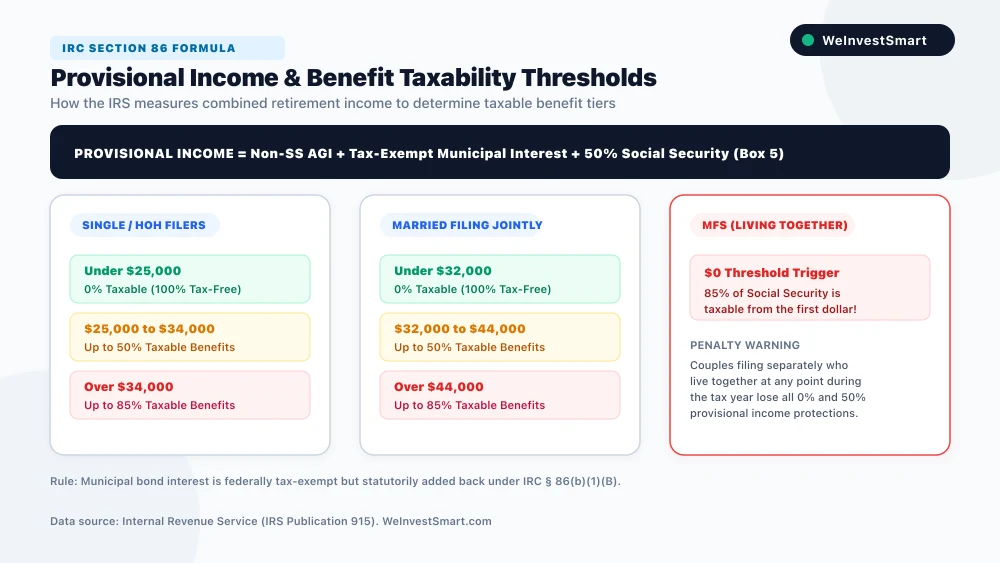
Provisional income, officially termed “combined income” by the IRS, is calculated as Modified Adjusted Gross Income (excluding taxable Social Security) plus tax-exempt municipal interest plus exactly 50% of your gross annual Social Security benefits from Box 5 of Form SSA-1099.
To evaluate whether your benefits are subject to taxation, the IRS requires you to complete the Social Security Benefits Worksheet in IRS Publication 915 or the Form 1040 instructions.
The statutory formula is defined as:
$$\text{Provisional Income} = \text{MAGI (excluding SS)} + \text{Tax-Exempt Interest} + 0.50 \times \text{Gross Social Security}$$
Where Modified Adjusted Gross Income includes:
- W-2 wages and self-employment consulting revenue
- Taxable pension distributions
- Traditional IRA and 401(k) distributions
- Taxable interest, ordinary dividends, and qualified dividends
- Net capital gains from taxable brokerage accounts
The Statutory Threshold Brackets
Once provisional income is established, the IRS compares the total against two fixed statutory hurdles:
| Filing Status | 0% Taxable Benefits | Up to 50% Taxable | Up to 85% Taxable |
|---|---|---|---|
| Single / Head of Household | Under $25,000 | $25,000 to $34,000 | Over $34,000 |
| Married Filing Jointly | Under $32,000 | $32,000 to $44,000 | Over $44,000 |
| Married Filing Separately (living together) | Not Available ($0) | Not Available ($0) | Over $0 (85% immediate) |
For married couples filing jointly, every dollar of provisional income between $32,000 and $44,000 subjects $0.50 of benefits to taxation. Once provisional income passes $44,000, each additional dollar subjects $0.85 of benefits to taxation, until the maximum ceiling of 85% of total annual benefits is reached. Under no circumstances does the federal government tax more than 85% of total Social Security benefits. The remaining 15% is always tax-exempt.
Notice the punitive treatment of Married Filing Separately: couples living together receive a $0 exemption, subjecting benefits immediately to 85% taxation. While separate returns can be useful during working years (such as Married Filing Separately for student loans under federal IDR plans), doing so in retirement maximizes tax exposure.
The Municipal Bond Interest Trap
Many conservative retirees purchase municipal bonds under the assumption that their coupon income is entirely immune to federal taxes. While municipal bond interest avoids direct income tax on Form 1040 Line 2b, Congress inserted IRC Section 86(b)(1)(B).
This statutory provision mandates that tax-exempt interest (reported on Form 1040 Line 2a) must be added back into provisional income in full. Consequently, receiving $10,000 in municipal bond interest can push a retiree past the $32,000 or $44,000 threshold, subjecting thousands of dollars of Social Security to taxation. The municipal interest remains tax-free, but its presence causes your Social Security check to be taxed.
The Mathematical Mechanics: Why a 22% Nominal Bracket Spikes to 40.7%
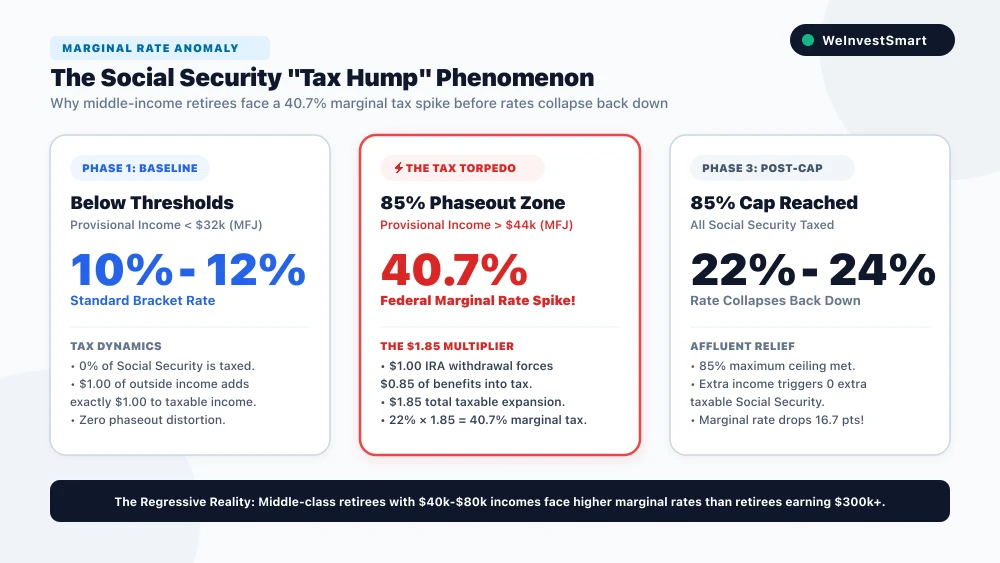
The marginal tax rate spikes because every additional $1 of ordinary income adds $1.85 to total taxable income across the 85% phaseout zone, multiplying the base 12% bracket to 22.2% and the base 22% bracket to 40.7%.
To grasp why the torpedo occurs, one must distinguish between an average tax rate and an effective marginal rate. An average tax rate measures total taxes paid divided by total income.
In contrast, an effective marginal rate measures the tax owed on your next dollar of income. This calculation factors in all interactions with phaseouts and deductions across the tax code.
Inside the 85% phaseout zone, an extra $1.00 of income (such as an IRA withdrawal) produces two simultaneous events:
- The $1.00 of IRA distribution is added directly to taxable income.
- The $1.00 increases provisional income by $1.00, which pulls an additional $0.85 of Social Security benefits into taxable income.
Total taxable income increases by $1.85 for every single dollar withdrawn from your retirement accounts.
$$\text{Effective Marginal Rate} = \text{Nominal Tax Bracket} \times 1.85$$
Here is how this multiplier alters federal tax liabilities across standard tax brackets:
| Statutory Tax Bracket | Phaseout Multiplier | Effective Federal Marginal Rate |
|---|---|---|
| Nominal 10% Bracket | 1.50 (50% phaseout) | 15.0% |
| Nominal 12% Bracket | 1.50 (50% phaseout) | 18.0% |
| Nominal 12% Bracket | 1.85 (85% phaseout) | 22.2% |
| Nominal 22% Bracket | 1.85 (85% phaseout) | 40.7% |
| Nominal 24% Bracket | 1.85 (85% phaseout) | 44.4% |
A retiree sitting comfortably in the 22% federal tax bracket who takes an extra $1,000 from an IRA does not pay $220 in federal tax. They pay $407 in federal income tax. If they reside in a state with a 5% state income tax that piggybacks on federal taxable income, their combined marginal tax rate reaches 45.7%.
Worked Case Study: Robert and Linda’s $10,000 IRA Withdrawal
To see the mechanics in action, consider Robert and Linda, both age 67, filing jointly. They receive $48,000 in combined Social Security benefits ($4,000 monthly) and have a modest corporate pension of $26,000 per year.
They need an extra $10,000 to replace their aging vehicle and decide to withdraw it from Robert’s traditional IRA. Let us examine their tax profile before and after this withdrawal.
Scenario A: Baseline Income (No Extra IRA Withdrawal)
- Gross Social Security Benefits (Box 5): $48,000
- Pension Income: $26,000
- Calculate Provisional Income:
- 50% of Social Security: $24,000
- Outside Income (Pension): $26,000
- Total Provisional Income: $50,000
- Determine Taxable Social Security:
- Because provisional income exceeds $44,000, Worksheet 1 applies.
- 50% of the span from $32,000 to $44,000: $6,000
- 85% of provisional income above $44,000: $6,000 × 0.85 = $5,100
- Total Taxable Social Security: $11,100
- Calculate Total Adjusted Gross Income (AGI):
- Pension ($26,000) + Taxable Social Security ($11,100) = $37,100
- Taxable Income (after standard deduction):
- For joint filers over 65, the federal standard deduction easily absorbs this balance, leaving their federal tax bill near zero.
Scenario B: Adding the $10,000 IRA Distribution
Robert withdraws $10,000 from his traditional IRA. Here is what happens on their tax return:
- Pension Income: $26,000
- IRA Distribution: $10,000
- Total Outside Income: $36,000
- Re-calculate Provisional Income:
- 50% of Social Security: $24,000
- Outside Income: $36,000
- Total Provisional Income: $60,000 (an exact $10,000 increase)
- Re-calculate Taxable Social Security:
- The extra $10,000 sits entirely in the 85% phaseout band ($60,000 vs. $50,000).
- Additional taxable Social Security: $10,000 × 0.85 = $8,500
- New Total Taxable Social Security: $11,100 + $8,500 = $19,600
- Total Increase in AGI:
- $10,000 (IRA withdrawal) + $8,500 (extra taxable benefits) = $18,500
Because Robert and Linda’s additional taxable income crosses into the 22% federal tax bracket, their federal tax increase is:
$$\text{Additional Federal Tax} = $18,500 \times 22% = $4,070$$
On a $10,000 withdrawal, Robert and Linda surrender $4,070 directly to the IRS. Their effective marginal tax rate on that transaction was 40.7%.
You can model your net take-home figures and bracket thresholds using our free net income calculator to anticipate these compounding tax brackets.
The “Tax Hump” Phenomenon: Why Wealthier Retirees Pay Lower Rates
The Social Security tax structure forms a hump because once 85% of total benefits are subjected to tax, additional income can no longer trigger more taxable benefits, causing marginal rates to abruptly collapse back to standard nominal bracket levels.
In standard progressive taxation, higher earners face higher marginal tax brackets. A worker earning $80,000 faces a 22% top marginal bracket, while an executive earning $700,000 faces a 37% top marginal bracket.
The Social Security tax rules invert this principle, creating what economists describe as the tax hump.
Consider a wealthy couple receiving $60,000 in annual Social Security who also collect $200,000 annually from corporate pensions and private investments. Their provisional income is already $230,000, which sits far beyond the $44,000 threshold. Under federal law, the maximum allowable 85% of their benefits ($51,000) is already fully taxed.
If this affluent couple takes an additional $10,000 distribution from their IRA, what happens?
- Their outside income increases by $10,000.
- Their taxable Social Security increases by $0.00, because they have already hit the statutory 85% cap.
- Their taxable income rises by exactly $10,000.
If they reside in the 24% federal tax bracket, their federal tax increase is exactly $2,400, reflecting a true marginal tax rate of 24%.
| Profile | Additional IRA Withdrawal | Incremental Federal Tax | True Marginal Rate |
|---|---|---|---|
| Middle-Class Couple (Robert & Linda) | $10,000 | $4,070 | 40.7% |
| Affluent Couple ($200k+ outside income) | $10,000 | $2,400 | 24.0% |
The middle-class couple pays a marginal tax rate that is 16.7 percentage points higher than the affluent couple on the exact same financial transaction. This regressive quirk penalizes middle-income retirees who diligently saved moderate balances in traditional 401(k) and IRA accounts.
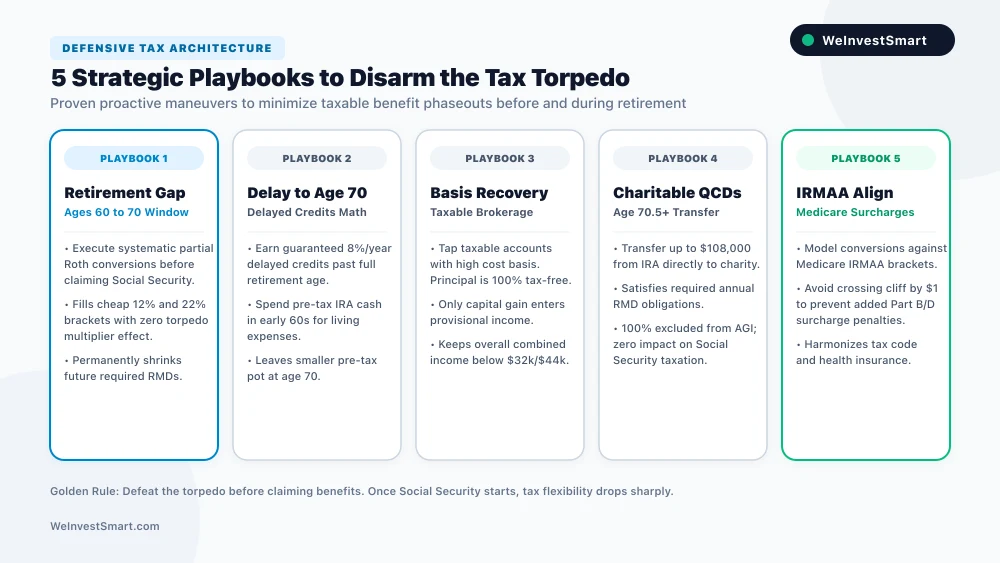
5 Strategic Playbooks to Disarm the Social Security Tax Torpedo
Retirees can disarm the torpedo by executing Roth conversions during the pre-70 transition window, delaying Social Security to age 70, recovering taxable basis, leveraging Qualified Charitable Distributions, and coordinating with Medicare IRMAA limits.
1. Leverage the “Retirement Transition Gap” (Ages 60 to 70)
The most potent defense against the tax torpedo is taking action before Social Security benefits begin.
Most Americans retire between ages 60 and 65, but Social Security benefits do not have to be claimed until age 70. This multi-year window represents the Retirement Transition Gap. During these years, your earned wage income drops to zero, but you have not yet claimed Social Security, and you are not yet forced to take Required Minimum Distributions (which begin at age 73 or 75 under the SECURE 2.0 Act).
During this low-income window, execute systematic partial Roth conversions. Convert pre-tax IRA dollars up to the top of the 12% or 22% federal tax bracket each calendar year. Pay the income tax today at standard, un-multiplied bracket rates.
By the time you reach age 70 and claim Social Security, your traditional IRA balance is substantially smaller. Future Required Minimum Distributions will be minimal, preventing them from pushing your provisional income into the 85% torpedo zone.
2. Delay Claiming Social Security to Age 70
Delaying Social Security past your Full Retirement Age accomplishes two objectives:
- Guaranteed Return: You earn an 8% annual delayed retirement credit for every year you wait past FRA up to age 70, establishing a larger baseline benefit for life.
- Defensive Spending Window: Delaying claims forces you to spend down traditional IRA or 401(k) balances in your early-to-mid 60s to fund living expenses.
Spending pre-tax balances before your Social Security starts depletes the very accounts that would otherwise trigger the torpedo later in life. When Social Security finally initiates at age 70, your outside taxable income is lower, preserving the tax-free status of your benefits.
3. Implement Strategic Asset Location and Basis Recovery
Distributions from non-retirement taxable brokerage accounts enjoy preferential tax treatment. When you sell shares from a taxable account, only the capital gain is recognized as income. The return of your original cost basis is completely non-taxable.
Furthermore, qualified dividends and long-term capital gains are taxed at 0% or 15% federal rates rather than ordinary income rates. Distributions from Roth IRAs are 100% tax-free and are completely excluded from the provisional income formula.
By blending withdrawals across taxable brokerage accounts, Roth accounts, and cash reserves, you can engineer an annual cash flow of $80,000 or $100,000 while keeping provisional income strictly below the $32,000 (MFJ) or $25,000 (Single) thresholds.
4. Utilize Qualified Charitable Distributions (QCDs)
For retirees who are charitably inclined and age 70½ or older, the IRS allows Qualified Charitable Distributions (QCDs). Under this rule, you can transfer up to $108,000 annually directly from a Traditional IRA to a qualifying 501(c)(3) charity.
A QCD counts toward satisfying your annual Required Minimum Distribution, but the dollar amount is entirely excluded from your Adjusted Gross Income. Because it never enters your AGI, it never touches your provisional income, protecting your Social Security benefits from the torpedo.
5. Coordinate With Medicare IRMAA Surcharges
Managing the Social Security tax torpedo requires careful alignment with other federal benefit thresholds. If you execute large Roth conversions or take substantial IRA distributions to power through the tax hump, be cautious not to cross the cliff brackets for Medicare IRMAA premium surcharges.
Crossing an IRMAA threshold by even one single dollar can trigger thousands of dollars in added Medicare Part B and Part D premiums two years later. Always model your Modified AGI against both the IRC Section 86 thresholds and the IRMAA surcharge brackets before initiating year-end withdrawals.
Frequently Asked Questions
At what income level does Social Security become 85% taxable?
For married couples filing jointly, Social Security benefits become up to 85% taxable once provisional income exceeds $44,000. For single filers, the 85% threshold begins at $34,000.
Does municipal bond interest trigger the Social Security tax torpedo?
Yes. While municipal bond interest is exempt from federal income tax, IRC Section 86(b)(1)(B) explicitly requires taxpayers to add tax-exempt interest back into provisional income when determining benefit taxability.
Can Roth IRA withdrawals trigger the Social Security tax torpedo?
No. Qualified distributions from a Roth IRA are completely excluded from Adjusted Gross Income and are not included in provisional income calculations under federal law.
Do all US states tax Social Security benefits?
No. The vast majority of US states completely exempt Social Security benefits from state income taxation, though roughly nine states continue to levy state-level taxes or apply modified income thresholds.
This article is for educational purposes only and should not be considered personalized financial advice. Consider consulting with a financial advisor for guidance specific to your situation.
For educational purposes. Consider your own circumstances before making financial decisions. Read our editorial policy.
From reading to planning
Explore the numbers for yourself.
Use our free calculators to compare scenarios and understand your options.