ACA Subsidy Cliff in Early Retirement: How to Keep MAGI Low
Learn how early retirees qualify for ACA health insurance subsidies, manage MAGI below the 400% FPL cliff, and maximize Silver CSRs to lower medical expenses.
Leaving the corporate workforce before age 65 represents the ultimate milestone for financial independence. Yet for many individuals pursuing early retirement, the single largest operational obstacle is not portfolio performance, but securing affordable healthcare.
Because Medicare eligibility begins strictly at age 65, pre-Medicare retirees ages 50 to 64 face a precarious bridge. In the private market, commercial health insurance premiums for a 62-year-old couple routinely exceed $24,000 annually due to statutory age-rating rules. Without employer-subsidized coverage, healthcare costs can easily derail an otherwise sound retirement plan.
As explored in our foundation guide on US stealth marginal tax traps, the Affordable Care Act provides vital financial relief through Premium Tax Credits. However, this system contains a severe structural hazard: the ACA subsidy cliff. Crossing statutory income thresholds by even a single dollar can cause thousands of dollars in health insurance subsidies to vanish instantly.
[!NOTE] Key Takeaways: ACA Subsidy Optimization at a Glance
- The 400% FPL Cliff: Under IRC Section 36B, exceeding 400% of the Federal Poverty Level by even $1 completely eliminates Premium Tax Credits, forcing full repayment on IRS Form 8962.
- The Healthcare Cost Shock: For a couple in their early sixties, crossing the 400% cliff can trigger an immediate $18,000 to $25,000 out-of-pocket spike in annual health insurance premiums.
- Zero Asset Testing: The Affordable Care Act evaluates annual taxable income rather than accumulated net worth, allowing multimillionaires with low taxable income to qualify legitimately.
- The Silver Plan Advantage: Managing household MAGI between 150% and 200% of poverty unlocks Cost-Sharing Reductions, shrinking deductibles from $9,000 down to under $1,000.
- MAGI Engineering: Early retirees can comfortably spend $100,000 or more annually while reporting under $45,000 in MAGI by blending taxable brokerage basis, Roth withdrawals, and HSA funds.
What Is the ACA Subsidy Cliff in Early Retirement?
The ACA subsidy cliff is a statutory threshold under IRC Section 36B where earning an extra dollar pushes an early retiree over 400% of the Federal Poverty Level, instantly disqualifying them from all Premium Tax Credits and triggering complete subsidy repayment on IRS Form 8962.
Under the Affordable Care Act, health insurance coverage purchased through state and federal marketplaces is subsidized through the Premium Tax Credit (PTC). Authorized under IRC Section 36B, this tax credit caps the percentage of household income that an eligible family must pay toward a benchmark health plan.
The benchmark plan is defined as the Second Lowest Cost Silver Plan (SLCSP) available in your geographic rating territory. The federal government pays the difference between your required percentage contribution and the actual premium of the benchmark plan.
For older workers, this subsidy is enormous. Federal law allows health insurance carriers to charge 64-year-old enrollees up to three times the rate charged to a 21-year-old for the exact same coverage. Consequently, an unsubsidized benchmark policy that costs $450 per month for a young adult can cost $1,900 to $2,300 per month for an older couple.
Under standard ACA rules, subsidies phase out gradually up to 400% of the Federal Poverty Level. However, once income crosses that 400% threshold, the subsidy does not taper to zero. It terminates abruptly. A household reporting $1 above the limit must repay 100% of their Advance Premium Tax Credits to the IRS at tax time.
Similar filing status tensions arise for younger borrowers evaluating Married Filing Separately for student loans, where separate returns shield income from federal calculations but sacrifice major deductions.
The ACA MAGI Formula: How the IRS Calculates Subsidy Eligibility
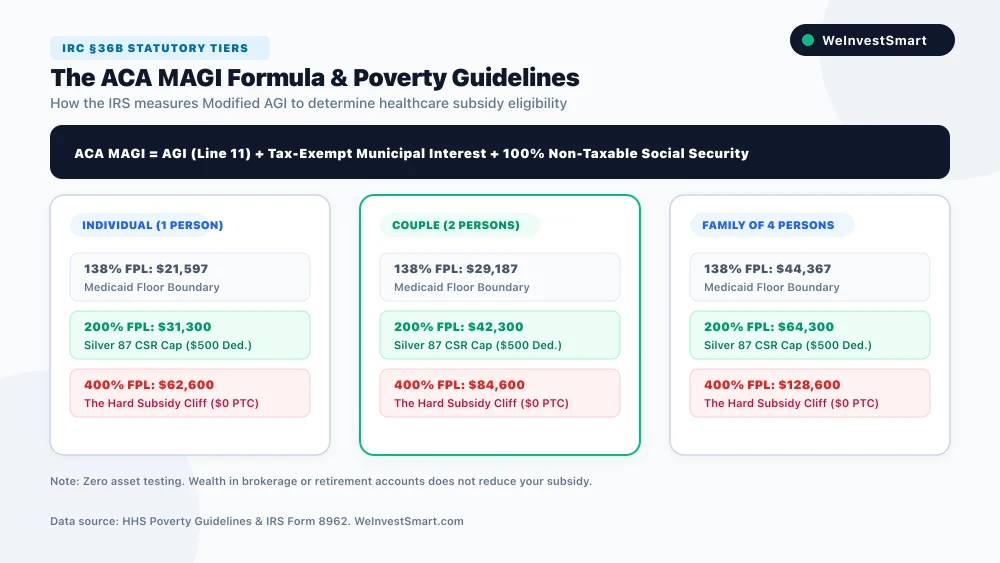
ACA Modified Adjusted Gross Income is calculated under IRC Section 36B as Form 1040 Line 11 Adjusted Gross Income plus tax-exempt municipal interest plus foreign earned income exclusions plus all non-taxable Social Security benefits.
Calculating income for ACA healthcare subsidies differs fundamentally from standard income tax calculations. Many financial planners make the mistake of using standard tax MAGI or Medicare IRMAA MAGI.
For marketplace coverage, the IRS applies a specific definition governed by IRS Form 8962 instructions:
$$\text{ACA MAGI} = \text{AGI (Form 1040 Line 11)} + \text{Tax-Exempt Interest (Line 2a)} + \text{Untaxed Foreign Income} + \text{Non-Taxable Social Security}$$
Where standard Adjusted Gross Income includes:
- W-2 wages and consulting earnings
- Net business income from Schedule C or S-Corporations
- Taxable traditional IRA and 401(k) distributions
- Realized capital gains from taxable investment accounts
- Ordinary dividends, qualified dividends, and taxable bank interest
The Non-Taxable Social Security Rule
Notice a vital statutory distinction: in standard tax calculations, Social Security benefits are only partially taxed (between 0% and 85%). However, for ACA subsidy purposes, 100% of non-taxable Social Security benefits (Form 1040 Line 6a minus Line 6b) must be added back into your MAGI.
If an early retiree claims Social Security benefits at age 62, their entire gross benefit check is counted toward ACA income limits. This rule frequently pushes early claimants over the 400% cliff without their realizing it.
Federal Poverty Level Guidelines for Subsidy Planning
The Department of Health and Human Services publishes annual HHS Poverty Guidelines. The table below outlines how household income maps to key ACA subsidy and assistance thresholds:
| Household Size | 100% FPL (Floor) | 138% FPL (Medicaid Boundary) | 200% FPL (CSR Cap) | 400% FPL (Subsidy Cliff) |
|---|---|---|---|---|
| 1 Person (Individual) | $15,650 | $21,597 | $31,300 | $62,600 |
| 2 Persons (Couple) | $21,150 | $29,187 | $42,300 | $84,600 |
| 3 Persons (Family) | $26,650 | $36,777 | $53,300 | $106,600 |
| 4 Persons (Family) | $32,150 | $44,367 | $64,300 | $128,600 |
Note: Poverty figures reflect baseline contiguous US guidelines. Figures for Alaska and Hawaii are statutorily higher.
Understanding where your income falls along this spectrum is essential. Exceeding the 400% FPL mark produces the steepest marginal tax penalty in the entire Internal Revenue Code.
The 400% Federal Poverty Level Cliff: The Ultimate Marginal Rate Spike
The ACA subsidy cliff occurs at 400% of the Federal Poverty Level, where earning an extra dollar pushes an early retiree over the threshold and forces full repayment of Advance Premium Tax Credits on IRS Form 8962.
When you enroll in an ACA exchange plan, you estimate your upcoming annual income. The marketplace uses this projection to calculate an Advance Premium Tax Credit (APTC), which is paid directly to your health insurance carrier each month to discount your premium.
When you file your federal tax return the following spring, you must complete IRS Form 8962 to reconcile your advance credits against your actual reported MAGI.
If your actual income stays below 400% FPL, any minor discrepancy between estimated and actual income is reconciled with statutory repayment caps. If you earned slightly more than expected, your repayment is capped at $700 for singles or $1,500 for married couples.
However, once your actual MAGI hits 400.01% of the Federal Poverty Level, those repayment caps completely evaporate. You must repay every single dollar of advance subsidies received during the calendar year.
$$\text{Clawback Penalty} = \text{Total Annual Advance Premium Tax Credits Received}$$
For a 30-year-old individual receiving $2,400 in annual subsidies, falling off the cliff costs $2,400. But for a 62-year-old couple receiving $22,000 in annual subsidies, earning $1 over the cliff costs $22,000.
In financial economics, this creates an effective marginal tax rate exceeding 20,000%. Earning an extra $100 in dividend income results in a $22,000 cash clawback on Line 29 of Form 8962.
Worked Case Study: Tom and Diane’s $22,400 Health Insurance Cliff
To see how easily this trap catches unwary retirees, consider Tom and Diane. Both are 62 years old and retired from corporate careers with a combined investment portfolio of $1,800,000.
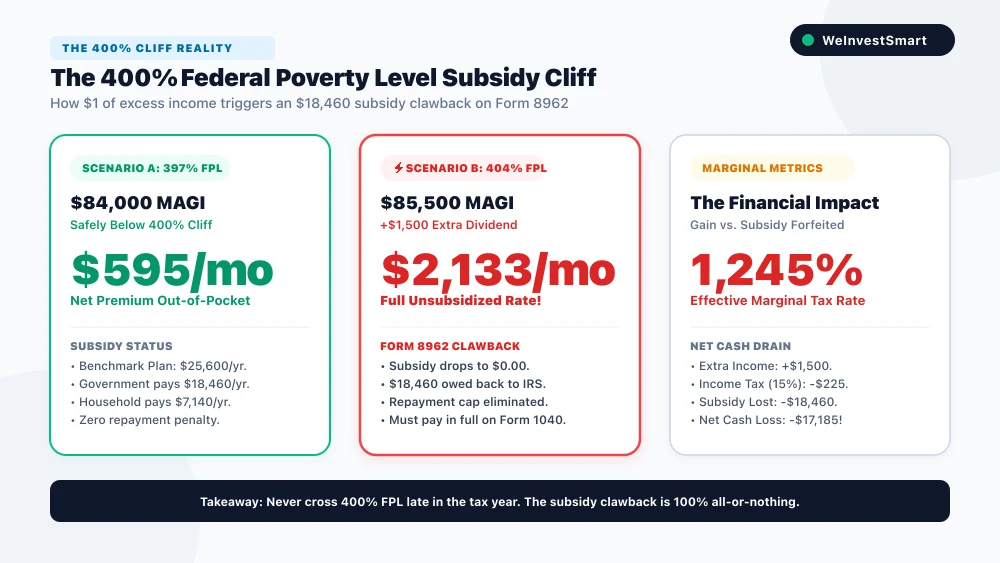
They reside in Ohio and enroll in an ACA marketplace plan. For a couple their age, the benchmark Second Lowest Cost Silver Plan carries an annual unsubsidized premium of $25,600 ($2,133 per month).
The 400% Federal Poverty Level threshold for a two-person household is $84,600.
Scenario A: Disciplined Income Planning ($84,000 MAGI)
Tom and Diane intentionally manage their retirement withdrawals to generate $84,000 in ACA MAGI.
- Federal Poverty Percentage: $84,000 / $21,150 = 397% FPL (safely under the 400% cliff).
- Required Household Contribution: Under ACA statutory formula tables, a household at 397% FPL is required to contribute approximately 8.5% of their income toward coverage, or $7,140 annually ($595 per month).
- Federal Premium Tax Credit:
- Benchmark SLCSP Premium: $25,600
- Minus Required Contribution: $7,140
- Annual Subsidy Paid by IRS: $18,460 ($1,538 per month)
- Tom and Diane’s Net Healthcare Cost: $7,140 per year.
Scenario B: The Unplanned Year-End Dividend ($85,000 MAGI)
In late December, a mutual fund held in Tom and Diane’s taxable account distributes an unexpected $1,000 capital gain distribution. Tom also sells a small stock holding, adding another $500 in gains.
Their total ACA MAGI rises from $84,000 to $85,500.
- New Federal Poverty Percentage: $85,500 / $21,150 = 404.2% FPL
- Subsidy Cliff Triggered: Because their income exceeds 400% FPL, their statutory subsidy rate drops from 8.5% to 0%.
- Reconciliation on IRS Form 8962:
- Total Advance Credits Received Throughout Year: $18,460
- Allowable Premium Tax Credit at 404.2% FPL: $0.00
- Repayment Limitation Cap: Does not apply (income over 400% FPL)
- Total Repayment Owed to IRS on Form 1040: $18,460
| Metric | Scenario A ($84,000 MAGI) | Scenario B ($85,500 MAGI) | Net Impact |
|---|---|---|---|
| Gross Incremental Income | $0.00 | +$1,500.00 | +$1,500.00 |
| Federal Income Tax on Gain (15%) | $0.00 | -$225.00 | -$225.00 |
| ACA Subsidy Clawback (Form 8962) | $0.00 | -$18,460.00 | -$18,460.00 |
| Net Financial Outcome | Baseline | -$17,185.00 Net Loss | -$17,185.00 |
By earning an additional $1,500 in investment income, Tom and Diane lost $17,185 in net household cash. Their effective marginal tax rate on that $1,500 was 1,245%.
You can model your household poverty percentages and calculate your exact MAGI using our free MAGI calculator to ensure you never accidentally breach statutory cliff thresholds.
The Silver Plan Sweet Spot: Unlocking Cost-Sharing Reductions
Cost-Sharing Reductions are government subsidies that artificially enhance Silver-tier ACA plans to 87% or 94% actuarial value for households earning between 100% and 200% of poverty, reducing deductibles and copays by up to 90%.
While Premium Tax Credits reduce your monthly premium, a secondary provision in the Affordable Care Act cuts your out-of-pocket medical bills: Cost-Sharing Reductions (CSR).
Under federal rules, CSR subsidies are available exclusively on Silver-tier plans. Gold and Bronze plans do not qualify. When your household MAGI falls below 250% FPL, the government mandates that your insurer enhance the plan’s actuarial value:
| Household Income Tier | Silver Plan Classification | Actuarial Value | Typical Deductible | Max Out-of-Pocket |
|---|---|---|---|---|
| 100% to 150% FPL | Silver 94 | 94% (Superior to Platinum) | $0 to $250 | $1,500 |
| 150% to 200% FPL | Silver 87 | 87% (Matches Gold) | $500 to $1,000 | $3,000 |
| 200% to 250% FPL | Silver 73 | 73% (Slight Upgrade) | $3,000 to $4,500 | $6,500 |
| Over 250% FPL | Standard Silver | 70% (Baseline) | $6,000 to $9,000 | $9,450 |
For early retirees, the Silver 87 and Silver 94 tiers represent the ultimate healthcare sweet spot. A standard Bronze plan might offer a $0 premium after subsidies, but carries a $9,000 deductible per person.
By engineering MAGI into the Silver 87 tier (roughly $32,000 to $42,000 for a couple), you receive comprehensive healthcare with near-zero deductibles and negligible copays, all while paying a discounted monthly premium.
Avoiding the Medicaid Floor Trap
While keeping MAGI low is desirable, there is a dangerous lower boundary: the Medicaid floor trap.
In the 41 states (plus Washington D.C.) that expanded Medicaid under the ACA, households with MAGI below 138% of the Federal Poverty Level ($29,187 for a couple) do not qualify for marketplace subsidies. Federal law automatically routes them into state Medicaid.
While Medicaid provides low-cost healthcare, it often restricts access to preferred physician networks, specialty clinics, and academic medical centers. Furthermore, in non-expansion states, earning below 100% FPL creates a total coverage gap where neither Medicaid nor subsidies are available.
Early retirees must carefully steer their income into the safe channel: above 138% FPL, but below 200% FPL.
MAGI Engineering: How to Spend $100,000 While Reporting $42,000 in Income
Early retirees can fund a six-figure lifestyle while maintaining low ACA MAGI by drawing return of basis from taxable brokerage accounts, withdrawing tax-free Roth contributions, utilizing HSA reimbursements, and calibrating traditional IRA distributions.
The most critical insight for early retirement planning is that spending does not equal taxable income. The Affordable Care Act does not examine how much wealth sits in your bank accounts, brokerage portfolios, or real estate holdings. Eligibility is determined exclusively by what appears on Form 1040.
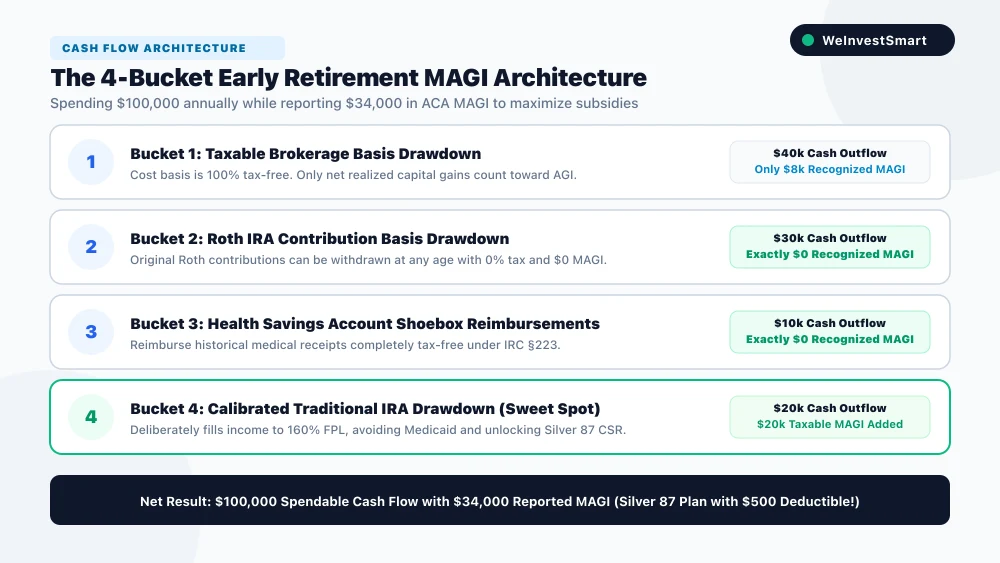
By structuring four distinct capital buckets, an early retiree can live comfortably on $100,000 of annual cash flow while legally reporting an ACA MAGI of $42,000:
Bucket 1: Taxable Brokerage Basis Recovery ($40,000 Cash, $8,000 MAGI)
When selling shares from a taxable brokerage account, you only pay taxes on the capital gain. The return of your original cost basis is 100% tax-free and completely excluded from AGI.
If you liquidate $40,000 worth of broad-market index fund shares with an original cost basis of $32,000, your realized gain is only $8,000. That $8,000 is all that registers toward your ACA MAGI.
Bucket 2: Roth IRA Basis Withdrawals ($30,000 Cash, $0 MAGI)
Under IRS ordering rules for Roth IRAs, original contributions can be withdrawn at any age, at any time, with zero taxes and zero penalties. Furthermore, qualified distributions from a Roth IRA are completely excluded from Gross Income under IRC Section 408A.
Taking $30,000 from a Roth IRA adds exactly $0.00 to your ACA MAGI.
Bucket 3: Health Savings Account Reimbursements ($10,000 Cash, $0 MAGI)
If you accumulated a Health Savings Account during your career and saved past medical receipts using the shoebox strategy, you can withdraw funds tax-free for reimbursement at any time.
Qualified medical reimbursements from an HSA are 100% tax-exempt and never appear on Form 1040 Line 11. Taking $10,000 from an HSA adds $0.00 to your ACA MAGI.
Bucket 4: Calibrated Traditional IRA Distributions ($20,000 Cash, $20,000 MAGI)
To avoid the Medicaid floor trap and land precisely in the Silver 87 CSR sweet spot, take a deliberate distribution from your traditional IRA or 401(k).
A $20,000 withdrawal from a traditional IRA generates $20,000 of taxable ordinary income. Combined with your $8,000 in brokerage capital gains and $6,000 in portfolio dividends, your total reported ACA MAGI is $34,000.
| Capital Bucket Source | Annual Cash Outflow | Recognized ACA MAGI | Tax Mechanism |
|---|---|---|---|
| Bucket 1: Taxable Brokerage Basis | $40,000 | $8,000 | Only net realized capital gains count toward AGI |
| Bucket 2: Roth IRA Basis Drawdown | $30,000 | $0 | Return of original contributions is 100% tax-free |
| Bucket 3: HSA Qualified Reimbursements | $10,000 | $0 | Tax-exempt medical reimbursement under IRC §223 |
| Bucket 4: Calibrated Traditional IRA | $20,000 | $20,000 | Ordinary income fills baseline CSR poverty band |
| Portfolio Dividends & Interest | $0 | $6,000 | Baseline passive yield from taxable accounts |
| Total Annual Metric | $100,000 Spendable Cash | $34,000 Reported MAGI | 160% FPL (Silver 87 CSR Sweet Spot!) |
This four-bucket blueprint delivers $100,000 in net lifestyle spending while locking in maximum healthcare subsidies and a $500 deductible Silver plan.
Cross-Tax Coordination: ACA Subsidies, Roth Conversions, and RMDs
Managing health insurance subsidies cannot occur in isolation. Every dollar converted from a traditional IRA to a Roth IRA adds a dollar to your ACA MAGI.
While executing aggressive Roth conversions in your early sixties is a proven tactic to avoid the Social Security tax torpedo and prevent future Medicare IRMAA surcharges, doing so during your ACA years will destroy your health insurance subsidies.
Consider the math: converting an extra $40,000 from a traditional IRA to a Roth IRA might generate $8,800 in federal income tax at the 22% bracket. But if that conversion also causes your household to cross the 400% FPL cliff, it will trigger an additional $18,000 in lost ACA subsidies. The true cost to convert that $40,000 is not $8,800, but $26,800 (a 67% effective tax hit).
The optimal sequence for early retirees is clear:
- Ages 55 to 64 (The ACA Years): Pause or moderate aggressive Roth conversions. Prioritize MAGI engineering to harvest maximum healthcare subsidies and Cost-Sharing Reductions.
- Ages 65 to 70 (The Medicare Gap Years): Once enrolled in Medicare at age 65, ACA subsidy rules no longer apply. Accelerate your Roth conversions to empty pre-tax IRAs before Required Minimum Distributions begin at age 73 or 75.
Frequently Asked Questions
How do early retirees qualify for ACA health insurance subsidies?
Early retirees qualify for ACA subsidies by keeping their household Modified Adjusted Gross Income between 100% and 400% of the Federal Poverty Level. Subsidies are calculated based on household income relative to poverty guidelines rather than total accumulated net worth.
Do assets in savings or investment accounts count against ACA subsidies?
No. The Affordable Care Act does not impose an asset test or net worth limit to qualify for marketplace premium tax credits. Eligibility depends exclusively on annual taxable income and Modified AGI reported on Form 1040.
Does executing a Roth conversion affect my ACA health insurance subsidy?
Yes. The taxable portion of a traditional IRA conversion to a Roth IRA is included in full within Adjusted Gross Income on Form 1040 Line 4b, increasing your ACA MAGI and reducing your premium subsidies.
What is the Medicaid floor trap for early retirees?
In states that expanded Medicaid, reporting an ACA MAGI below 138% of the Federal Poverty Level disqualifies you from marketplace subsidies and routes you automatically into state Medicaid. Early retirees typically engineer their income to stay above 138% FPL to preserve access to broad commercial provider networks.
This article is for educational purposes only and should not be considered personalized financial advice. Consider consulting with a financial advisor for guidance specific to your situation.
For educational purposes. Consider your own circumstances before making financial decisions. Read our editorial policy.
From reading to planning
Explore the numbers for yourself.
Use our free calculators to compare scenarios and understand your options.