The 401(k) Reverse Rollover: How to Cleanse Pre-Tax IRA Balances
Complete guide to the 401(k) reverse rollover strategy. Learn how to move pre-tax IRA money into an employer 401(k) to bypass the Backdoor Roth pro-rata rule.
High-earning investors who want to execute a Backdoor Roth IRA often run headfirst into a major obstacle: an existing Traditional or Rollover IRA balance. Because the IRS aggregates all your non-Roth IRAs under the pro-rata rule, holding pre-tax IRA dollars subjects your conversion to unexpected ordinary income taxes.
The most effective tool for overcoming this hurdle is an upstream transfer known as a 401(k) reverse rollover. By transferring your pre-tax IRA balances into an active employer-sponsored retirement plan, you can reduce your individual non-Roth IRA balance to zero.
This maneuver completely neutralizes the pro-rata rule. It forms a central component of advanced Roth conversion strategies by allowing high-income households to isolate after-tax basis and complete 100% tax-free backdoor conversions year after year.
Key Takeaways
- A 401(k) reverse rollover moves pre-tax dollars from Traditional, Rollover, SEP, or SIMPLE IRAs into an active employer-sponsored plan.
- Qualified employer retirement plans like 401(k)s and 403(b)s are legally excluded from the IRA aggregation rule under Internal Revenue Code Section 408(d)(2).
- Under Internal Revenue Code Section 408(d)(3)(A)(ii), you can only roll pre-tax funds into a qualified plan, preventing after-tax basis from entering the 401(k).
- This restriction allows you to cream-skim pre-tax dollars away from after-tax basis, leaving behind pure basis that converts to a Roth IRA tax-free.
- All reverse rollover transfers must settle into your employer plan before midnight on December 31 of the tax year in which you execute your Roth conversion.
What Is a 401(k) Reverse Rollover and How Does It Work?
A 401(k) reverse rollover is the process of transferring pre-tax funds from a traditional IRA, rollover IRA, SEP-IRA, or SIMPLE IRA into an active employer-sponsored 401(k) plan, reducing your non-Roth IRA balance to zero and unlocking tax-free backdoor Roth conversions.
In standard financial planning, rollovers typically flow in one direction: from an old employer 401(k) into a personal Rollover IRA. A reverse rollover reverses that pipeline. You take funds out of an individual retirement account and deposit them into your current employer’s qualified plan.
The motivation for this reverse transfer lies in how the tax code treats different retirement vehicles. Under Internal Revenue Code Section 408(d)(2), the IRS enforces the aggregation rule. When calculating the taxable portion of a Roth conversion, the agency aggregates every Traditional, SEP, and SIMPLE IRA you own as outlined in our breakdown of the Backdoor Roth pro-rata rule.
However, qualified employer plans governed by ERISA are completely exempt from Section 408(d)(2) aggregation. The IRS does not count dollars held inside a 401(k), 403(b), or governmental 457(b) plan when determining your IRA conversion ratio.
| Evaluation Metric | Standard Rollover (401k to IRA) | Reverse Rollover (IRA to 401k) | Strategic Advantage of Reverse Rollover |
|---|---|---|---|
| Direction of Funds | Employer plan to individual IRA | Individual IRA to active employer 401(k) | Clears personal IRA balance |
| Pro-Rata Impact | Contaminates future backdoor conversions | Eliminates pro-rata tax exposure completely | Unlocks 100% tax-free Roth conversions |
| Asset Protection | State-level statutory protections | Federal unlimited ERISA creditor protection | Superior protection against legal judgments |
| Loan Access | Loans strictly prohibited by IRS | Many plans allow loans up to $50,000 | Provides emergency liquidity option |
| Investment Choices | Unlimited brokerage universe | Restricted to employer plan fund menu | Slight tradeoff in exchange for massive tax savings |
By moving pre-tax assets into your company plan, you legally shelter those funds from the IRS aggregation formula. When you report your year-end balance on Form 8606 Line 6, your non-Roth IRA balance registers as zero.
The Statutory Basis Isolation Rule: Understanding IRC §408(d)(3)(A)(ii)
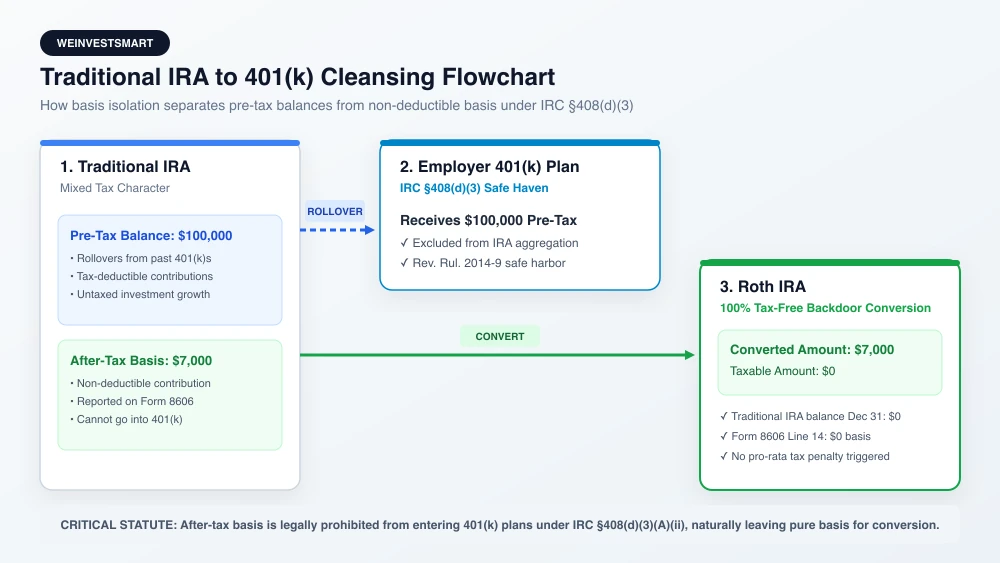
Under Internal Revenue Code Section 408(d)(3)(A)(ii), only pre-tax dollars that would otherwise be taxable upon distribution can be transferred into a qualified employer plan. After-tax nondeductible basis is legally excluded, leaving it isolated in the IRA for tax-free conversion.
Many investors hold traditional IRAs containing a blended mix of deductible pre-tax contributions, compound growth, and nondeductible after-tax contributions. When attempting to separate these funds, taxpayers often assume the pro-rata rule prevents them from splitting the accounts.
Here is where statutory tax law creates an exceptional opportunity. Under IRC Section 408(d)(3), Congress enacted a specific restriction governing rollovers from an individual retirement account into an eligible employer plan:
The transfer rules mandate that only the portion of an IRA distribution that would be includible in gross income can be rolled over into a qualified employer retirement plan.
Because after-tax contributions (your basis) are not includible in gross income when distributed, the law explicitly prohibits you from rolling after-tax dollars into your 401(k). This rule works strongly in your favor through a mechanism known as basis isolation:
- Step 1: Calculate Exact Balances. You determine your total IRA value and identify your cumulative after-tax basis documented on Form 8606.
- Step 2: Roll Pre-Tax Dollars to 401(k). You request a direct rollover of only the pre-tax earnings and contributions into your company plan.
- Step 3: Isolate Basis. Because after-tax dollars cannot legally enter the 401(k), exactly 100% of your nondeductible basis remains behind in the Traditional IRA.
- Step 4: Convert Basis to Roth. You convert the remaining after-tax balance into your Roth IRA. Because the Traditional IRA now holds only basis, the conversion generates zero taxable income.
This statutory cream-skimming rule allows you to cleanly rescue stranded after-tax basis that would otherwise be trapped by the pro-rata calculation. Note that inherited accounts cannot be moved under this statute, as they are governed by dedicated withdrawal rules detailed in our Inherited IRA 10-year rule guide.
Which Retirement Accounts Qualify for a Reverse Rollover?
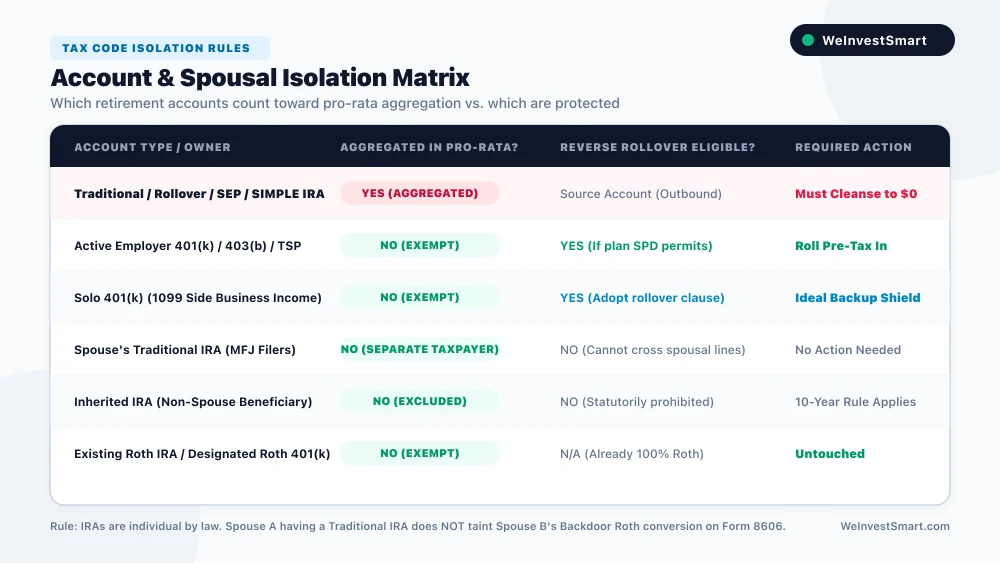
Traditional IRAs, rollover IRAs, and SEP-IRAs can be rolled into a 401(k) at any time. SIMPLE IRAs qualify only after a mandatory two-year seasoning period from the initial contribution. Inherited IRAs and Roth IRAs are strictly ineligible.
Before initiating paperwork with your plan administrator, verify whether your specific IRA account type qualifies for an upstream transfer. While the federal tax code permits rollovers across many plan types, specific statutory restrictions apply to different account categories:
| Account Type | Eligible for 401(k) Reverse Rollover? | Statutory Prerequisite | Special Planning Notes |
|---|---|---|---|
| Traditional IRA | Yes | Pre-tax portion only | Ideal candidate for basis isolation |
| Rollover IRA | Yes | Pre-tax portion only | Common destination after rolling over old 401(k)s |
| SEP-IRA | Yes | Pre-tax portion only | Must be an inactive plan or coordinated timing |
| SIMPLE IRA | Conditional | Must satisfy 2-year seasoning rule | Ineligible if opened within previous 24 months |
| Roth IRA | No (Strictly Prohibited) | N/A | Roth IRA funds can never be rolled into a 401(k) |
| Inherited IRA | No (Strictly Prohibited) | N/A | Non-spouse inherited accounts cannot be moved |
The two-year seasoning rule for SIMPLE IRAs requires careful attention. Under IRC Section 72(t)(6), any distribution or rollover from a SIMPLE IRA within the first two years of your employer’s initial contribution incurs a punitive 25% early withdrawal tax penalty.
Once exactly two years have passed from the date of the first contribution, your SIMPLE IRA can be rolled into an active 401(k) plan without tax penalty.
The 5-Step Implementation Checklist: Executing a Clean Transfer
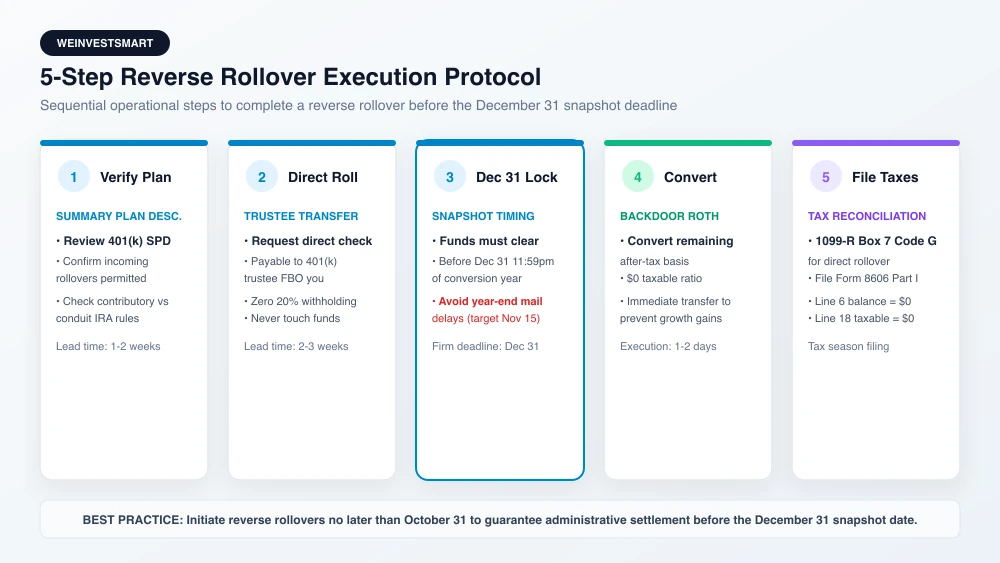
Executing a clean reverse rollover requires verifying your plan’s Summary Plan Description, requesting distribution paperwork, opting for direct trustee-to-trustee check issuance, settling balances before December 31, and recording Form 8606 accurately.
Executing a reverse rollover requires coordination between your IRA custodian, your employer’s human resources department, and the 401(k) plan recordkeeper. Follow this five-step checklist to avoid tax withholding errors:
Step 1: Verify Your 401(k) Summary Plan Description
While federal law permits 401(k) plans to accept rollover contributions, the tax code does not require employers to offer this feature. Request a copy of your plan’s Summary Plan Description (SPD) or contact the benefits department to confirm that your plan accepts incoming rollovers from Traditional and Rollover IRAs.
Under IRS Revenue Ruling 2014-9, the IRS established safe harbor verification procedures making it simple for plan administrators to accept incoming rollovers without fearing plan disqualification.
Step 2: Calculate Exact Pre-Tax Balances
Review your most recent Form 8606 to verify your cumulative after-tax basis. Subtract that basis from the total fair market value of your Traditional IRA on the transfer date. The resulting difference represents the exact pre-tax dollar amount eligible for transfer to your 401(k).
Step 3: Request a Direct Trustee-to-Trustee Transfer
Always select a direct institutional rollover rather than an indirect 60-day distribution. Request that your IRA custodian issue a check made payable directly to the 401(k) plan trustee for your benefit.
The check memo line should read: [401(k) Recordkeeper Name] FBO [Your Name], Account #[Your 401(k) Number]. This wording ensures that zero taxes are withheld from the transfer and that the check cannot be cashed into personal accounts.
Step 4: Ensure Settlement Before December 31
Timing is everything in retirement planning. The rollover check must be received, processed, and fully settled inside your 401(k) account before midnight on December 31 of the calendar year in which you convert basis to a Roth IRA.
Initiate the rollover process by November 15 at the latest to account for administrative processing times during the holidays.
Step 5: Document Basis Clearance on Form 8606
When filing your tax return, report your zero year-end IRA balance on IRS Form 8606 Line 6. This confirms to the IRS that your remaining conversion consists entirely of after-tax basis, producing zero taxable income on Line 18.
Concrete Case Study: Jason Cleanses a $110,000 Mixed IRA
A detailed dollar breakdown showing how Jason rolls $102,500 of pre-tax funds into his company 401(k), isolates his $7,500 after-tax basis, and converts it to a Roth IRA, saving $2,562.50 in surprise taxes compared to an unshielded conversion.
To understand the mathematical power of a reverse rollover, examine the financial profile of Jason, a senior product manager earning $210,000 annually.
Jason’s Financial Dilemma
Jason has an existing Traditional IRA with a total balance of $110,000. This account contains:
- $102,500 in deductible pre-tax contributions and accumulated market growth.
- $7,500 in nondeductible after-tax contributions made earlier this year.
- Federal marginal tax bracket: 32%.
If Jason converts his $7,500 after-tax contribution without cleansing the account, the pro-rata rule treats 93.18% of his conversion ($6,988.50) as taxable ordinary income. At his 32% marginal bracket, that mistake costs him $2,236.32 in immediate federal taxes.
The Reverse Rollover Solution
Instead, Jason executes a 401(k) reverse rollover in October:
- Jason contacts his IRA custodian and requests a direct trustee-to-trustee rollover of exactly $102,500 into his corporate 401(k).
- The $102,500 pre-tax balance settles into his 401(k) on November 5.
- Jason’s Traditional IRA now holds exactly $7,500, which consists of 100% nondeductible after-tax basis.
- On November 12, Jason converts the remaining $7,500 into his Roth IRA.
- On December 31, Jason’s total non-Roth IRA balance equals $0.00.
| Form 8606 Line Comparison | Without Reverse Rollover | With 401(k) Reverse Rollover | Net Tax Benefit |
|---|---|---|---|
| Line 5 (Net After-Tax Basis) | $7,500 | $7,500 | Basis preserved |
| Line 6 (Dec 31 Non-Roth IRA Balance) | $102,500 | $0.00 | Pre-tax assets sheltered in 401(k) |
| Line 8 (Amount Converted to Roth) | $7,500 | $7,500 | Full contribution converted |
| Line 9 (Total Aggregated Value) | $110,000 | $7,500 | Aggregation pot eliminated |
| Line 10 (Nontaxable Percentage) | 6.82% | 100.0% | Full tax-free classification |
| Line 11 (Nontaxable Portion) | $511.50 | $7,500.00 | 100% basis converted |
| Line 18 (Taxable Ordinary Income) | $6,988.50 | $0.00 | $6,988.50 removed from taxable income |
| Immediate Federal Tax Due (32%) | $2,236.32 | $0.00 | $2,236.32 Cash Tax Savings |
By using the reverse rollover strategy, Jason moves his entire $7,500 contribution into a permanent tax-free Roth IRA with zero tax liability.
To project how long-term compound growth accumulates when pre-tax funds compound inside your company plan while Roth balances grow tax-free, evaluate your retirement trajectory with our 401(k) Retirement Calculator.
What to Do If Your Employer 401(k) Plan Rejects Rollovers
If an employer 401(k) does not accept incoming IRA rollovers, you can establish an individual Solo 401(k) using side-business 1099 earnings, coordinate conversions across spousal accounts, or execute strategic partial conversions during low-tax transition years.
Not every corporate 401(k) plan permits incoming rollovers from individual retirement accounts. If your employer’s plan document prohibits incoming transfers, you have several alternative pathways to clear your pre-tax IRA balance:
Pathway 1: The Solo 401(k) for 1099 Side Income
If you earn any self-employment or 1099 independent contractor income (from consulting, freelance design, board fees, or a small business), you are legally eligible to establish an individual Solo 401(k) plan.
Because a Solo 401(k) is an employer-sponsored qualified retirement plan under ERISA, it is fully exempt from Section 408(d)(2) aggregation. When drafting your Solo 401(k) plan adoption agreement with providers like Fidelity, Schwab, or specialized plan administrators, you simply elect to accept incoming IRA rollovers.
You roll your pre-tax Traditional and SEP-IRA balances directly into your Solo 401(k). This reduces your personal non-Roth IRA balance to zero, unlocking clean backdoor conversions as explained in our comparison of SEP-IRA vs Solo 401(k) retirement structures.
Pathway 2: Spousal Account Separation
If one spouse has a clean zero-balance IRA profile while the other spouse holds large pre-tax rollover balances, prioritize backdoor Roth contributions for the clean spouse.
Because IRS aggregation rules apply to individuals rather than tax-filing units, the spouse with zero pre-tax IRA assets can execute annual backdoor conversions completely free of pro-rata taxation, regardless of the other partner’s holdings.
Pathway 3: Full Conversion During Career Transition Years
If your pre-tax IRA balance is small (under $15,000 to $25,000), or if you experience a temporary drop in taxable income due to a sabbatical, career pivot, or startup phase, consider executing a full taxable conversion.
By converting the entire pre-tax balance into a Roth IRA during a low-income year, you absorb the tax hit at a lower marginal rate while permanently cleansing your IRA balance for all future tax years.
Frequently Asked Questions
What is a 401(k) reverse rollover?
A reverse rollover is the process of moving pre-tax assets from a traditional, rollover, SEP, or SIMPLE IRA into an active employer-sponsored 401(k) plan.
Can you roll an IRA into an active 401(k)?
Yes, provided your employer’s 401(k) plan document explicitly permits incoming rollover contributions from individual retirement arrangements.
How does a reverse rollover eliminate the Backdoor Roth pro-rata rule?
Because 401(k) plans are exempt from IRA aggregation under IRC Section 408(d)(2), moving all pre-tax IRA funds into a 401(k) leaves your non-Roth IRA balance at zero on December 31, making backdoor conversions 100% tax-free.
Can you roll after-tax IRA money into a 401(k)?
No. Under IRC Section 408(d)(3)(A)(ii), the tax code prohibits rolling after-tax IRA basis into a qualified employer plan, ensuring that only pre-tax funds transfer.
What is the deadline to complete a reverse rollover?
The reverse rollover must be fully completed and settled into your employer 401(k) plan before midnight on December 31 of the calendar year in which you execute a Roth conversion.
Does a reverse rollover impact Medicare IRMAA surcharges?
No, a direct trustee-to-trustee reverse rollover of pre-tax IRA funds into a 401(k) is a non-taxable event that does not increase Adjusted Gross Income. Consequently, it has zero impact on Medicare IRMAA surcharges or healthcare premium calculations.
This article is for educational purposes only and should not be considered personalized financial advice. Consider consulting with a financial advisor for guidance specific to your situation.
For educational purposes. Consider your own circumstances before making financial decisions. Read our editorial policy.
From reading to planning
Explore the numbers for yourself.
Use our free calculators to compare scenarios and understand your options.