The Backdoor Roth Pro-Rata Rule Trap: IRS Form 8606 Explained
Comprehensive guide to the Backdoor Roth pro-rata rule. Learn how IRC Section 408(d)(2) calculates taxes, how to file Form 8606, and how to avoid the trap.
High-income households often view the Backdoor Roth IRA as an effortless way to bypass statutory income caps. You contribute nondeductible post-tax dollars to a Traditional IRA and convert them to a Roth IRA, expecting zero tax liability.
However, many investors fall into a costly tax ambush known as the pro-rata rule. If you hold existing pre-tax money in any Traditional, Rollover, SEP, or SIMPLE IRA, the IRS will not permit you to convert only your after-tax contribution.
Instead, the tax code blends all your pre-tax and after-tax balances together, triggering surprise ordinary income taxes on the majority of your conversion. Understanding this mechanism is a core component of advanced Roth conversion strategies designed to protect high earners from unnecessary tax friction.
Key Takeaways
- The IRS pro-rata rule under Internal Revenue Code Section 408(d)(2) treats all your non-Roth IRAs as a single collective account on December 31 of the conversion year.
- You cannot cherry-pick after-tax dollars for a Roth conversion; taxes are levied proportionally across your entire aggregated IRA balance.
- IRS Form 8606 is mandatory whenever you make nondeductible IRA contributions or execute a Roth conversion, calculating your nontaxable percentage on Line 10.
- Employer-sponsored 401(k), 403(b), and governmental 457(b) plans are legally excluded from the pro-rata calculation, providing a safe harbor for pre-tax wealth.
- Rolling pre-tax IRA assets into an active 401(k) before December 31 reduces your aggregate non-Roth IRA balance to zero, unlocking completely tax-free conversions.
What Is the Backdoor Roth Pro-Rata Rule?
The Backdoor Roth pro-rata rule is an IRS tax regulation under Internal Revenue Code Section 408(d)(2) requiring that all distributions and conversions from non-Roth IRAs contain a proportional blend of pre-tax dollars and after-tax basis, preventing investors from converting only nondeductible contributions tax-free.
When your modified adjusted gross income exceeds statutory limits ($168,000 for single filers or $252,000 for married couples filing jointly), you cannot make direct contributions to a Roth IRA. To build tax-free wealth, high earners deposit post-tax funds into a Traditional IRA and immediately convert that money to a Roth account, or save even larger sums through a Mega Backdoor Roth inside their employer 401(k).
Under IRC Section 408(d), Congress created the aggregation rule to prevent taxpayers from segmenting after-tax dollars into separate accounts to avoid taxes. The law treats all non-Roth individual retirement accounts owned by a single taxpayer as one unified account.
When you execute a conversion, the IRS looks at the ratio of after-tax basis to total pre-tax dollars across every IRA you own. The tax-free percentage is calculated using the following statutory formula:
$$\text{Tax-Free Ratio} = \frac{\text{Total After-Tax Basis}}{\text{Total Year-End Non-Roth IRA Balance} + \text{Conversion Amount}}$$
If 90% of your total IRA assets consist of pre-tax money, exactly 90% of your conversion is taxed as ordinary income. The remaining 10% transfers tax-free as a return of your after-tax basis.
Which Accounts Trigger IRS Pro-Rata Aggregation?
The IRS aggregates all traditional IRAs, rollover IRAs, SEP-IRAs, and SIMPLE IRAs owned by an individual. It explicitly excludes employer 401(k) plans, 403(b) plans, governmental 457(b) plans, inherited IRAs, and existing Roth IRAs.
Preventing pro-rata penalties requires knowing exactly which retirement containers the IRS includes in the aggregation pool. Many investors mistakenly assume that keeping funds in separate financial institutions isolates their accounts.
In reality, the IRS tracks accounts by Social Security number, not by brokerage account number or custodian name. Moving money between Vanguard, Fidelity, or Schwab provides zero shelter from the aggregation formula.
The table below outlines which accounts are included in the Section 408(d)(2) aggregation pot versus those protected by statutory safe harbors:
| Retirement Account Type | Subject to Pro-Rata Aggregation? | Governing IRS Classification | Impact on Backdoor Roth Conversion |
|---|---|---|---|
| Traditional IRA | Yes | IRC §408(a) | Full balance included in year-end valuation |
| Rollover IRA | Yes | IRC §408(d)(3) | Major trap; common repository for old 401(k)s |
| Traditional SEP-IRA | Yes | IRC §408(k) | Counts even if established for side business |
| Traditional SIMPLE IRA | Yes | IRC §408(p) | Counts toward total aggregate balance |
| Active Employer 401(k) / 403(b) | No (Exempt) | IRC §401(a) / §403(b) | Excluded; safe harbor for pre-tax balances |
| Governmental 457(b) | No (Exempt) | IRC §457(e) | Excluded from individual IRA aggregation |
| Inherited Traditional IRA | No (Exempt) | IRC §402(c)(11) | Segregated under original decedent rules |
| Roth IRA / Roth 401(k) | No (Exempt) | IRC §408A | Already after-tax; never counted in aggregation |
Many workers inadvertently trigger the pro-rata rule when switching employers by following standard instructions for rolling over old 401(k)s into a Rollover IRA. Once pre-tax funds land in a personal IRA, they contaminate all future backdoor conversion attempts.
The pro-rata calculation also enforces strict spousal separation. The IRS treats each spouse as an independent taxpayer for retirement account aggregation. If your spouse holds a $200,000 Rollover IRA, their balance does not taint your personal backdoor conversion, provided your individual non-Roth IRA accounts remain at zero.
IRS Form 8606: The Line-by-Line Calculation Breakdown
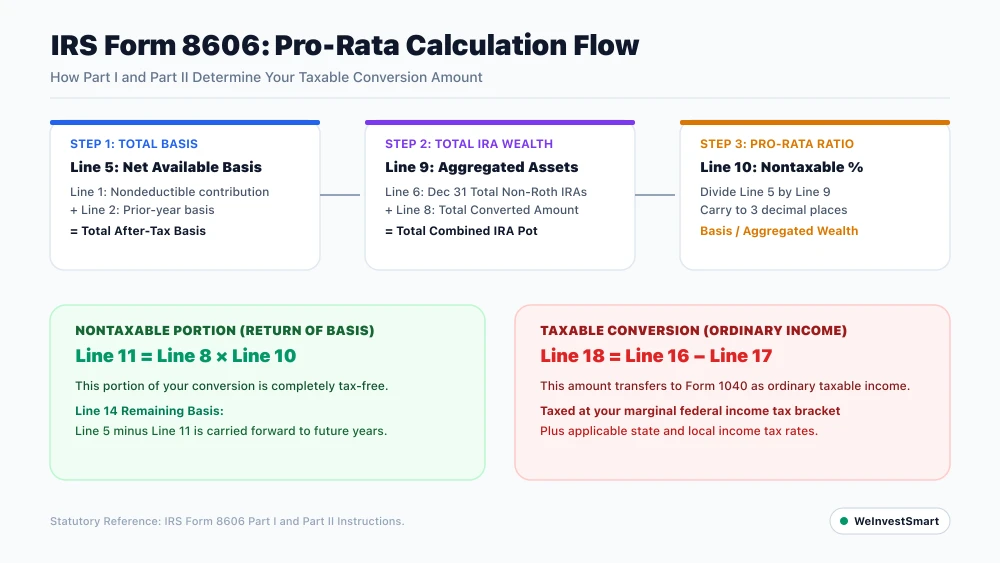
IRS Form 8606 calculates the taxable portion of a Roth conversion across lines 1 through 18. Line 5 establishes your net basis, Line 9 aggregates your total IRA wealth, Line 10 determines your nontaxable percentage, and Line 18 reports the final taxable ordinary income.
Whenever you contribute nondeductible money to a Traditional IRA or execute a conversion, you must file IRS Form 8606 with your Form 1040 tax return. This form serves as your official accounting ledger, tracking your post-tax basis across multiple tax years.
Form 8606 divides the backdoor conversion process into two primary parts:
Part I: Nondeductible Contributions and Basis Tracking
Part I documents your basis and calculates the proportional distribution:
- Line 1: Enter your nondeductible contributions made for the current tax year (for example, $7,500).
- Line 2: Enter your total basis from prior years (carried over from Line 14 of your previous Form 8606).
- Line 3: Add Line 1 and Line 2 to establish your total basis.
- Line 4: Enter any contributions made between January 1 and April 15 of the following year that apply to the current year.
- Line 5: Subtract Line 4 from Line 3 to determine your net basis available for conversion.
- Line 6: Enter the total value of all your Traditional, SEP, and SIMPLE IRAs as of December 31 of the tax year. Note that inherited IRAs are legally excluded from Line 6 under statutory separate-accounting rules, allowing you to manage an Inherited IRA 10-year rule strategy without tainting your backdoor conversion.
- Line 8: Enter the total net amount converted from your Traditional IRAs to Roth IRAs during the year.
- Line 9: Add Line 6, Line 7, and Line 8 to calculate total aggregate IRA wealth.
- Line 10: Divide Line 5 by Line 9. This produces your nontaxable decimal percentage (rounded to three decimal places).
- Line 11: Multiply Line 8 by Line 10. This calculates the nontaxable portion of your conversion.
- Line 14: Subtract Line 11 from Line 5. This records your remaining basis carried forward to future tax years.
Part II: Conversions to Roth IRAs
Part II establishes the final taxable amount that transfers to Form 1040:
- Line 16: Enter the net amount converted from Traditional, SEP, and SIMPLE IRAs to Roth IRAs (matches Line 8).
- Line 17: Enter the nontaxable portion calculated on Line 11.
- Line 18: Subtract Line 17 from Line 16. This is your taxable conversion amount, which must be added to your taxable income on Form 1040.
[!CAUTION] Failing to file Form 8606 triggers a statutory $50 penalty under Internal Revenue Code Section 6693. More importantly, if you fail to record your after-tax basis on Form 8606, the IRS will assume your entire conversion consists of pre-tax dollars, subjecting your already-taxed contributions to double taxation.
The December 31 Calendar Snapshot Rule
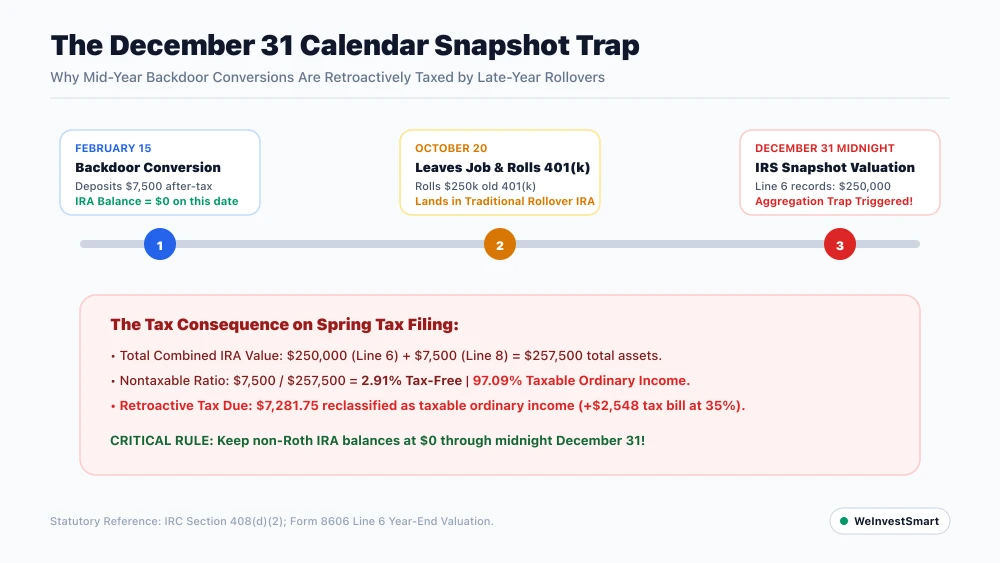
The IRS determines your pro-rata tax ratio based on your aggregate non-Roth IRA balance at midnight on December 31 of the tax year in which the conversion occurs, regardless of when during the year the contribution and conversion took place.
The December 31 snapshot rule is the most deceptive trap in retirement tax planning. Many investors assume that if their Traditional IRA balance equals zero on the exact day they execute their backdoor conversion, the transaction is permanently tax-free.
This assumption is incorrect. The IRS does not inspect account balances on the conversion date. Line 6 of Form 8606 explicitly asks for the fair market value of all non-Roth IRAs as of December 31 of the calendar year in which the conversion occurred.
Consider a common scenario: An executive executes a clean backdoor conversion in February when her Traditional IRA balance is zero. In October, she leaves her corporate employer and rolls her $250,000 company 401(k) into a personal Rollover IRA.
| Transaction Date | Account Action Taken | Traditional IRA Balance on Date | Tax State at Action |
|---|---|---|---|
| February 15 | Deposits $7,500 after-tax; converts $7,500 to Roth | $0.00 | Appears 100% Tax-Free |
| October 20 | Rolls $250,000 old 401(k) into Rollover IRA | $250,000.00 | Pre-Tax Rollover Settled |
| December 31 | IRS Year-End Snapshot Valuation | $250,000.00 | Triggers 97% Taxable Reclassification! |
When she files her taxes the following spring, Form 8606 aggregates that $250,000 rollover balance with her $7,500 conversion. Her total IRA wealth on Line 9 equals $257,500.
Her after-tax basis represents less than 3% of her total assets ($7,500 divided by $257,500). Nearly 97% of her February conversion is retroactively reclassified as taxable income, generating an unexpected tax liability of over $2,500.
Concrete Case Study: Elena’s $150,000 Rollover IRA Trap
A detailed dollar breakdown demonstrating how a high-earning professional with a $142,500 pre-tax rollover IRA who contributes $7,500 after-tax triggers $7,125 in unexpected taxable income and a $2,493 tax bill under the pro-rata formula.
To understand the real dollar impact of the pro-rata rule, examine the financial profile of Elena, a corporate director earning $230,000 annually.
Elena’s Financial Baseline
- Existing Pre-Tax Rollover IRA: $142,500 from a previous employer 401(k).
- Annual Backdoor Contribution: $7,500 in after-tax cash deposited into a new Traditional IRA.
- Conversion Amount: Elena immediately converts the entire $7,500 to her Roth IRA.
- Marginal Tax Bracket: 35% federal income tax bracket.
- Elena’s Expectation: $0 in taxable income, believing she converted only her after-tax basis.
The table below illustrates how Form 8606 calculates Elena’s actual tax outcome:
| Form 8606 Line Number | Line Description | Dollar Amount | Calculation Logic |
|---|---|---|---|
| Line 1 | Nondeductible contribution for current year | $7,500 | Elena’s after-tax deposit |
| Line 2 | Total basis from prior years | $0 | First year executing backdoor strategy |
| Line 3 | Total after-tax basis | $7,500 | Line 1 + Line 2 |
| Line 5 | Net basis available for conversion | $7,500 | Net available basis |
| Line 6 | Fair market value of all non-Roth IRAs on Dec 31 | $142,500 | Pre-tax rollover balance |
| Line 8 | Net amount converted to Roth IRA | $7,500 | Full conversion executed |
| Line 9 | Total aggregated IRA wealth | $150,000 | Line 6 + Line 8 ($142,500 + $7,500) |
| Line 10 | Nontaxable percentage (Line 5 / Line 9) | 0.050 (5.0%) | $7,500 / $150,000 |
| Line 11 | Nontaxable portion of conversion | $375 | $7,500 × 5.0% |
| Line 14 | Remaining after-tax basis carried forward | $7,125 | $7,500 - $375 |
| Line 18 | Taxable conversion amount (Line 8 - Line 11) | $7,125 | $7,500 - $375 |
Instead of converting $7,500 tax-free, Elena must report $7,125 as taxable ordinary income. At her 35% federal tax rate, this mistake costs her $2,493.75 in additional federal taxes.
Furthermore, Elena now has $7,125 of trapped after-tax basis stranded inside her Traditional IRA on Line 14. She must track this basis on Form 8606 every year until she liquidates the entire account, as detailed in IRS Publication 590-B.
To estimate how compound returns interact with traditional versus Roth account balances over your working career, test different contribution scenarios using our Traditional and Roth IRA Calculator.
Three Legal Strategies to Eliminate the Pro-Rata Tax Trap
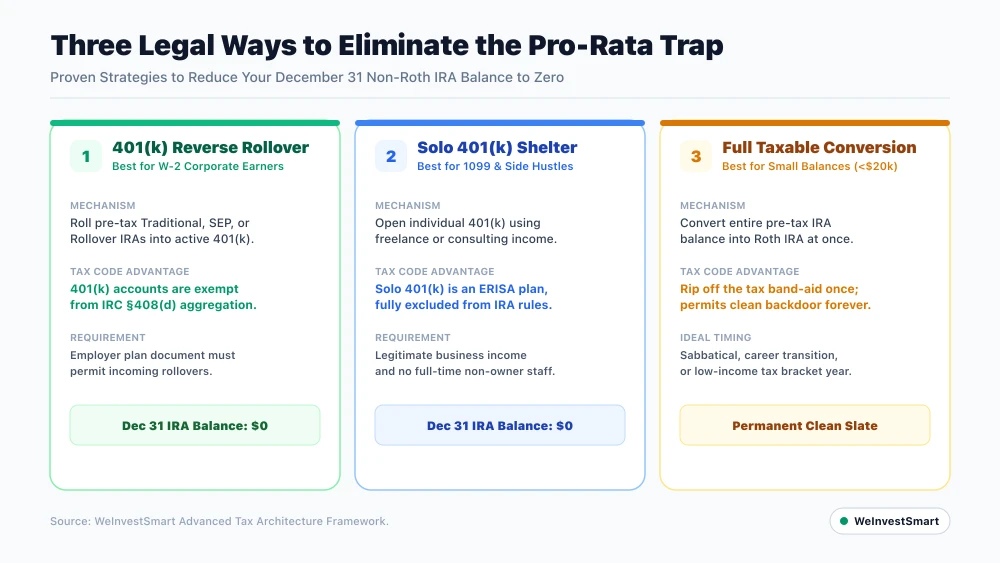
Investors can eliminate the pro-rata rule by rolling pre-tax IRA assets into an active employer 401(k), transferring balances into a Solo 401(k) using side-business income, or executing a full taxable conversion during a transitional low-income year.
Fortunately, having pre-tax IRA assets does not permanently prevent you from utilizing the backdoor Roth strategy. High earners use three proven strategies to clear their non-Roth IRA balances:
Strategy 1: The 401(k) Reverse Rollover
The most popular solution is transferring all pre-tax assets from Traditional, Rollover, SEP, and SIMPLE IRAs into your active employer 401(k) or 403(b) plan.
Because qualified employer plans are exempt from Section 408(d)(2) aggregation, moving your pre-tax IRA balances into your 401(k) reduces your individual IRA balance to zero. Learn the statutory mechanics and paperwork steps in our comprehensive 401(k) reverse rollover guide.
Ensure the reverse rollover is completed and settled before December 31. Once your Traditional IRA holds zero pre-tax dollars, future backdoor conversions are 100% tax-free while you continue maximizing standard workplace salary deferrals.
Strategy 2: The Solo 401(k) Shelter for 1099 Earners
If your employer plan does not accept incoming rollovers, or if you work as an independent contractor, you can establish an individual Solo 401(k) plan.
Solo 401(k) plans are qualified employer plans under ERISA. Any self-employed individual with 1099 consulting, freelance, or small business income can open a Solo 401(k) that allows incoming pre-tax rollovers.
You roll your pre-tax IRA balances into the Solo 401(k), leaving zero non-Roth IRA assets in your personal name on December 31. This permanently shields you from pro-rata taxation.
Strategy 3: Full Conversion in Low-Bracket Transition Years
If your pre-tax IRA balance is relatively small (under $20,000), or if you experience a transitional low-income year (such as during a career break, sabbatical, or early retirement), it may make mathematical sense to convert the entire pre-tax balance to a Roth IRA.
You pay ordinary income tax on the pre-tax portion once, but you permanently cleanse your IRA balance. In subsequent years, you can execute clean backdoor Roth contributions without ongoing tracking or reverse rollover friction, following established multi-year tax bracket management principles.
Frequently Asked Questions
What is the pro-rata rule for a Backdoor Roth IRA?
Under IRC Section 408(d)(2), the pro-rata rule requires the IRS to treat all of your non-Roth IRAs as a single account, taxing any Roth conversion proportionally based on the ratio of pre-tax to after-tax dollars.
How do you report a Backdoor Roth on IRS Form 8606?
You record your nondeductible contribution in Part I of Form 8606 and calculate the taxable conversion amount in Part II, transferring the taxable portion to your Form 1040 as ordinary income.
Does a SEP IRA or SIMPLE IRA count toward the pro-rata rule?
Yes. Traditional SEP-IRAs and SIMPLE IRAs are explicitly included in the IRS Section 408(d)(2) aggregation calculation and will trigger pro-rata taxes unless their pre-tax balances are cleared before December 31.
How can you legally avoid the pro-rata rule on a Roth conversion?
The most effective method is a reverse rollover, transferring all pre-tax traditional, SEP, and SIMPLE IRA balances into an active employer 401(k) or Solo 401(k) plan prior to December 31.
What happens if you have an IRA balance on December 31?
If you hold any pre-tax IRA balances on December 31 of the year you converted, the IRS will retroactively apply the pro-rata formula across your entire conversion, taxing a proportional share at ordinary income rates.
This article is for educational purposes only and should not be considered personalized financial advice. Consider consulting with a financial advisor for guidance specific to your situation.
For educational purposes. Consider your own circumstances before making financial decisions. Read our editorial policy.
From reading to planning
Explore the numbers for yourself.
Use our free calculators to compare scenarios and understand your options.