US Stealth Marginal Tax Traps: Avoiding Benefit Cliffs
Stealth tax traps can push your real marginal rate to 40% to 60%. See how the Social Security tax torpedo, IRMAA, and the 3.8% NIIT stack up and how to plan.
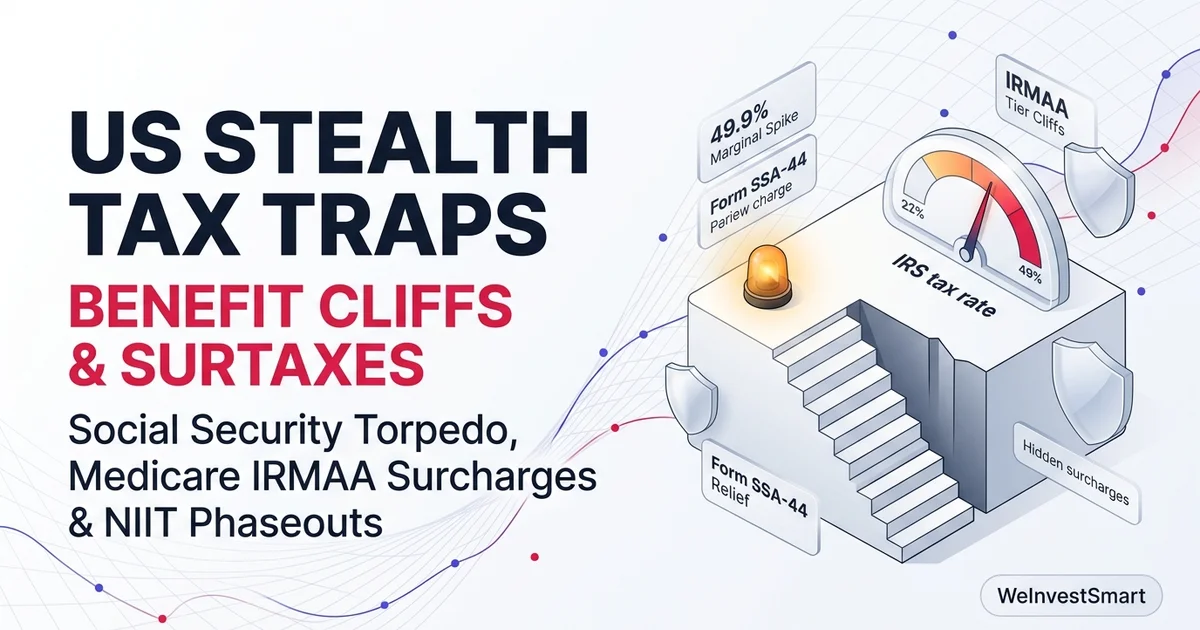
Most American taxpayers assume their tax liability follows the orderly brackets published each autumn by the Internal Revenue Service. If your taxable income sits in the 22% or 24% bracket, you logically assume that making an additional $1,000 will cost you $220 or $240 in federal taxes. In reality, the US statutory code is interwoven with income phaseouts, credit clawbacks, benefit phase-ins, and mandatory surcharges.
These hidden mechanisms create stealth marginal tax traps where your true marginal tax rate can surge past 40%, 50%, or even 100%. When an extra dollar of income simultaneously triggers a base tax, reduces a tax credit, and exposes previously tax-free Social Security benefits to taxation, the government claws back far more than the nominal rate suggests. Understanding where these cliffs hide is essential for protecting your net household wealth.
[!NOTE] Key Takeaways & Strategic Summary
- Nominal Rates vs. Effective Reality: Statutory federal tax brackets (10% to 37%) do not represent your true marginal cost of earning. The effective marginal tax rate accounts for clawed-back deductions, phased-out credits, and statutory surcharges.
- The Social Security Tax Torpedo: Under IRC Section 86, earning an extra $1.00 can force up to $0.85 of Social Security benefits into taxable income. This dynamic creates effective federal marginal rates between 40.7% and 44.4% for middle-income retirees.
- Medicare IRMAA Cliffs: Unlike gradual phaseouts, Medicare Income-Related Monthly Adjustment Amount tiers are strict cliffs. Exceeding a tier limit by even $1.00 triggers immediate annual premium surcharges exceeding $1,000 to $2,000 per couple.
- Defensive Tax Smoothing: Proactive strategies such as gap-year Roth conversions, pre-tax salary deferrals, and Qualified Charitable Distributions allow households to suppress their income below critical trigger thresholds.
The Anatomy of a Stealth Tax Trap: Statutory Brackets vs. Effective Marginal Rates
What is a stealth marginal tax trap and why does it catch so many high earners and retirees off guard? A stealth marginal tax trap is a structural zone in the tax code where earning additional gross income triggers secondary phaseouts, benefit clawbacks, or premium spikes. While your statutory bracket remains unchanged on paper, your take-home pay is depleted at a dramatically heightened rate.
The mathematical formula for the Effective Marginal Tax Rate (EMTR) defines this reality:
$$\text{EMTR} = \frac{\Delta \text{Taxes Paid} + \Delta \text{Benefits Lost} + \Delta \text{Surcharges Incurred}}{\Delta \text{Gross Income}}$$
When you model your paycheck with our gross to net calculator, you quickly discover that statutory brackets only tell part of the story. If you earn an extra $10,000 bonus while in the nominal 24% tax bracket, you might expect to keep $7,600 after federal taxes.
However, if that $10,000 eliminates $1,000 of Child Tax Credits and triggers the 3.8% Net Investment Income Tax on your capital gains, your total incremental tax liability jumps to $3,780. In that scenario, your effective marginal rate is not 24%, but 37.8%.
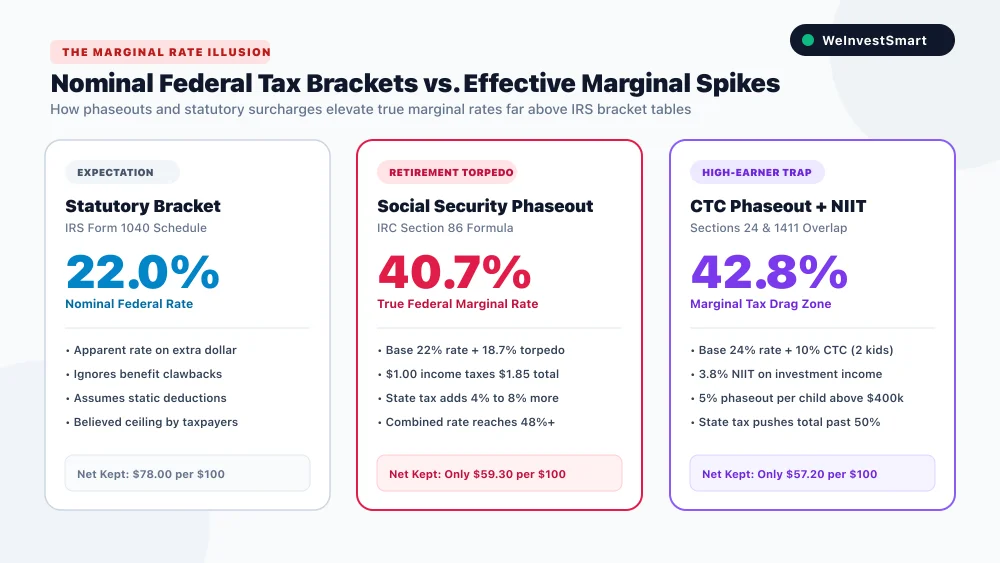
The primary reason these traps proliferate is legislative design. Congress frequently passes tax credits or social benefit programs with targeted phaseout windows to reduce the headline fiscal cost of legislation. Rather than raising statutory tax rates, lawmakers introduce hidden phaseouts that simulate tax hikes exclusively on specific income bands.
Compounding this problem is the lack of inflation indexing in older provisions of the tax code. When statutory thresholds remain frozen for decades while wages and asset values climb with inflation, millions of households drift into stealth tax territory every single year. The result is a tax landscape filled with invisible friction points that penalize unsuspecting savers.
The 5 Most Dangerous Stealth Tax Traps in the US Tax Code
Which specific provisions in the federal tax system trigger the steepest stealth marginal spikes? Five distinct statutory mechanisms create substantial tax drag for American households across different life stages.

1. The Social Security “Tax Torpedo” (IRC §86)
The Social Security Tax Torpedo is arguably the most punitive stealth trap for middle-class retirees. Under IRS Publication 915 rules, the taxability of your Social Security benefits depends on a metric called Provisional Income (also known as Combined Income):
$$\text{Provisional Income} = \text{Adjusted Gross Income} + \text{Tax-Exempt Municipal Interest} + 0.5 \times (\text{Gross Social Security Benefits})$$
Congress established the statutory provisional income thresholds between 1983 and 1993, and they have never been adjusted for inflation:
- Single Filers: Benefits are 0% taxable below $25,000; up to 50% taxable between $25,000 and $34,000; and up to 85% taxable above $34,000.
- Married Filing Jointly: Benefits are 0% taxable below $32,000; up to 50% taxable between $32,000 and $44,000; and up to 85% taxable above $44,000.
When a retiree enters the 85% phase-in band, each extra dollar withdrawn from a traditional IRA or 401(k) does double duty. It represents $1.00 of taxable income on Form 1040, and it simultaneously pulls $0.85 of previously untaxed Social Security benefits into taxable income. As a result, $1.85 of income is exposed to federal taxation for every $1.00 withdrawn.
In the nominal 22% bracket, the math produces an astonishing result:
$$\text{Effective Federal Marginal Rate} = 22% \times 1.85 = 40.7%$$
If the retiree lives in a state with an ordinary 5% income tax, their total marginal tax rate climbs to 45.7%. A retiree attempting to withdraw an extra $5,000 for home repairs can easily sacrifice nearly half of the distribution to involuntary taxes.
2. Medicare IRMAA Surcharges (Social Security Act §1839(i))
While the Social Security torpedo functions as a steep phaseout, Medicare Income-Related Monthly Adjustment Amounts (IRMAA) operate as absolute cliffs. According to the Social Security Administration IRMAA guidance, Medicare Part B (medical insurance) and Part D (prescription drug coverage) premiums are means-tested based on your Modified Adjusted Gross Income from two tax years prior.
If your income exceeds a tier boundary by a single dollar, you do not pay a fractional surcharge. You are pushed into the higher tier for the entire 12-month calendar year:
- Standard Coverage: Base Part B premium without surcharges.
- Tier 1 Cliff: MAGI over $106,000 (Single) or $212,000 (Married Filing Jointly). Triggers monthly Part B surcharges of roughly $70 per person and Part D surcharges of roughly $13 per person.
- Annual Impact: For a married couple on Medicare, crossing the Tier 1 line by just $1.00 results in over $2,000 in combined annual surcharges.
Because IRMAA uses a two-year lookback, capital gains realized or Roth conversions executed today dictate Medicare premiums two years in the future. Evaluating your projected income against these thresholds using our MAGI calculator prevents accidental cliff breaches.
3. Net Investment Income Tax & Additional Medicare Tax (IRC §1411 & §3101)
The Net Investment Income Tax (NIIT) imposes a 3.8% surtax on investment income for higher earners under IRS statutory rules. It applies to the lesser of net investment income (interest, dividends, capital gains, passive rental income) or the amount by which Modified AGI exceeds statutory limits:
- Single Filers: $200,000
- Married Filing Jointly: $250,000
- Married Filing Separately: $125,000
These thresholds were enacted in 2010 under the Affordable Care Act and have never been indexed for inflation. In addition, IRC Section 3101(b)(2) imposes a 0.9% Additional Medicare Tax on wages and self-employment income exceeding these exact thresholds.
When an investor crosses the $250,000 line, long-term capital gains and qualified dividends are suddenly taxed at 18.8% instead of 15%, or 23.8% instead of 20%. Furthermore, earning extra W-2 wage income can cause investment gains to become subject to NIIT, increasing the effective marginal drag on that salary increase.
4. Child Tax Credit Phaseout (IRC §24)
Under current statutory rules, the Child Tax Credit provides up to $2,000 per qualifying child. However, the credit phases out rapidly once Modified AGI exceeds $200,000 for single parents or $400,000 for married couples filing jointly.
The credit is reduced by $50 for every $1,000 (or fraction thereof) of MAGI above the threshold. This reduction translates directly to a 5.0% marginal surtax per child:
- One Child: Base bracket rate + 5.0%
- Two Children: Base bracket rate + 10.0%
- Three Children: Base bracket rate + 15.0%
A married couple earning $410,000 with three children sits in the nominal 24% federal tax bracket. However, as their income moves across the phaseout band, they face their 24% base bracket plus a 15% credit clawback, resulting in a federal marginal rate of 39%. When state and local taxes are added, their true marginal tax rate comfortably exceeds 45%.
5. Qualified Business Income (QBI) Deduction Phaseout (IRC §199A)
The Tax Cuts and Jobs Act created the Section 199A deduction, allowing eligible pass-through business owners to deduct up to 20% of their qualified business income. However, for Specified Service Trades or Businesses (SSTBs), including doctors, lawyers, consultants, financial advisors, and accountants, this deduction is systematically eliminated once taxable income exceeds statutory thresholds.
The phaseout takes place over a narrow band:
- Single Filers: Full deduction below statutory threshold; completely eliminated over the next $50,000 of income.
- Married Filing Jointly: Full deduction below statutory threshold; completely eliminated over the next $100,000 of income.
During this phaseout corridor, earning an extra dollar not only triggers ordinary tax in the 32% or 35% bracket, but it also extinguishes 20 cents of existing deductions. This compounding dynamic frequently drives effective marginal tax rates above 45% to 50% for professional service practitioners.
Comprehensive Comparison: Key Stealth Tax Cliffs and Phaseout Bands
How do the major stealth tax traps compare in terms of their statutory triggers, mechanics, and financial penalties? The following reference matrix outlines the operational structure of each stealth trap across the federal tax code.
| Stealth Trap Name | IRC Authority | Metric Measured | Statutory Threshold (Single / MFJ) | Structure Type | Peak Marginal Tax Drag |
|---|---|---|---|---|---|
| Social Security Tax Torpedo | IRC §86 | Provisional Income (AGI + Tax-Exempt Int + 0.5×SS) | $25,000 / $32,000 (50%) $34,000 / $44,000 (85%) | Compounding Phase-In | +18.7% to +20.4% on base rate (Peaks at 40.7%–44.4%) |
| Medicare IRMAA Part B & D | SSA §1839(i) | 2-Year Lookback MAGI | Tier 1: $106,000 / $212,000 Tier 2: $133,000 / $266,000 | Rigid Cliff (Zero Tolerance) | +$1,000 to +$2,100+ total surcharge for $1 over tier |
| Net Investment Income Tax (NIIT) | IRC §1411 | Lesser of Net Inv. Income or MAGI excess | $200,000 / $250,000 (Unindexed) | Linear Surtax | +3.8% on capital gains, dividends, and interest |
| Additional Medicare Tax | IRC §3101(b) | W-2 Wages & Self-Employment Earnings | $200,000 / $250,000 (Unindexed) | Payroll Surtax | +0.9% on earned income above threshold |
| Child Tax Credit Phaseout | IRC §24 | Modified Adjusted Gross Income | $200,000 / $400,000 | Linear Clawback | +5.0% per child ($50 per $1,000 MAGI) |
| QBI Deduction SSTB Phaseout | IRC §199A | Taxable Income | Narrow $50,000 (Single) or $100,000 (MFJ) band | Deduction Elimination | +10.0% to +15.0% additional effective tax drag |
| ACA Premium Tax Credit Phaseout | IRC §36B | Household Income relative to FPL | Household MAGI vs Benchmark Silver Plan | Subsidy Clawback | +8.5% to +15.0%+ effective rate on extra earnings |
Notice that several of these traps share overlapping income thresholds. A dual-income household earning $250,000 can easily collide with both the Net Investment Income Tax and the Additional Medicare Tax simultaneously.
Similarly, an early retiree transitioning into Medicare can encounter both the Social Security tax torpedo and IRMAA cliffs within the same tax year. For a full breakdown of lookback rules and appeal strategies, explore our guide to Medicare IRMAA surcharges and Form SSA-44 appeals.
Case Studies: Mathematical Modeling of Real-World Stealth Tax Scenarios
How do these theoretical rules translate into real dollars on IRS tax returns? The following two case studies illustrate the exact mathematical mechanics behind stealth tax spikes.
Case Study 1: Dual-Earner Family Navigating CTC Phaseout & NIIT
David and Sarah are married filing jointly with two children ages 8 and 11. David earns $250,000 as a software director, and Sarah earns $140,000 as a corporate marketing consultant. Their combined W-2 wages total $390,000, and they receive $20,000 in dividends and capital gains from a taxable brokerage account, putting their baseline Modified AGI at $410,000.
In November, David is offered a performance consulting bonus of $20,000, which would increase their total MAGI from $410,000 to $430,000. Under standard statutory brackets, this $20,000 sits comfortably within the 24% marginal federal income tax bracket. David expects to pay $4,800 in federal tax on this bonus ($20,000 × 24%).
The table below breaks down the true financial impact of this $20,000 bonus:
| Tax Component | Calculation Basis | Out-of-Pocket Dollar Impact | Effective Marginal Drag |
|---|---|---|---|
| Base Federal Income Tax | $20,000 × 24.0% statutory bracket | $4,800.00 | 24.0% |
| Child Tax Credit Clawback | 20 units ($1,000 each) × $50 × 2 children | $2,000.00 | 10.0% |
| Additional Medicare Payroll Surtax | $20,000 × 0.9% (wages over $250k) | $180.00 | 0.9% |
| State Income Tax (Estimated) | $20,000 × 6.0% state bracket | $1,200.00 | 6.0% |
| Total Combined Tax & Lost Credits | Sum of all incremental liabilities | $8,180.00 | 40.9% |
David believed he was working in a 24% tax environment, but his true effective marginal tax rate was 40.9%. Running scenarios through our net income calculator ensures you evaluate supplemental earnings through an accurate post-tax lens.
Case Study 2: Retiree Couple Triggering the Social Security Tax Torpedo & IRMAA
Robert (age 68) and Elena (age 67) are retired and collect $50,000 in combined annual Social Security benefits. They also receive $40,000 in fixed pension income. To purchase a recreational vehicle, Robert considers withdrawing an additional $20,000 from his traditional IRA in a single calendar year.
Their baseline Provisional Income before the extra withdrawal is:
$$\text{Provisional Income} = $40,000 + 0.5 \times ($50,000) = $65,000$$
Because their provisional income exceeds the $44,000 MFJ threshold, their Social Security benefits are already in the 85% phase-in zone. Consider what occurs if their baseline pension had been only $20,000, placing baseline provisional income at $45,000. In that scenario, withdrawing $20,000 pulls an extra $17,000 ($20,000 × 0.85) of Social Security into taxable income.
The table below summarizes the compounding tax impact of this $20,000 withdrawal:
| Item | Dollar Amount | Percentage / Effective Rate |
|---|---|---|
| Direct IRA Ordinary Distribution | $20,000.00 | 100% Taxable |
| Additional Social Security Exposed to Tax | $17,000.00 | 85% Phase-In Factor |
| Total New Taxable Income on Form 1040 | $37,000.00 | $1.85 exposed per $1.00 withdrawn |
| Federal Income Tax at 22% Bracket | $8,140.00 | 40.7% Effective Federal Rate |
| Potential Medicare IRMAA Tier 1 Breach | $2,100.00 | Combined annual surcharge per couple |
| Total Comprehensive Cost (Tax + IRMAA) | $10,240.00 | 51.2% Total Effective Drag |
If that extra $20,000 withdrawal also pushed their combined MAGI from $210,000 to $230,000, it would breach the Medicare IRMAA Tier 1 threshold ($212,000). That single dollar of excess income would slap both Robert and Elena with an extra $2,100 in annual Medicare surcharges.
Adding $2,100 of IRMAA penalties to an $8,140 tax bill pushes total costs to $10,240. This yields an effective marginal rate of 51.2% on what seemed like a routine IRA withdrawal.
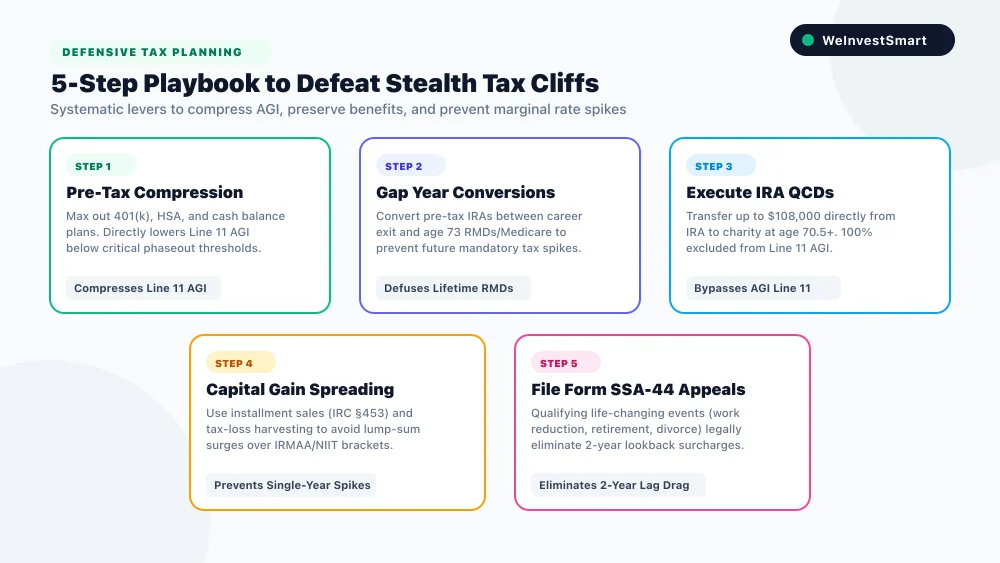
The 5-Step Strategic Mitigation Playbook: How to Bypass Stealth Tax Traps
How can investors and retirees proactively insulate their wealth from these compounding tax drags? A disciplined multi-year tax planning roadmap allows you to navigate around benefit cliffs and suppress your reported MAGI.
Step 1: Pre-Tax Compression via Defined Contribution & HSA Accounts
The most direct way to eliminate phaseout drag during high-earning years is to compress your Adjusted Gross Income on Form 1040 Line 11. Every dollar contributed to an employer-sponsored pre-tax 401(k), 403(b), or 457(b) plan bypasses Box 1 of your Form W-2 entirely.
Similarly, contributing to a pre-tax Health Savings Account (HSA) provides an above-the-line deduction that lowers both AGI and MAGI. For self-employed individuals and business owners, adopting a Cash Balance Defined Benefit Plan can shelter an additional $100,000 to $300,000+ of pre-tax income each year. This aggressive pre-tax compression drops taxable income beneath the Child Tax Credit, NIIT, and QBI phaseout corridors.
Step 2: Bracket-Smoothing Roth Conversions During Low-Income “Gap Years”
For pre-retirees, the period between career retirement (often between age 60 and 65) and the start of Required Minimum Distributions (age 73 to 75) represents a golden planning window. During these gap years, household earned income drops significantly, and Social Security benefits have often not yet been claimed.
Rather than leaving pre-tax balances untouched until RMD age, forward-looking savers execute partial Roth conversions up to the top of the 12% or 22% statutory tax bracket. As detailed in our comprehensive guide to advanced Roth conversion strategies, converting pre-tax dollars during low-income years defuses the future Social Security tax torpedo. When mandatory RMDs eventually begin, smaller pre-tax balances prevent your income from skyrocketing into Medicare IRMAA cliff territory.
Step 3: Execute Qualified Charitable Distributions (QCDs) After Age 70½
For charitably inclined retirees aged 70½ and older, Qualified Charitable Distributions (QCDs) offer an unbeatable mechanism to neutralize stealth taxes. Under IRC Section 408(d)(8), you can transfer up to $108,000 per individual (indexed for inflation) directly from a traditional IRA to an eligible 501(c)(3) charity each year.
The profound structural advantage of a QCD is that the distributed funds never touch Form 1040 Line 11 as Adjusted Gross Income. Unlike ordinary charitable deductions, which require itemizing on Schedule A, a QCD directly bypasses AGI calculation. Consequently, QCDs satisfy your annual RMD obligations without increasing provisional income, without triggering the Social Security torpedo, and without breaching Medicare IRMAA thresholds.
Step 4: Asset Location and Capital Gain Smoothing
Spreading capital gains across multiple calendar years prevents single-year income surges from triggering secondary surcharges. If you plan to sell a highly appreciated business, real estate asset, or concentrated stock position, consider utilizing an installment sale under IRC Section 453. An installment sale spreads the taxable gain across several years, preventing your MAGI from crossing the 3.8% NIIT or highest IRMAA thresholds in a single tax period.
Furthermore, practicing deliberate asset location shields ongoing yields from stealth tax calculations. Holding high-yield taxable bonds and REITs inside tax-deferred accounts prevents annual interest distributions from inflating your baseline AGI. Meanwhile, equities held in taxable brokerage accounts can be managed with tax-loss harvesting to offset realized gains.
Step 5: File Form SSA-44 Life-Changing Event Appeals
Because Medicare IRMAA determinations rely on tax returns from two years prior, new retirees frequently receive surcharge bills reflecting peak earning years when they are no longer employed. Many retirees assume these premium surcharges are mandatory and non-negotiable.
In reality, the Social Security Administration allows you to contest an IRMAA surcharge by filing Form SSA-44 (Medicare Income-Related Monthly Adjustment Amount - Life-Changing Event). Valid qualifying life-changing events include:
- Work stoppage (retirement)
- Work reduction (transition to part-time or consulting)
- Marriage or divorce
- Death of a spouse
- Loss of income-producing property due to a disaster
By submitting Form SSA-44 alongside documentation of your retirement or income reduction, the SSA can recalculate your Medicare premiums based on an estimate of your current year income rather than your prior tax return. This single administrative filing can instantly save a retired couple several thousand dollars in annual healthcare expenses.
Frequently Asked Questions About Stealth Marginal Taxes
What is the difference between a statutory tax bracket and an effective marginal tax rate?
A statutory tax bracket is the base percentage rate established by the Internal Revenue Code that applies to taxable income within a specific bracket. An effective marginal tax rate measures the actual percentage of an additional dollar lost to combined taxes, phased-out deductions, clawed-back credits, and income-tested surcharges.
What is the Social Security Tax Torpedo and who does it affect?
The Social Security Tax Torpedo occurs when additional retirement income causes up to 85 cents of Social Security benefits to become taxable for every dollar earned under IRC Section 86 provisional income rules. This compounding effect pushes retirees in the nominal 22% bracket into effective marginal tax rates exceeding 40%.
Why are Medicare IRMAA surcharges considered tax cliffs rather than phaseouts?
Medicare IRMAA operates on rigid tier thresholds rather than gradual reductions, meaning exceeding a limit by a single dollar triggers a full year of higher Part B and Part D premiums. This all-or-nothing cliff can cost an individual or married couple over $1,000 to $2,000 in extra annual expenses for earning nominal incremental income.
Can appealing Medicare IRMAA surcharges eliminate the stealth tax penalty?
Yes, individuals who experience qualifying life-changing events such as retirement, work reduction, marriage, divorce, or loss of income-producing property can file Form SSA-44 with the Social Security Administration. A successful appeal allows Medicare to calculate current premiums based on recent lower income rather than prior higher tax returns.
This article is for educational purposes only and should not be considered personalized financial advice. Consider consulting with a financial advisor for guidance specific to your situation.
For educational purposes. Consider your own circumstances before making financial decisions. Read our editorial policy.
From reading to planning
Explore the numbers for yourself.
Use our free calculators to compare scenarios and understand your options.