Married Filing Separately for Student Loans: When It Pays
Evaluate Married Filing Separately for federal student loans. Compare IDR payment savings against IRS tax penalties to find your net annual arbitrage.
For married couples navigating large federal student loan balances, tax season presents a high-stakes calculation. Choosing whether to file taxes jointly or separately is not merely a tax filing decision. It directly dictates the monthly payment required on federal income-driven repayment plans.
Under traditional financial advice, married couples default to filing Married Filing Jointly (MFJ) to secure lower tax brackets and generous family credits. However, when one spouse carries substantial federal debt, joint filing exposes the debt-free spouse’s income to federal loan servicer calculations.
As detailed in our foundational guide on US stealth marginal tax traps, statutory phaseouts and benefit formulas often create steep financial penalties. Combining spousal income on a tax return can easily trigger thousands of dollars in higher student loan payments each year.
Filing Married Filing Separately (MFS) insulates the borrower by isolating their individual earnings. Yet the IRS aggressively penalizes separate filers through lost deductions, strict phaseouts, and compressed brackets. Navigating this trade-off requires measuring the exact dollar value of loan payment savings against the resulting tax penalty.
[!NOTE] Key Takeaways: MFS Student Loan Strategy at a Glance
- The Spousal Income Shield: Under federal regulations (34 CFR § 685.209), filing MFS excludes your spouse’s income from Income-Driven Repayment (IDR) plans such as SAVE, PAYE, and IBR.
- The IRS Tax Penalty: MFS completely eliminates the $2,500 student loan interest deduction, wipes out the traditional IRA deduction above $10,000 of income, and eliminates child care tax credits.
- The Net Arbitrage Test: The strategy is financially optimal whenever your annual student loan payment savings exceed the additional tax liability triggered by filing separately.
- The PSLF Multiplier: For borrowers pursuing Public Service Loan Forgiveness, every dollar saved on monthly payments is permanently discharged tax-free, dramatically increasing the value of MFS.
- Community Property Nuance: In the nine community property states, borrowers can use alternative documentation of income (pay stubs) to bypass state 50/50 tax return income splits.
The Core Strategy: Why Married Borrowers File Separately for Student Loans
The primary reason married borrowers file separately is to prevent their spouse’s income from being factored into monthly federal student loan repayment calculations.
Under federal student loan guidelines authorized by the Department of Education under 34 CFR § 685.209, Income-Driven Repayment plans calculate payments based on household income. When you file a joint tax return, the Department of Education defines household income as the combined Adjusted Gross Income (AGI) of both spouses.
If a physician resident earning $65,000 is married to a software engineer earning $140,000, filing jointly creates a combined household AGI of $205,000. Even though the resident holds all the educational debt, loan servicers calculate monthly payments based on the entire $205,000 cash flow.
By electing Married Filing Separately on IRS Form 1040, the borrower reports only their own $65,000 salary. The federal loan servicer calculates monthly payments using strictly the borrower’s isolated income. For households with large income disparities, this single election can reduce monthly payments by $800 to $1,500 or more.
However, isolating income for student loans triggers secondary federal tax traps. For high-earning households with investment assets, filing separately cuts the 3.8% Net Investment Income Tax (NIIT) threshold from $250,000 down to just $125,000, creating an unexpected investment surtax.
How Federal Student Loan IDR Formulas Calculate Monthly Payments
Federal Income-Driven Repayment plans do not demand payments based on your total gross paycheck. Instead, they bill a percentage of your discretionary income.
Discretionary income is calculated by taking your Adjusted Gross Income from Form 1040 Line 11 and subtracting a statutory poverty protection allowance. The poverty protection allowance is tied to the annual HHS Poverty Guidelines published by the federal government.
Because monthly loan payments are anchored directly to Line 11 AGI, exploring proven strategies on how to lower taxable income through pre-tax retirement accounts and HSA contributions provides a double benefit: it lowers your tax bill while shrinking your student loan payment.
$$\text{Discretionary Income} = \text{Adjusted Gross Income} - (\text{Poverty Multiplier} \times \text{Federal Poverty Level})$$
The table below summarizes how each major federal income-driven plan treats spousal income, poverty exemptions, and discretionary payment percentages:
| Repayment Plan | Spousal Income Excluded Under MFS? | Poverty Exemption Level | Discretionary Income Payment Rate |
|---|---|---|---|
| Saving on a Valuable Education (SAVE) | Yes | 225% of Poverty Line | 5% (Undergrad) / 10% (Grad) |
| Pay As You Earn (PAYE) | Yes | 150% of Poverty Line | 10% of Discretionary Income |
| Income-Based Repayment (IBR - New) | Yes | 150% of Poverty Line | 10% of Discretionary Income |
| Income-Based Repayment (IBR - Old) | Yes | 150% of Poverty Line | 15% of Discretionary Income |
| Income-Contingent Repayment (ICR) | No (includes spousal income) | 100% of Poverty Line | 20% of Discretionary Income |
On the SAVE plan, a single individual or separate filer receives a poverty deduction equal to 225% of the federal poverty line ($35,213 in contiguous states). If a borrower’s isolated AGI is $65,000, their annual discretionary income is $29,787.
At a 10% discretionary assessment, their annual loan bill is $2,979 ($248 per month). Under a joint return with a spouse earning $140,000, combined AGI climbs to $205,000.
With a two-person poverty exemption ($47,588), joint discretionary income spikes to $157,412, pushing the annual loan bill to $15,741 ($1,312 per month). Filing separately saves over $12,700 in direct annual payments.
The Family Size Allocation Rule
When filing separately, borrowers must follow strict Department of Education rules regarding family size.
Under current federal regulations, an MFS borrower cannot claim their spouse in their family size calculation. Furthermore, dependent children can only be included in the borrower’s family size if the borrower provides more than 50% of the child’s financial support during the year.
If a high-earning non-borrower spouse provides the majority of household financial support, the borrower must certify a family size of one. This adjustment slightly reduces the poverty exemption but remains vastly superior to absorbing the spouse’s entire salary.
The True Cost of MFS: The 7 IRS Tax Penalties You Must Absorb
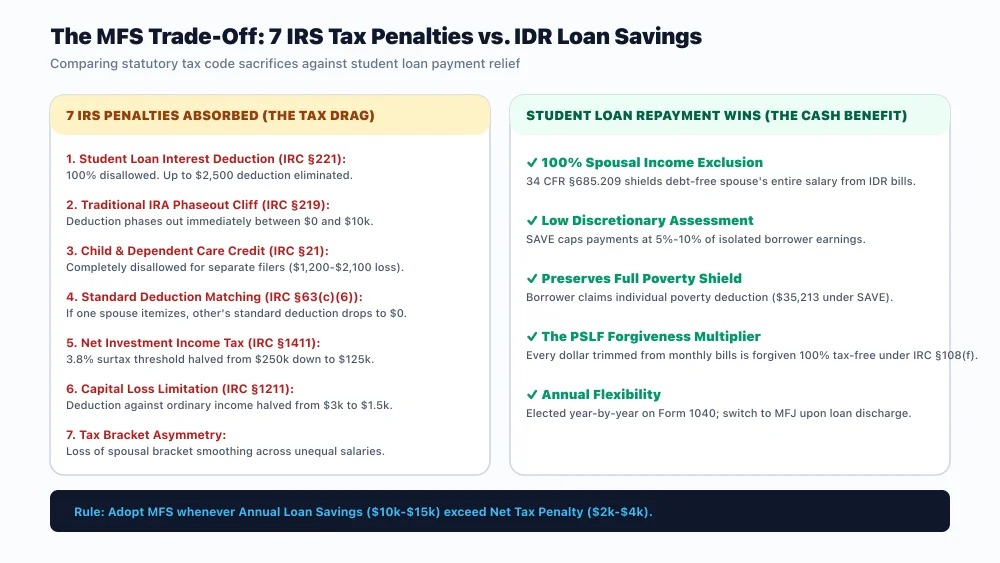
While isolating your income slashes student loan payments, the Internal Revenue Code heavily disincentivizes Married Filing Separately. Congress designed the tax code to encourage joint filing, creating seven specific tax penalties for couples who file separately.
Before adopting this strategy, you must model each penalty against your household finances.
1. Complete Loss of the Student Loan Interest Deduction (IRC § 221)
Under IRC Section 221(f)(1), married taxpayers are explicitly barred from claiming the student loan interest deduction if they file separate returns.
On a joint return, eligible borrowers can deduct up to $2,500 of paid student loan interest as an above-the-line deduction, subject to phaseout limits. Filing separately eliminates this deduction entirely, regardless of how low your income is. In the 22% tax bracket, this loss adds up to $550 in federal tax liability.
2. The $0 to $10,000 Traditional IRA Deduction Cliff (IRC § 219)
Under IRC Section 219(g)(4), if you file separately and either you or your spouse participates in an employer-sponsored retirement plan, your ability to deduct traditional IRA contributions is virtually wiped out.
Instead of the standard joint phaseout range that extends past $120,000 of income, the phaseout window for an MFS taxpayer begins at $0 and terminates completely at $10,000. Earning more than $10,000 eliminates all traditional IRA tax deductions. Both spouses must rely on workplace plans or backdoor contribution strategies detailed in our guide on how to open a Roth IRA and invest.
3. Disallowance of the Child and Dependent Care Credit (IRC § 21)
The Child and Dependent Care Credit allows working parents to claim a tax credit for daycare, preschool, and babysitting expenses. Under IRC Section 21(e)(2), this credit is completely unavailable to married individuals who file separately, unless they live apart for the last six months of the year.
For a family paying qualifying childcare expenses for two children, forfeiting this credit costs between $1,200 and $2,100 in direct tax credits.
4. The Standard Deduction Matching Trap (IRC § 63(c)(6))
One of the most dangerous traps in the Internal Revenue Code is the deduction consistency rule under IRC Section 63(c)(6).
If one spouse itemizes deductions on Schedule A (for example, to write off large mortgage interest or state and local taxes), the other spouse’s standard deduction is statutorily reduced to $0.00. The second spouse is legally forbidden from claiming the standard deduction and must itemize, even if their allowable itemized deductions total zero.
Couples must coordinate their deductions carefully. If one spouse claims the standard deduction, both spouses must claim the standard deduction.
5. Lowered Net Investment Income Tax Threshold (IRC § 1411)
The 3.8% Net Investment Income Tax (NIIT) applies to capital gains, dividends, and passive investment yields. For joint filers, this surtax triggers at $250,000 of Modified AGI.
For married individuals filing separately, the statutory trigger drops to $125,000. A spouse with significant investment earnings who reports $140,000 in separate income must pay the 3.8% surtax on their investment earnings, even if total combined household income is well under $250,000.
6. Halved Capital Loss Deduction Limit (IRC § 1211)
When tax-loss harvesting in a taxable brokerage account, joint filers can use net capital losses to offset up to $3,000 of ordinary income each year.
Under MFS rules, the annual capital loss deduction limit is cut in half to $1,500 per spouse. Any remaining losses must be carried forward to future tax years.
7. Tax Bracket Asymmetry and Loss of Bracket Smoothing
When a couple files jointly, their incomes blend together. If one spouse earns $150,000 and the other earns $30,000, the joint brackets smooth their combined $180,000 income across wider joint tax bands.
When filing separately, the higher earner’s income pushes deep into the 24% and 32% brackets on individual rate schedules. Meanwhile, the lower earner underutilizes the lower 10% and 12% brackets. This bracket asymmetry frequently adds $1,500 to $4,000 in total household income taxes.
The Net Arbitrage Formula: Calculating Your Annual Financial Payoff
Deciding whether to file separately requires balancing student loan savings against tax penalties. The decision boils down to a clear mathematical formula:
$$\text{Net Annual Arbitrage} = \text{Annual IDR Loan Payment Savings} - \text{Additional Annual MFS Tax Liability}$$
Where:
- Annual IDR Savings: The difference between your annual student loan payments under MFJ versus your annual payments under MFS.
- Additional MFS Tax Liability: The total extra federal and state income taxes paid across both separate tax returns compared to a joint return.
If your Net Annual Arbitrage is positive, filing separately puts your household ahead financially. If the number is negative, the tax hit wipes out your student loan savings, making joint filing the superior choice.
To calculate your exact tax differential across both filing statuses, model your take-home pay using our free gross to net calculator. It accounts for standard deductions, payroll withholdings, and bracket differences.
The PSLF Multiplier
When evaluating this formula, you must identify your long-term student loan endgame. Borrowers fall into two distinct camps:
- Borrowers Repaying in Full: If you plan to repay your entire student loan balance, lowering your monthly payment simply extends your repayment timeline and accrues more interest. In this case, MFS only provides cash-flow timing benefits.
- Borrowers on Forgiveness Tracks (PSLF): If you work for a 501(c)(3) non-profit, government agency, or hospital system under Public Service Loan Forgiveness, your remaining loan balance is forgiven completely tax-free under IRC Section 108(f) after 120 qualifying payments.
For PSLF borrowers, every single dollar saved on monthly student loan payments is a permanent dollar kept in your pocket. You will never pay back the underlying principal or accrued interest. For public servants, MFS is almost always a massive financial win.
Worked Case Study: Maya and Liam’s $10,164 Net Annual Arbitrage
To understand how the math works in practice, consider Maya and Liam. They married last year and reside in Illinois.
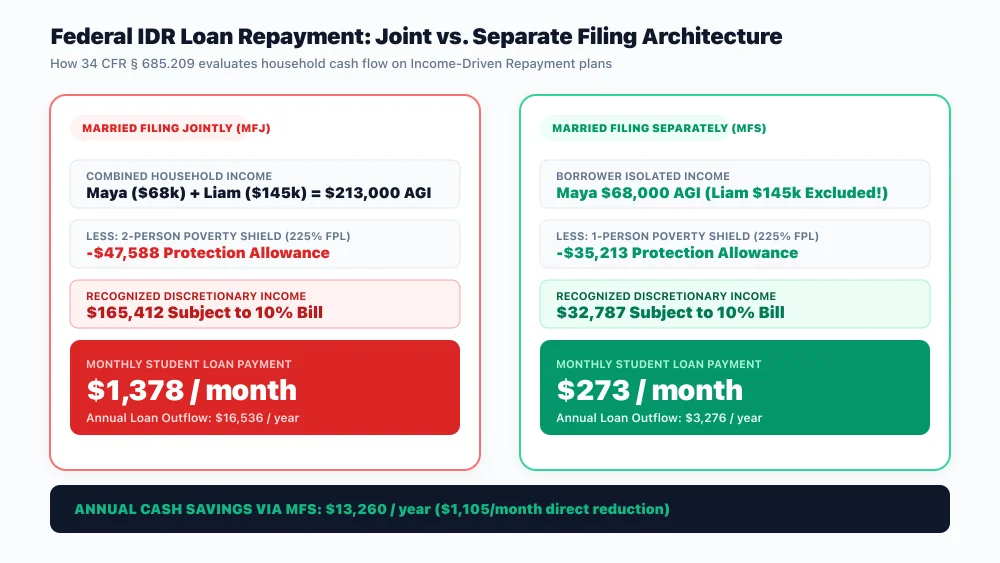
Maya is a second-year pediatric resident earning $68,000 annually. She holds $180,000 in federal direct graduate loans and works at an academic hospital qualifying for Public Service Loan Forgiveness. Liam is a senior software engineer earning $145,000 with zero student debt. Their combined household AGI is $213,000.
Maya is enrolled in the SAVE repayment plan. The table below compares their financial outcomes under Married Filing Jointly versus Married Filing Separately:
| Financial Metric | Scenario A: Married Filing Jointly | Scenario B: Married Filing Separately | Net Difference (MFS Impact) |
|---|---|---|---|
| Maya’s Reported AGI | $213,000 (Combined) | $68,000 (Individual) | -$145,000 isolated income |
| Applicable Poverty Exemption | $47,588 (Family of 2 at 225% FPL) | $35,213 (Family of 1 at 225% FPL) | -$12,375 poverty base |
| Discretionary Income for IDR | $165,412 | $32,787 | -$132,625 discretionary base |
| Monthly Student Loan Payment | $1,378 / month | $273 / month | -$1,105 / month |
| Annual Student Loan Payments | $16,536 / year | $3,276 / year | +$13,260 Cash Saved |
| Combined Federal Income Tax | $27,420 | $30,516 | +$3,096 Extra Tax Paid |
| Net Annual Cash Flow Benefit | Baseline | +$10,164 net household gain | +$10,164 Annual Arbitrage |
Analyzing Maya and Liam’s Results
By filing separately, Maya and Liam pay $3,096 more in federal income tax. This extra tax occurs because Liam’s $145,000 salary is taxed on individual brackets without blending into Maya’s lower 12% space, and Maya loses her student loan interest deduction.
When evaluating why their tax bill climbed, reviewing the mechanics of marginal vs effective tax rates reveals how Liam’s salary pushed into higher individual rate schedules without marital bracket smoothing.
However, filing separately slashes Maya’s annual student loan bill from $16,536 down to $3,276, saving $13,260 in direct cash payments.
Subtracting their $3,096 tax penalty from their $13,260 loan savings produces a net household profit of $10,164 per year. Because Maya is on the PSLF path, this $13,260 in annual savings will never be repaid. Over Maya’s remaining three years of residency, this strategy preserves over $30,000 in household wealth.
The Community Property State Trap (And How to Solve It)
For borrowers living in community property states, filing separately introduces a major legal complexity.
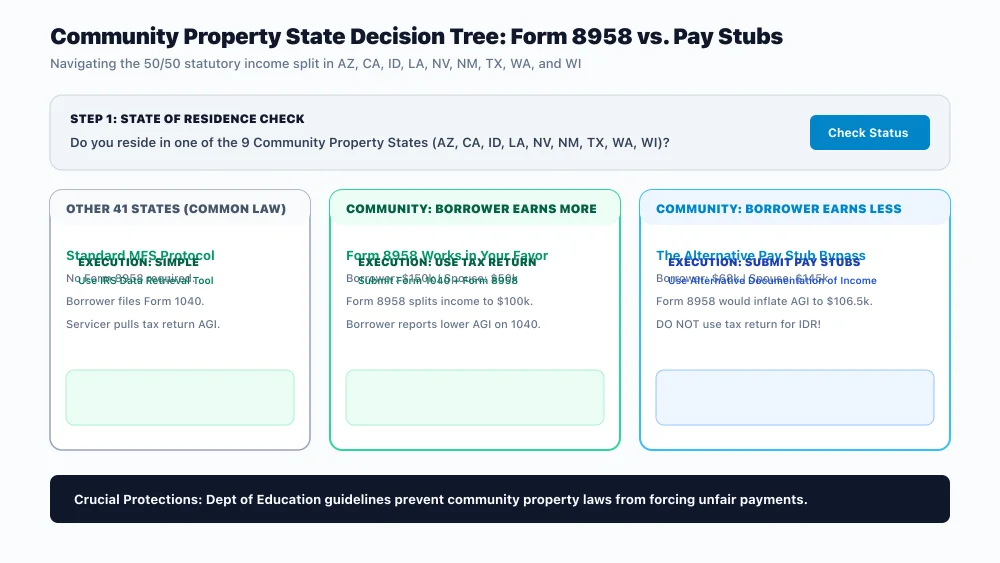
Nine US states operate under community property laws: Arizona, California, Idaho, Louisiana, Nevada, New Mexico, Texas, Washington, and Wisconsin. In these states, marital property law dictates that all income earned during the marriage belongs equally to both spouses.
The IRS Form 8958 Mandate
When married couples in community property states file separate federal tax returns, the IRS requires them to complete IRS Form 8958. Form 8958 pools the couple’s total wages, business profits, and interest, allocating exactly 50% of the marital income to each spouse’s Form 1040.
If a non-working borrower is married to a spouse earning $200,000 in California, filing MFS will cause the borrower’s Form 1040 Line 11 to report $100,000 of community income. If the student loan servicer pulls this tax return, the borrower’s monthly payment will be based on $100,000 rather than their actual zero-dollar earnings.
Conversely, if the borrower is the high earner ($150,000) and the spouse earns $50,000, community property splitting works in the borrower’s favor by cutting their reported tax return AGI to $100,000.
The Alternative Documentation of Income Solution
Fortunately, the Department of Education anticipated this conflict. Under federal IDR regulations, borrowers in community property states are not forced to use their tax returns if doing so inflates their payment.
When recertifying your income-driven repayment plan on StudentAid.gov, you can indicate that you cannot provide a tax return that accurately reflects your individual income. You can then submit Alternative Documentation of Income (ADI), such as your most recent pay stubs or W-2 statements.
The loan servicer calculates your payment based on your gross pay from your pay stubs, completely bypassing the 50/50 community property split on Form 8958.
The 5-Step Annual MFS Implementation Playbook
Executing the Married Filing Separately student loan strategy requires an organized, multi-step workflow each year. Follow this five-step playbook to protect your cash flow:
- Step 1: Model Dual Mock Returns in January: Before filing your taxes, enter your W-2s, 1099s, and deductions into tax software to calculate your total tax bill under MFJ. Then, generate separate MFS returns for both spouses to measure your exact tax penalty.
- Step 2: Calculate Your Annual Student Loan Differential: Log into StudentAid.gov or use an IDR calculator to determine your monthly payment under both combined AGI (joint) and individual AGI (separate). Multiply the monthly difference by 12.
- Step 3: Execute the Net Arbitrage Check: Subtract your MFS tax penalty from your annual loan savings. If the net number is positive and you are on a forgiveness track, proceed with filing separately.
- Step 4: File Form 1040 and Align Deduction Methods: File both separate federal and state returns. Ensure both spouses select the exact same deduction method (both claim standard, or both itemize).
- Step 5: Complete Annual IDR Recertification: Submit your MFS tax return (or pay stubs in community property states) to your loan servicer during your scheduled annual recertification window.
Frequently Asked Questions
Does Married Filing Separately always lower student loan payments?
Married Filing Separately lowers student loan payments only on Income-Driven Repayment plans like SAVE, PAYE, and IBR by excluding your spouse’s income from the calculation. It does not lower payments on standard 10-year repayment plans or older ICR plans that include spousal income.
What tax deductions do you lose when filing separately?
Filing separately completely eliminates the student loan interest deduction under IRC Section 221, disallows the Child and Dependent Care Credit, phases out the traditional IRA deduction between $0 and $10,000 of income, and restricts the Child Tax Credit phaseout.
How does community property affect student loan payments under MFS?
In the nine community property states, state law divides marital income 50/50 on separate tax returns via Form 8958. However, Department of Education regulations permit borrowers to submit alternative documentation of income such as recent pay stubs to certify individual gross income.
Can you switch back to Married Filing Jointly after student loans are forgiven?
Yes. Tax filing status is elected annually on Form 1040. Once your student debt is discharged through Public Service Loan Forgiveness or fully repaid, you can immediately file Married Filing Jointly to reclaim all marital tax benefits.
This article is for educational purposes only and should not be considered personalized financial advice. Consider consulting with a financial advisor for guidance specific to your situation.
For educational purposes. Consider your own circumstances before making financial decisions. Read our editorial policy.
From reading to planning
Explore the numbers for yourself.
Use our free calculators to compare scenarios and understand your options.