How to Minimize the 3.8% Net Investment Income Tax (NIIT)
Learn how to reduce the 3.8% Net Investment Income Tax under IRC Section 1411 using asset location, installment sales, active S-Corps, and real estate rules.

For high-earning professionals, business owners, and successful investors, navigating federal tax liability requires looking beyond standard income tax brackets. Even if your long-term capital gains qualify for preferential statutory rates, an additional federal levy frequently erodes your portfolio returns: the 3.8% Net Investment Income Tax (NIIT).
Created under the Affordable Care Act and codified in the Internal Revenue Code under Section 1411, this statutory surtax targets investment yields. When combined with the highest long-term capital gains bracket of 20%, the NIIT pushes the top federal capital gains rate to 23.8%. On short-term gains, dividends, and interest, it drives top marginal federal rates to 40.8%.
As explored throughout our comprehensive coverage of US stealth marginal tax traps, statutory phaseouts and unindexed thresholds quietly distort marginal tax rates. Because Congress permanently froze NIIT income limits when drafting the statute, millions of taxpayers who never considered themselves wealthy now trigger this surtax each year.
Fortunately, the Internal Revenue Code provides distinct structural exemptions. By mastering how the IRS calculates net investment yields, high earners can deploy proven wealth planning techniques to legally insulate their gains.
[!NOTE] Key Takeaways: NIIT Optimization at a Glance
- The “Lesser Of” Formula: Under IRC § 1411, the 3.8% surtax applies strictly to the lesser of your net investment income or the amount by which your MAGI exceeds statutory limits.
- Permanently Frozen Thresholds: Statutory thresholds of $200,000 (Single) and $250,000 (Married Filing Jointly) are completely unindexed for inflation, dragging more households into the tax every year.
- The Dual-Surtax Hazard: High earners frequently collide with both the 3.8% NIIT on passive investment yields and the 0.9% Additional Medicare Tax on earned wages simultaneously.
- Real Estate Exemption Shields: Achieving Real Estate Professional Status (REPS) with material participation converts rental income into active business profits, eliminating NIIT liability under IRC § 469.
- Active Business Safe Harbors: Operating through an S-Corporation where you materially participate allows pass-through distributions to escape both FICA payroll taxes and the 3.8% NIIT.
What Is the Net Investment Income Tax (NIIT) and Who Pays It?
The Net Investment Income Tax is a 3.8% federal surtax imposed by IRC Section 1411 on the investment income of individuals, estates, and trusts whose earnings exceed fixed statutory thresholds.
Enacted under the Health Care and Education Reconciliation Act of 2010, the NIIT went into effect on January 1, 2013. The tax was designed to fund Medicare hospital insurance trust reserves by tapping passive investment cash flows.
The tax does not apply to all investment earnings universally. Instead, the IRS calculates your liability using a specific “lesser of” statutory formula reported on IRS Form 8960:
$$\text{NIIT Liability} = 3.8% \times \min\Big(\text{Net Investment Income}, \ \max\big(0, \ \text{MAGI} - \text{Statutory Threshold}\big)\Big)$$
Where statutory income thresholds are established by law based on filing status:
- Married Filing Jointly: $250,000
- Single or Head of Household: $200,000
- Married Filing Separately: $125,000
- Qualifying Surviving Spouse: $250,000
If your Modified Adjusted Gross Income sits below your statutory threshold, your NIIT liability is $0.00, regardless of how much capital gain or dividend income your portfolio produces.

The Unindexed Threshold Trap
The most insidious feature of the Net Investment Income Tax is that Congress chose not to index the statutory thresholds to inflation.
When established in 2010, a $250,000 joint income represented top-tier household earnings. However, after more than a decade of cumulative inflation, $250,000 in nominal dollars represents ordinary dual-income middle-class earnings in many metropolitan markets.
Had Congress indexed the thresholds to the Consumer Price Index, the 2026 married filing jointly threshold would sit comfortably above $360,000. Because the limits remain frozen at $250,000, everyday investors who sell an appreciated rental property, execute an equity compensation vesting, or rebalance an index fund portfolio find themselves trapped by this surtax.
The Two Medicare Surtaxes: 3.8% NIIT vs. 0.9% Additional Medicare Tax
Many taxpayers confuse the 3.8% Net Investment Income Tax with the 0.9% Additional Medicare Tax. While both taxes were created under the Affordable Care Act and share identical income thresholds, they target entirely different revenue streams.
The table below contrasts the legal authorities, forms, and mechanics of the two federal surtaxes:
| Tax Attribute | Net Investment Income Tax (NIIT) | Additional Medicare Tax |
|---|---|---|
| Statutory Authority | IRC Section 1411 | IRC Section 3101(b)(2) & § 1401(b)(2) |
| Statutory Tax Rate | 3.8% Surtax | 0.9% Payroll / Surtax |
| IRS Tax Form | IRS Form 8960 | IRS Form 8959 |
| Income Base Taxed | Passive investment income (Dividends, gains, rents) | Active earned wages and self-employment earnings |
| Statutory Thresholds | $200k Single / $250k Joint / $125k MFS | $200k Single / $250k Joint / $125k MFS |
| Employer Matching | None (Assessed only on individuals) | None (Employee-paid only, no employer match) |
| Formula Mechanism | Lesser of Net Investment Income or MAGI excess | Flat 0.9% on earned wages exceeding threshold |
High earners frequently face both surtaxes in the same tax year.
If a married couple earns $320,000 in W-2 wages and receives $40,000 in taxable brokerage dividends, they will pay the 0.9% Additional Medicare Tax on the $70,000 of wages exceeding $250,000. Simultaneously, they will pay the 3.8% NIIT on the entire $40,000 of dividend income because their total MAGI ($360,000) exceeds their threshold by $110,000.
Understanding which income stream triggers which tax is critical for strategic tax defense.
What Counts as Net Investment Income (And What Is Exempt)
To minimize your liability on IRS Form 8960, you must categorize your incoming cash flows into statutory investment income versus exempt income.
Under IRC Section 1411(c), Net Investment Income is calculated by taking gross investment income and subtracting allowable deductions directly allocable to producing that income.
Income Streams Subject to the 3.8% NIIT
The following income sources are statutorily classified as Net Investment Income:
- Capital Gains: Net gains from the sale of stocks, bonds, mutual funds, exchange-traded funds, and digital assets.
- Dividends: Both ordinary dividends and qualified dividends distributed from taxable brokerage accounts.
- Taxable Interest: Interest income from bank savings accounts, certificates of deposit, and corporate debt securities.
- Passive Rental Real Estate: Net rental profits from investment properties where the owner does not qualify as an active real estate professional.
- Royalties and Non-Qualified Annuities: Royalty income from mineral rights, patents, and earnings from commercial annuities.
- Passive Business Income: Profits from partnerships, S-Corporations, or LLCs in which the taxpayer does not materially participate.
Income Streams Statutorily Exempt from the 3.8% NIIT
Congress explicitly excluded several prominent income types from Net Investment Income:
- W-2 Wages and Salary: Active employment compensation and executive bonuses.
- Active Self-Employment Income: Net business profits from Schedule C sole proprietorships or active partnerships.
- Active S-Corporation Distributions: Pass-through distributions from an S-Corporation where the shareholder materially participates.
- Tax-Exempt Municipal Bond Interest: Coupon interest from qualified state and local municipal bonds.
- Roth IRA and Roth 401(k) Distributions: Qualified tax-free withdrawals from Roth accounts.
- Life Insurance Death Benefits: Proceeds received by beneficiaries from life insurance policies.
The Traditional IRA and 401(k) Paradox
A subtle trap catches many retirees when taking distributions from traditional retirement accounts.
Withdrawals from traditional 401(k) plans, traditional IRAs, and corporate pensions are not classified as Net Investment Income. They do not appear on Line 4 of Form 8960.
However, taxable retirement distributions are included in full on Form 1040 Line 11 Adjusted Gross Income. By inflating your AGI, large traditional retirement distributions can push your total income past the $200,000 or $250,000 threshold.
If you take a $100,000 traditional IRA distribution while holding $50,000 of capital gains in a taxable account, that retirement withdrawal pushes your MAGI into the danger zone, exposing your previously sheltered $50,000 in capital gains to the 3.8% surtax.
Real Estate Strategies: The § 469 Material Participation & REPS Shield
Real estate investors represent one of the most common groups ensnared by the 3.8% NIIT. By default, federal tax law under IRC Section 469 treats all rental real estate income as per se passive.
Because passive income is automatically included in Net Investment Income, a profitable landlord reporting $60,000 in net rental income and earning $220,000 in professional salary will owe a 3.8% surtax on their rental profits.
However, real estate owners can legally eliminate this surtax using two statutory safe harbors:
1. Real Estate Professional Status (REPS) under IRC § 469(c)(7)
Under IRC Section 469(c)(7), a taxpayer can overcome the automatic passive presumption by qualifying as a Real Estate Professional.
To achieve this status, you (or your spouse if filing jointly) must satisfy two rigorous annual statutory tests:
- The 750-Hour Test: You must perform more than 750 hours of personal services during the tax year in real property trades or businesses in which you materially participate.
- The 50% Time Test: More than one-half of the total personal services you perform in all trades or businesses during the year must be performed in real property trades or businesses.
Once you qualify as a Real Estate Professional, you must also prove material participation in each rental property (typically by logging at least 500 hours or being the primary manager). Meeting these criteria reclassifies your rental profits as active business earnings, completely exempting them from the 3.8% NIIT.
2. The Section 121 Primary Residence Capital Gain Exclusion
When selling a personal home, many homeowners fear a massive NIIT bill on their home equity. Under IRC Section 121, homeowners can exclude up to $250,000 of capital gain for single filers or $500,000 for married couples filing jointly.
Any gain sheltered by Section 121 is completely excluded from gross income and is never subject to the NIIT.
However, if your primary home gain exceeds the statutory cap (for example, a married couple realizing an $800,000 gain on a home owned for decades), the excess $300,000 gain is taxable capital gain. That $300,000 will be subject to both federal capital gains tax and the 3.8% NIIT if household MAGI exceeds $250,000.
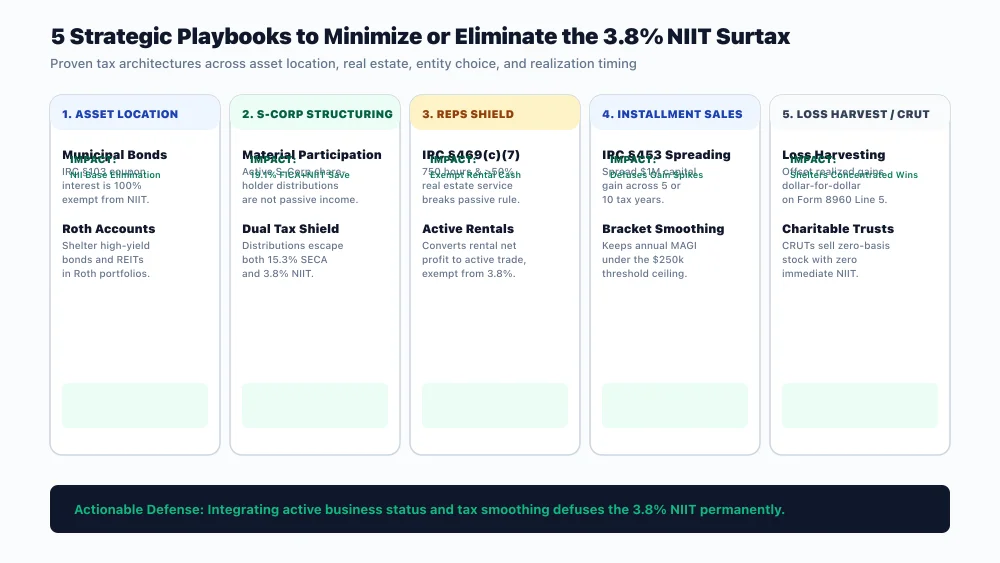
5 Proven Strategies to Minimize or Eliminate the 3.8% NIIT Surtax
Managing your exposure to the Net Investment Income Tax requires deliberate tax engineering across asset location, business entity structuring, and realization timing.
The following five strategies offer powerful legal mechanisms to minimize your liability:
1. Strategic Asset Location and Municipal Bond Optimization
Asset location involves placing tax-inefficient assets into tax-sheltered accounts while keeping tax-efficient holdings in taxable brokerage accounts.
High-yielding corporate bonds, dividend-paying securities, and REITs generate steady ordinary income that triggers the 3.8% surtax. By relocating these assets into traditional IRAs, 401(k)s, or Roth accounts, the annual interest and dividends avoid Form 8960 entirely.
For taxable fixed-income allocations, shift from corporate bonds to tax-exempt municipal bonds. Under IRC Section 103, municipal bond interest is completely exempt from federal income tax and is explicitly excluded from Net Investment Income.
For high earners in top brackets, municipal bonds provide an attractive tax-equivalent yield while keeping your NII base clean.
2. Active S-Corporation Officer Distribution Structuring
For small business owners, consultants, and independent operators, selecting the right legal entity offers a significant NIIT advantage.
If you operate as a single-member LLC or sole proprietorship, all business profits are subject to self-employment taxes (15.3% FICA/SECA). If you operate as a passive partner, your share of profits is subject to the 3.8% NIIT.
By electing S-Corporation tax status and materially participating in the business operations, you create an optimal tax structure:
- Pay yourself a reasonable W-2 salary, which is subject to FICA payroll taxes.
- Distribute remaining business profits as S-Corp shareholder distributions.
Because you materially participate, those pass-through distributions are not passive income, so they are 100% exempt from the 3.8% NIIT. Furthermore, because they are distributions rather than wages, they escape FICA payroll taxes. This dual exemption represents one of the most effective tax shields in the federal code.
3. IRC § 453 Installment Sales for Large Capital Gains
When selling highly appreciated commercial real estate, private business equity, or valuable land, recognizing the entire profit in a single tax year pushes your MAGI deep into top tax brackets.
Under IRC Section 453, you can structure the transaction as an installment sale, receiving promissory note payments across multiple calendar years.
Instead of recognizing a $1,000,000 capital gain in Year 1 and triggering maximum NIIT, an installment sale spreads $200,000 of gain over five years. This multi-year smoothing prevents single-year income spikes, allowing you to maximize lower tax brackets and reduce the dollar amount of gain exposed to the 3.8% surtax.
4. Disciplined Tax-Loss Harvesting and Bracket-Smoothing
Net Investment Income is calculated on a net basis. Capital losses directly offset capital gains dollar-for-dollar under IRC Section 1211.
By actively harvesting unrealized investment losses in taxable brokerage accounts throughout the year, you create tax offsets. If you realize $50,000 in capital gains from selling appreciated index funds, harvesting $50,000 in capital losses reduces your net capital gain on Line 5a of Form 8960 to $0.00.
For early retirees, coordinate loss harvesting during low-income gap years before Required Minimum Distributions begin. Keeping taxable yields low during these gap years shields your accounts from secondary Medicare surcharges.
5. Charitable Remainder Unitrusts (CRUTs) for Concentrated Gains
For philanthropic investors holding deeply appreciated assets with near-zero cost basis (such as early employee tech stock or founding business shares), a Charitable Remainder Unitrust (CRUT) provides an exceptional shelter.
When you contribute appreciated stock to a CRUT, the trust can sell the stock at full market value without paying immediate federal capital gains tax or NIIT. The full proceeds are reinvested inside the trust to generate an annual income stream for you or your beneficiaries.
You receive an upfront charitable income tax deduction, and your capital gain recognition is stretched across decades, preventing large single-year NIIT liabilities.
To model how different compensation and realization structures affect your bottom line, calculate your true take-home pay using our free gross to net calculator. It isolates federal brackets, payroll surcharges, and state taxes.
Worked Case Study: Marcus and Elena’s $11,400 Dual-Surtax Mitigation
To see how these strategies function in practice, consider Marcus and Elena. Both are 48 years old and reside in Pennsylvania.
Marcus is an executive earning $240,000 in W-2 wages. Elena owns a profitable design consultancy operating as a single-member LLC, generating $160,000 in net profits. In their taxable brokerage account, they hold appreciated growth funds that produce $15,000 in annual dividends and require $80,000 in capital gains rebalancing.
Their unmanaged baseline Modified AGI totals $495,000.
Scenario A: Unmanaged Portfolio (The Default Tax Drag)
Without proactive tax planning, Marcus and Elena trigger multiple stealth surtaxes:
- Earned Income for Additional Medicare Tax: $240,000 (W-2) + $160,000 (Schedule C) = $400,000.
- Earned income exceeding $250,000: $150,000.
- 0.9% Additional Medicare Tax: $150,000 × 0.9% = $1,350.
- Net Investment Income Base: $80,000 (Capital Gains) + $15,000 (Dividends) = $95,000.
- MAGI Excess over Threshold: $495,000 - $250,000 = $245,000.
- Taxable NIIT Base: Lesser of $95,000 NII or $245,000 MAGI excess = $95,000.
- 3.8% NIIT Surtax: $95,000 × 3.8% = $3,610.
- Total Surtaxes Paid: $1,350 + $3,610 = $4,960.
Scenario B: Implementing the Strategic Defense Playbook
Marcus and Elena implement three coordinated defensive adjustments:
- S-Corp Election for Elena’s Business: Elena elects S-Corporation status for her consultancy. She pays herself a reasonable W-2 salary of $80,000 and takes the remaining $80,000 as shareholder distributions.
- Tax-Loss Harvesting Offset: Marcus reviews their brokerage account and harvests $45,000 in unrealized losses from international equity holdings, reducing net realized capital gains from $80,000 to $35,000.
- Municipal Bond Reallocation: They shift $300,000 of taxable corporate bond funds into in-state Pennsylvania municipal bonds, eliminating $15,000 in taxable dividends and replacing them with tax-free yields.
The table below summarizes the financial outcome of their planning:
| Financial Metric | Scenario A: Unmanaged Default | Scenario B: Strategic Defense | Net Tax Savings |
|---|---|---|---|
| Combined Earned Income Subject to FICA | $400,000 | $320,000 ($240k W2 + $80k W2) | -$80,000 wage base |
| 0.9% Additional Medicare Tax Liability | $1,350.00 | $630.00 ($70,000 excess × 0.9%) | +$720.00 Saved |
| Net Investment Income (Form 8960 Base) | $95,000.00 | $35,000.00 ($35k net capital gains) | -$60,000 NII base |
| 3.8% Net Investment Income Tax (NIIT) | $3,610.00 | $1,330.00 ($35,000 × 3.8%) | +$2,280.00 Saved |
| Self-Employment Tax Savings (FICA) | $0.00 | $8,400.00 (Medicare + SECA avoidance) | +$8,400.00 Saved |
| Total Annual Cash Preserved | Baseline Drag | +$11,400.00 Total Savings | +$11,400.00 / year |
By implementing entity restructuring, loss harvesting, and municipal reallocation, Marcus and Elena eliminated $11,400 in annual federal tax drag. Over a ten-year horizon, compounding that tax savings adds more than $160,000 to their net household wealth.
The NIIT Annual Filing & Compliance Roadmap
Complying with Net Investment Income Tax rules requires careful execution on your annual Form 1040 return to avoid costly penalties.
Follow this four-step compliance checklist every tax filing season:
- Reconcile IRS Form 8960: Complete Form 8960 to calculate your net investment income. Ensure all allowable investment expenses (such as margin interest expense, state tax allocations, and legal fees tied to investment property) are reported on Part II deductions.
- Avoid Underpayment Penalties on Form 2210: The 3.8% NIIT is considered a regular income tax for estimated tax penalty calculations. If you realize a large mid-year capital gain, you must adjust your quarterly estimated tax payments or increase W-2 withholding to meet statutory safe harbor rules (paying 110% of prior year tax).
- Account for State-Level Piggyback Surtaxes: Several high-tax states (including California, New York, and New Jersey) mirror federal tax calculations or impose supplementary high-income surcharges. Ensure your state quarterly estimates account for combined federal and state drags.
- Coordinate With Other Health Surcharges: For pre-retirees approaching age 65, keep in mind that investment gains recognized today will show up two years later when Medicare sets your Part B premiums under Medicare IRMAA surcharges. Defending against NIIT today provides the secondary benefit of protecting your future healthcare premiums.
Frequently Asked Questions
What is the Net Investment Income Tax (NIIT)?
The Net Investment Income Tax is a 3.8% federal surtax created under IRC Section 1411. It applies to individuals, estates, and trusts with investment income whose Modified Adjusted Gross Income exceeds statutory thresholds of $200,000 for single filers or $250,000 for married couples filing jointly.
Does selling a primary home trigger the 3.8% NIIT surtax?
Capital gains from selling a primary residence are exempt from NIIT up to the Section 121 exclusion limits of $250,000 for single taxpayers and $500,000 for married couples filing jointly. Any realized capital gain exceeding those statutory caps is included in Net Investment Income and subject to the 3.8% surtax if your MAGI exceeds the threshold.
Are traditional 401(k) and IRA distributions subject to NIIT?
Distributions from traditional 401(k) plans and IRAs are not classified as Net Investment Income. However, because these distributions increase your overall Adjusted Gross Income on Form 1040 Line 11, they can push your total MAGI over the statutory thresholds, subjecting your other taxable brokerage gains and dividends to the 3.8% tax.
Why are the NIIT income thresholds not adjusted for inflation?
Congress deliberately omitted inflation indexing from IRC Section 1411 when passing the Affordable Care Act in 2010. As a result of cumulative inflation, the static $200,000 single and $250,000 married thresholds capture far more middle-to-upper-middle-class investors each year than originally intended.
This article is for educational purposes only and should not be considered personalized financial advice. Consider consulting with a financial advisor for guidance specific to your situation.
For educational purposes. Consider your own circumstances before making financial decisions. Read our editorial policy.
From reading to planning
Explore the numbers for yourself.
Use our free calculators to compare scenarios and understand your options.