Business & Freelance Tax Planning
Self-Employment Tax Calculator
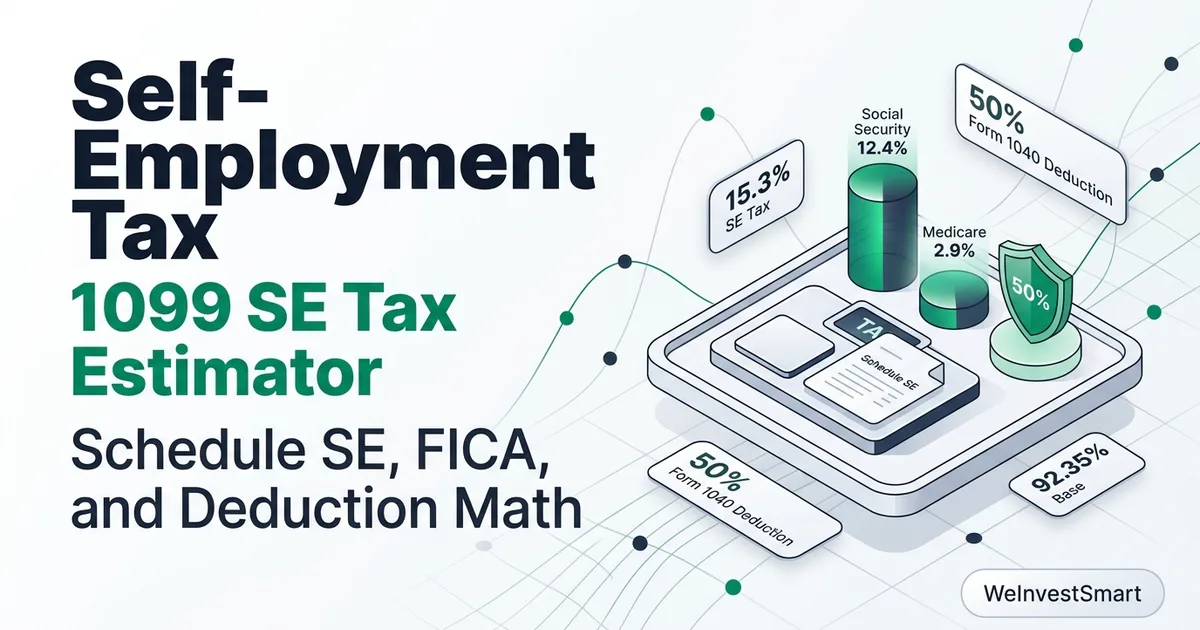
Calculate your exact 15.3% self-employment tax liability under IRS Schedule SE and IRC § 1401, including the 92.35% statutory earnings factor, Social Security wage cap, and the 50% above-the-line income deduction.
- Instant Real-Time Math
- 100% Client-Side Privacy
- IRS Schedule SE & IRC § 1401 Standards
Business Earnings & Tax Assumptions
Results
Estimated Total Self-Employment Tax
$12,010
Quarterly Estimated Payment: $3,003 (Form 1040-ES)
- Form 1040 Above-the-Line Deduction
- $6,005
- Taxable SE Earnings (92.35%)
- $78,498
Itemized Tax Component Breakdown
- Social Security Tax (12.4%)
- $9,734
- Medicare Tax (2.9%)
- $2,276
- Additional Medicare Tax (0.9%)
- $0
- Total Self-Employment Tax Obligation
- $12,010
- Deductible Half (Schedule 1)
- -$6,005
Tax Component Proportions
81.0% Social Security • 19.0% Medicare- Social Security (12.4%)
- Medicare (2.9%)
- Additional Medicare (0.9%)
On $85,000 of net self-employment profit, your estimated self-employment tax is $12,010. You can deduct 50% ($6,005) on Form 1040 Schedule 1 line 15 to reduce your taxable income, yielding an effective SE tax rate of 14.13%. To avoid penalties, set aside approximately $3,003 for each quarterly estimated tax voucher.
Last reviewed by the WeInvestSmart Editorial Team · Editorial Policy
On this page
What is the Self-Employment Tax?
The self-employment tax is a mandatory federal payroll levy collected under Internal Revenue Code Section 1401 to fund Social Security and Medicare protections for sole proprietors, independent contractors, gig economy workers, and general partners. When individuals work as traditional W-2 employees, employers fund half of mandatory payroll contributions (7.65%), while the remaining half (7.65%) is withheld directly from employee paychecks. Self-employed professionals operate as both employee and employer, requiring them to fund both shares through a consolidated 15.3% tax calculated on IRS Schedule SE.
Understanding self-employment tax is vital for accurate budgeting and pricing. Unlike traditional workers who only notice payroll deductions on their paystubs, independent earners must calculate, report, and remit these obligations independently. Because this tax applies directly to net business profit rather than gross revenues, business deductions play a critical role in controlling total liability.
Good to know: Self-employment tax applies directly to net profit (gross revenues minus business expenses), not your gross revenue. Every legitimate business deduction reduces both your income tax and self-employment tax.
To evaluate how business earnings translate into overall household cash flow after income taxes, combine this tool with our gross-to-net paycheck calculator and our hourly to salary calculator.
Primary Operational Components
Social Security Funding (Old-Age, Survivors, and Disability Insurance)
Applies a 12.4% statutory rate up to the federal annual wage base cap ($184,500 for 2026), funding retirement credits and survivor safety nets.
Medicare Hospital Insurance
Applies an un-capped 2.9% rate across all qualifying business earnings, guaranteeing long-term Medicare access.
Above-the-Line Tax Mitigation
Permits self-employed workers to deduct 50% of their total self-employment tax obligation directly from adjusted gross income on Form 1040 Schedule 1.
Quarterly Compliance Framework
Integrates with Form 1040-ES to avoid statutory underpayment interest penalties through timely four-part quarterly vouchers.
How It Works: The 15.3% Rate and 92.35% Statutory Base
Calculating self-employment tax requires applying specific statutory multipliers defined in the Internal Revenue Code. Many new business owners incorrectly assume they multiply their bottom-line Schedule C profit directly by 15.3%. In statutory practice, the calculation incorporates an essential tax-parity adjustment:
Core Statutory Equation
1. Net Taxable Earnings = Net Business Profit × 0.9235
2. Social Security Tax = min(Net Taxable Earnings, Remaining SS Cap) × 12.4%
3. Medicare Tax = Net Taxable Earnings × 2.9%
4. Additional Medicare Tax = max(0, Combined Income - Threshold) × 0.9%
5. Total Self-Employment Tax = Social Security Tax + Medicare Tax + Additional Medicare Tax
6. Above-the-Line Deduction = Total Self-Employment Tax × 50%
The 92.35% Statutory Factor Explained
In traditional employment, employees only pay FICA taxes on their gross wages; they do not pay income tax on the matching 7.65% payroll contribution paid by their employer. To create mathematical equity for independent workers, Internal Revenue Code Section 1402(a)(12) provides an equivalent deduction.
Before computing self-employment tax, your net schedule profit is multiplied by 92.35% (calculated as 100% minus 7.65%). For instance, on a $100,000 net profit, your taxable self-employment base is $92,350 rather than the full $100,000. This single statutory provision saves self-employed workers $1,170.45 in taxes on every $100,000 of profit.
Two-Tier Rate Distribution
Once the 92.35% base is established, the liability splits into two distinct tax tranches:
- Social Security (12.4%): Applies to earnings up to the annual limit indexed by the Social Security Administration ($184,500 in 2026, up from $176,100 in 2025). Any self-employment profit above this threshold is completely free from the 12.4% Social Security tax.
- Medicare (2.9%): Has no statutory dollar ceiling. Every dollar of taxable self-employment earnings is subject to the 2.9% Medicare rate, regardless of whether you earn $10,000 or $10,000,000.
The 0.9% Additional Medicare Surtax
High-earning independent professionals face an additional 0.9% Medicare surtax under the Affordable Care Act. Unlike the baseline Medicare tax, this surtax is triggered only when combined earned income (including W-2 wages and self-employment earnings) surpasses statutory filing thresholds:
- Married Filing Jointly: $250,000
- Married Filing Separately: $125,000
- Single and Head of Household: $200,000
When triggered, the total Medicare rate on income above the threshold rises from 2.9% to 3.8%. Unlike standard Medicare taxes, employers and self-employed workers receive no matching tax deduction for the Additional Medicare Tax.
Example A uses the calculator’s default values and Example B models a high-income consultant exceeding the Social Security wage cap. Select Try to load either scenario into the calculator above.
Worked examples
| Example A | Example B | |
|---|---|---|
| Net business profit (Schedule C) | $85,000 | $220,000 |
| Outside W-2 employment wages | $0 | $0 |
| Tax filing status | Single | Single |
| Tax year horizon | 2026 | 2026 |
| Taxable SE earnings base (92.35%) | $78,498 | $203,170 |
| Total estimated self-employment tax | $12,010 | $28,798 |
| Social Security tax (12.4%) | $9,734 | $22,878 |
| Medicare hospital insurance tax (2.9%) | $2,276 | $5,892 |
| Additional Medicare tax (0.9%) | $0 | $29 |
| Form 1040 Schedule 1 deduction (50%) | -$6,005 | -$14,399 |
| Effective self-employment tax rate | 14.13% | 13.09% |
Key Concepts: Social Security Caps, W-2 Offsets & S-Corp Traps
Understanding how self-employment tax interacts with other compensation sources protects business owners from overpaying taxes or miscalculating quarterly estimates:
Outside W-2 Wage Offsets
One of the most valuable yet frequently misunderstood rules applies to individuals operating a side business while maintaining a full-time W-2 job. The annual Social Security wage cap applies across all combined earned income sources. Crucially, the IRS requires that W-2 wages apply against the Social Security wage cap first.
If your primary employer pays you a W-2 salary of $140,000 in 2026, you have already absorbed $140,000 of your $184,500 annual cap. Consequently, only your first $44,500 of self-employment taxable earnings is subject to the 12.4% Social Security tax. Any self-employment profit earned beyond that point is taxed solely at the 2.9% Medicare rate, delivering significant tax savings.
If your W-2 salary reaches or exceeds $184,500, your self-employment profit is completely exempt from Social Security tax. You will pay only 2.9% Medicare tax (plus the 0.9% surtax if combined income exceeds $200,000 for single filers or $250,000 for joint filers).
The S-Corporation Election Threshold
As self-employed profits expand, the 15.3% tax burden becomes a significant operating expense. Operating as a standard sole proprietorship or single-member LLC exposes 100% of net profits to self-employment tax. By making an S-Corporation election using IRS Form 2553, business owners can bifurcate earnings into two distinct categories:
- Reasonable W-2 Salary: Subject to standard 15.3% FICA payroll taxes.
- Shareholder Profit Distributions: Exempt from self-employment taxes, subject only to ordinary income tax.
To evaluate when your net earnings justify corporate legal formation and payroll processing fees, use our LLC vs. S-Corp business profit margin calculator to analyze potential annual savings.
How to Use the Calculator: Step-by-Step
Follow these practical steps to project your exact tax obligations and set aside accurate quarterly reserves:
- Select a Quick Comparison Preset: Choose from our four pre-configured financial profiles (Side Hustle, Full Freelance, High Earner, or Joint Filing) to populate instant baseline benchmarks.
- Enter Net Business Profit: Input your projected annual net business profit. This represents gross client billings minus legitimate allowable operating write-offs reported on Schedule C line 31.
- Input Outside W-2 Wages: If you also work as a traditional employee, input your gross annual W-2 pay. The calculator automatically calculates your remaining Social Security cap allowance.
- Select Filing Status and Tax Year: Choose your tax filing status to set Additional Medicare thresholds ($200,000 Single or $250,000 Joint) and select the active tax year schedule.
- Analyze Results and Plan Deductions: Review the primary headline tax liability, quarterly Form 1040-ES installment vouchers, itemized tax allocations, and your 50% above-the-line deduction.
Strategic Tax Deductions & Planning Strategies
Proactive planning significantly reduces the burden of self-employment taxes:
Maximizing Schedule C Expense Deductions
Because self-employment tax applies directly to net profit, every eligible dollar of business expense deducted saves both income tax and self-employment tax. A business owner in the 22% federal income tax bracket saves 22 cents in income tax plus 14.13 cents in self-employment tax on every deductible dollar, yielding a combined marginal tax savings of 36.13%.
Key deductible operating categories include home office square footage allocations, professional software subscriptions, equipment depreciation under Section 179, business insurance, and vehicle travel logged under official mileage reimbursement calculator schedules.
Self-Employed Health Insurance Deduction
Eligible self-employed individuals who purchase health, dental, and qualifying long-term care insurance policies for themselves, spouses, and dependents can deduct 100% of premiums as an above-the-line adjustment on Form 1040 Schedule 1. While this deduction does not reduce self-employment tax directly, it substantially reduces overall adjusted gross income and federal income tax.
Solo 401(k) and SEP-IRA Contributions
Independent professionals can leverage advanced retirement vehicles to shield income from federal income taxes. A Solo 401(k) enables self-employed workers to contribute both as an employee (up to statutory elective deferral limits) and as an employer (up to 20% of net adjusted self-employment earnings), maximizing pre-tax wealth accumulation. Explore our companion 401(k) retirement calculator to model these compound growth schedules.
Critical Factors, Penalties & Estimated Quarterly Deadlines
Operating as an independent worker requires strict adherence to federal and state compliance calendars:
Watch out: If you expect to owe more than $1,000 in federal tax, failing to submit quarterly Form 1040-ES installments can trigger IRS Section 6654 underpayment interest penalties even if you pay in full by April 15.
Quarterly Estimated Tax Deadlines
The United States income tax system operates on a pay-as-you-earn basis. If you expect to owe at least $1,000 in federal tax for the year after subtracting withholding and credits, you must submit quarterly estimated tax payments via EFTPS or IRS Direct Pay using Form 1040-ES vouchers across four annual deadlines:
- First Quarter (January 1 – March 31): Due April 15
- Second Quarter (April 1 – May 31): Due June 15
- Third Quarter (June 1 – August 31): Due September 15
- Fourth Quarter (September 1 – December 31): Due January 15 of the following calendar year
Avoiding Statutory Underpayment Penalties (Safe Harbor Rules)
To avoid underpayment penalties assessed under Internal Revenue Code Section 6654, self-employed taxpayers must satisfy at least one of the statutory safe harbor thresholds:
- The 90% Current-Year Rule: Remit at least 90% of your total tax liability for the active tax year through timely quarterly installments.
- The 100% Prior-Year Rule: Remit 100% of the total tax shown on your prior year return (increased to 110% if prior year adjusted gross income exceeded $150,000 for married couples filing jointly or $75,000 for single filers).
Applying safe harbor calculations ensures protection from unexpected IRS interest penalties even if your business experiences an unexpected surge in fourth-quarter revenue.
Sources and Statutory Authorities
- Internal Revenue Service (IRS): Self-Employment Tax (Social Security and Medicare Taxes)
- IRS Schedule SE (Form 1040): Self-Employment Tax Instructions
- Social Security Administration: Contribution and Benefit Bases
- Internal Revenue Code § 1401: Rate of Tax on Self-Employment Income
- U.S. Department of Labor: Fair Labor Standards Act Guidelines
Frequently Asked Questions About Self-Employment Tax
What is the self-employment tax rate for 2026?
The base self-employment tax rate is 15.3%, consisting of 12.4% for Social Security on earnings up to $184,500 and 2.9% for Medicare on all net earnings. High earners also owe a 0.9% Additional Medicare Tax on earnings exceeding statutory thresholds.
Why is self-employment tax calculated on 92.35% of net profit?
Under Internal Revenue Code Section 1402(a)(12), you deduct the employer-equivalent portion (7.65%) before calculating tax, leaving exactly 92.35% of net profit subject to self-employment tax. This statutory adjustment mirrors W-2 payroll treatment where employees are not taxed on their employer's FICA share.
How do W-2 wages from a day job affect self-employment taxes?
W-2 employment wages count first toward the annual Social Security wage base cap ($184,500 for 2026). If your W-2 earnings already reach this threshold, your self-employment profit is completely exempt from the 12.4% Social Security tax, reducing your SE rate to just 2.9% for Medicare.
Can I deduct self-employment taxes on my federal tax return?
Yes, you can deduct exactly 50% of your total self-employment tax liability as an above-the-line deduction on Form 1040 Schedule 1 line 15. This deduction reduces your Adjusted Gross Income (AGI) regardless of whether you claim the standard deduction or itemize.
What is the minimum profit threshold to owe self-employment tax?
You owe self-employment tax once net earnings from self-employment reach $400 in a calendar year. Because net earnings equal 92.35% of net profit, a business profit of roughly $433.13 triggers the Schedule SE filing requirement.
When should a business owner consider electing S-Corporation tax status?
Businesses generating consistent net profits above $70,000 to $90,000 often benefit from an S-Corporation election. This structure permits owners to split profits between reasonable W-2 salary (subject to FICA) and corporate distributions (exempt from self-employment tax).